 AIREITER
The question keeps coming up on r/codex: "I was using GPT-5.5 extra-high — is Sol or Terra the equivalent?" The short answer: GPT-5.6 Sol lists at exactly the same API price as GPT-5.5 and beats it on agent benchmarks, so for long-running agent and browsing work the upgrade is close to free.
But "same price" hides two real costs. Sol charges for cache writes that GPT-5.5 doesn't, and it thinks longer, so per-task spend can multiply even though the rate card never moved.
Same list price, a different bill
GPT-5.6 Sol and GPT-5.5 have identical standard API pricing: $5.00 per million input tokens, $30.00 per million output tokens, and $0.50 for cached input. I pulled both rows from OpenAI's pricing page on July 29, 2026:
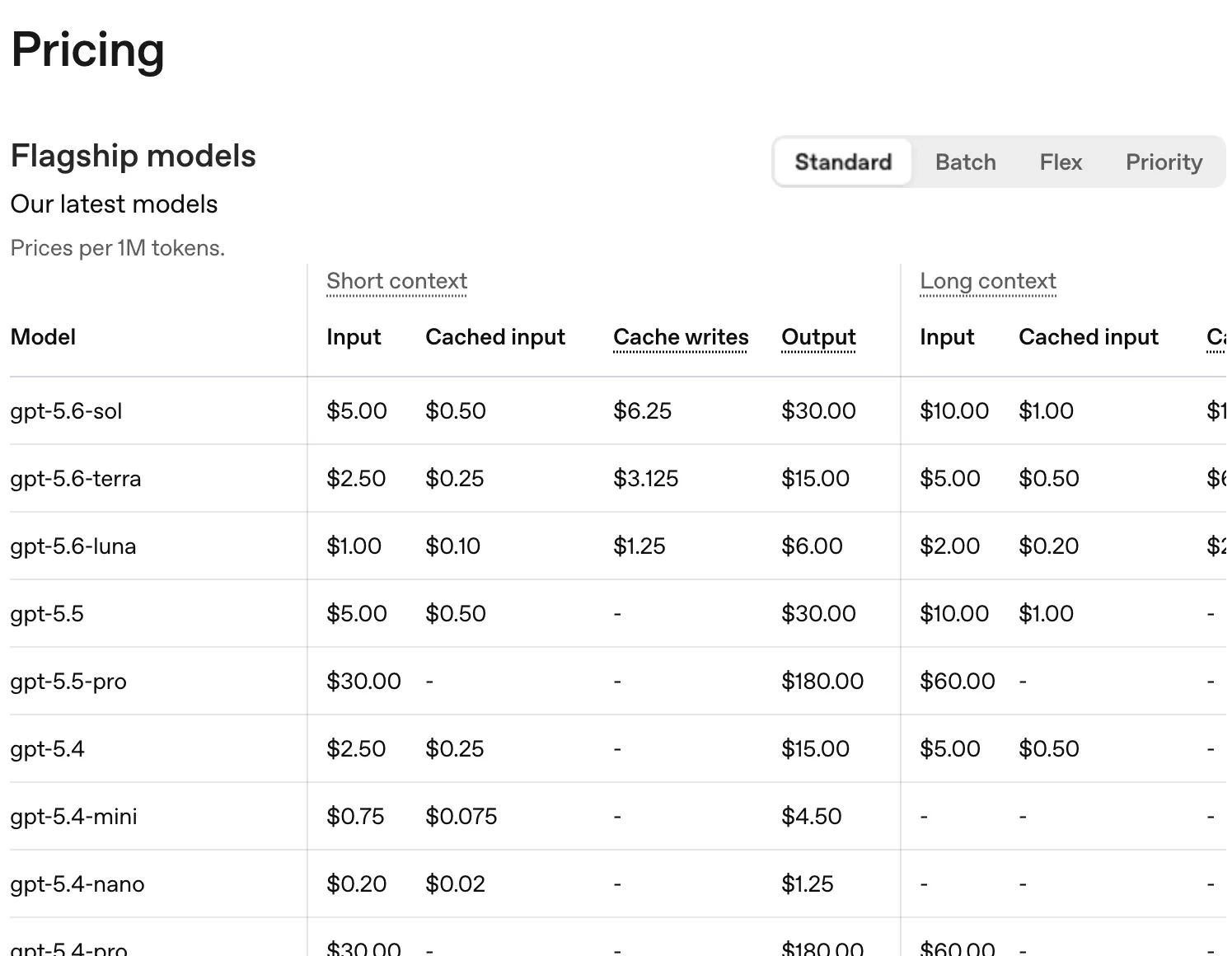
Three line items on that table separate the models:
| Line item | GPT-5.6 Sol | GPT-5.5 |
|---|---|---|
| Input / Output (per 1M tokens) | $5.00 / $30.00 | $5.00 / $30.00 |
| Cached input | $0.50 | $0.50 |
| Cache writes | $6.25 | not charged |
| Long context (>272K) input / output | $10.00 / $45.00 | $10.00 / $45.00 |
The cache-write line is the one that bites migrations. GPT-5.6 introduces explicit cache breakpoints with a 30-minute minimum lifetime (Vellum's breakdown covers the mechanics), and writing costs 1.25x the uncached input rate while reads stay discounted 90%. The arithmetic from the table above: a cached segment costs $6.25 to write plus $0.50 per read, against $5.00 per uncached resend — so caching pays for itself from the second reuse, and a pipeline that writes more than it reads pays a fee GPT-5.5 never charged.
The second cost is time-shaped. Sol reasons longer before answering, and reasoning tokens bill as output. Codex users who migrated report the effect directly:
"5.6 sol médium is three times more expensive than 5.5-xhigh, while delivering the same code quality (at least at the 5.5 launch)." — r/codex, "GPT 5.5 and 5.6 conversion table"
Same rate card, three times the per-task cost, because the model spends three times the tokens getting there. OpenAI's GPT-5.6 announcement points the other way: 22% fewer input and 23% fewer output tokens than GPT-5.5 on their internal comparisons. Both claims can be true at once — efficiency improved per unit of thinking while higher effort settings think much more, so what you experience depends on the effort level you pick.
What actually improved on paper
On independent evaluation, GPT-5.6 Sol and GPT-5.5 are nearly tied for raw intelligence: Artificial Analysis scores Sol (medium) at 54 on its Intelligence Index v4.1 against 53 for GPT-5.5 (high), at an identical blended cost of $4.35 per million tokens. The headline gains live elsewhere:
- First-token latency: 4.13 seconds for Sol versus 16.67 seconds for GPT-5.5 (high), a 4x difference. For interactive tools and agent loops that make dozens of sequential calls, this is the most noticeable upgrade in daily use.
- Agent benchmarks: Sol posts 88.8% on Terminal-Bench 2.1 and 92.2% on BrowseComp — the largest gains in this release cluster on long-horizon tool use.
- Context: 1M tokens for Sol against 922K for GPT-5.5, plus reasoning that persists across conversation turns (documented in the same Vellum analysis linked above).
- Output speed: the one regression. Sol streams at 65 tokens/second against GPT-5.5's 77.3. Bulk generation jobs get slower, not faster.
CodeRabbit's long-horizon coding suite (100+ tasks across five languages) has Sol at a 63.7% pass rate, and its code-review benchmark shows Sol adding 7.4 percentage points over a baseline integration, with a caveat: Sol's review precision measured 31.6%, meaning it recalls more real issues but buries them in more noise. The same testers logged Sol burning 8 rounds on a simple change after committing to a bad path. Stronger on marathon tasks does not mean immune to rabbit holes.
I ran the same three prompts on both
Benchmarks reward long-horizon work, but most API calls are short. So I sent the same three prompts to gpt-5.6-sol and gpt-5.5 on July 29, 2026: a Python date-handling bug fix, a constraint-logic puzzle with exactly two valid answers, and a strict JSON extraction with a trap (a date missing its year, which the rules said must become null, not a guess). One API call per task, default reasoning effort, no tools, no retries. This is a small sample, not a benchmark.
Both models went three for three. GPT-5.5 fixed the December-crash bug with calendar.monthrange; Sol hand-rolled a correct leap-year table. Both found exactly the two valid deployment orderings, returned byte-identical JSON on the extraction, and refused to invent a year for "the 14th of July."
Token spend and speed split the difference:
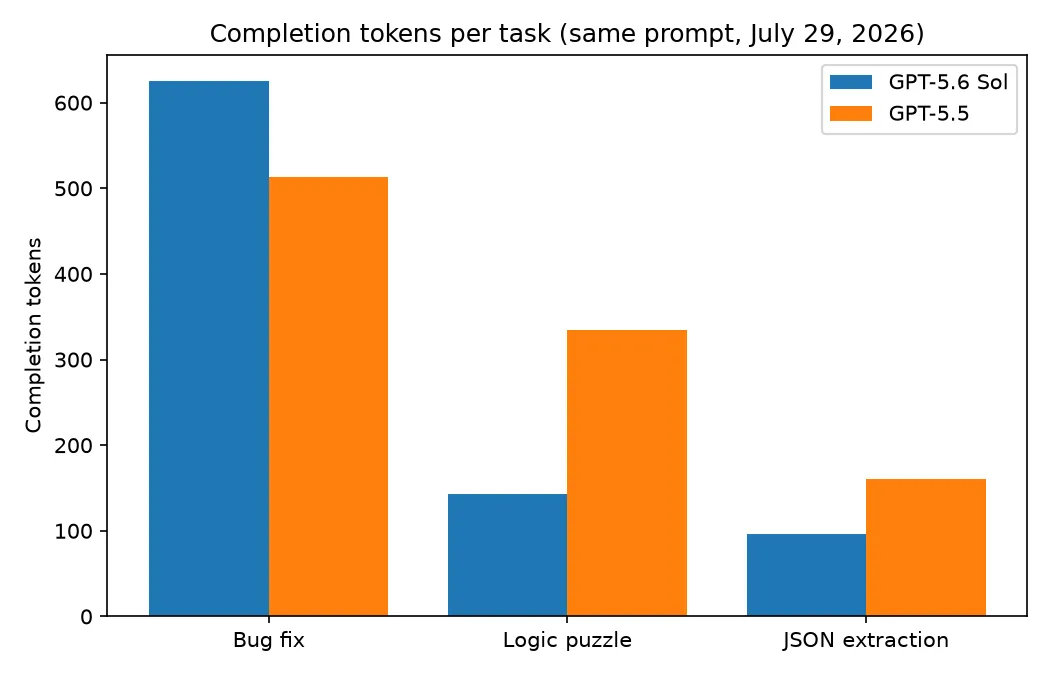
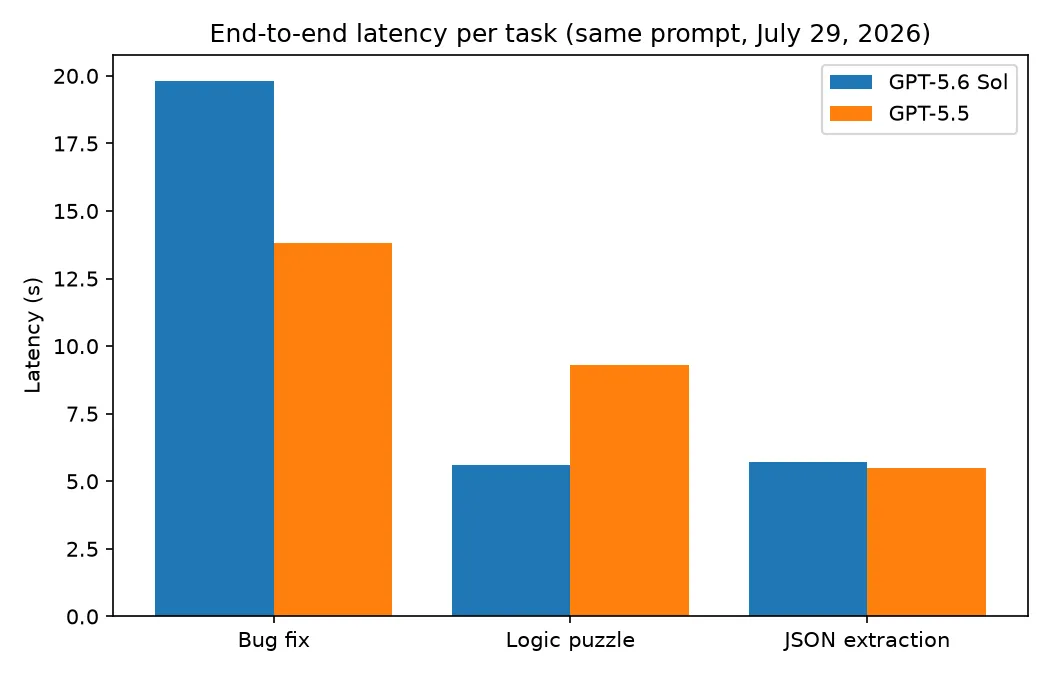
Sol spent fewer completion tokens overall (864 to 1,007) but was slower and chattier on the code task: 19.8 seconds and 625 tokens against 13.8 seconds and 513. On the logic puzzle the roles flipped: Sol answered in 5.6 seconds with 143 tokens while GPT-5.5 took 9.3 seconds and 334. My read after watching both: on short, well-specified tasks the models are interchangeable, and nothing in this test would justify a migration by itself. The upgrade case rests entirely on the agent and long-context work in the benchmark section above.
Mapping your GPT-5.5 effort level to 5.6
The bare gpt-5.6 model ID routes to gpt-5.6-sol by default, per the Vellum breakdown linked above. Anyone who upgrades by swapping the alias gets the flagship tier, and the flagship bill, without choosing it. If you are migrating deliberately, three data points anchor the mapping:
- GPT-5.5 xhigh → Sol medium is the community's working equivalence — the r/codex report quoted above, measured at 5.5 quality parity and roughly 3x per-task cost around launch. Treat it as a starting hypothesis to validate on your prompts, not a guarantee. Budget-sensitive workloads that lived at 5.5 high sit closer to GPT-5.6 Terra at $2.50/$15, half of Sol's rate card.
- Thinking time inflates at the top. ChatGPT Pro users report GPT-5.6 spending 20–50 minutes on tasks where 5.5 Pro spent 5–10 (a ChatGPT observation, but the same reasoning stack bills as API output tokens). The
reasoning.mode: "pro"setting is available on all three 5.6 tiers, so the ceiling is opt-in. - Your old prompts can sabotage the new model. Every.to's testing team found Sol's output improved sharply only after they deleted defensive instructions written for older models — rules like "always double-check X" that made Sol over-verify and overbuild. Migrate the model, then re-audit the system prompt; the paranoid scaffolding GPT-5.5 needed is now a tax.
Who should switch, and who should stay
Switch to GPT-5.6 Sol if your workload is agentic: multi-step tool use, browsing research, or repo-scale coding sessions. That is where the 88.8% Terminal-Bench and 92.2% BrowseComp scores live, and the 4x first-token latency cut compounds across every loop iteration. At the same $5/$30 rate card, the capability jump costs nothing extra — provided your extra reasoning tokens and cache writes don't eat the difference. The 1M context and cross-turn reasoning persistence remove two workarounds 5.5 pipelines had to build.
Stay on GPT-5.5 — for now — if your traffic is short, well-specified calls: extraction, classification, single-shot code fixes, high-volume generation. My three-prompt test put the models at parity on exactly this shape of work, and Sol's slower streaming (65 vs 77.3 tokens/second) makes bulk jobs strictly worse. Cache-write-heavy pipelines should price the $6.25 line before moving. And if what you want from an upgrade is a lower bill at similar quality, the answer is Terra, not Sol.
I ran my head-to-head through AIReiter, which exposes gpt-5.6-sol and gpt-5.5 behind one API key, so swapping a model string is the whole A/B test — compare success rate, end-to-end latency, and completion tokens per task on your own traffic.
FAQ
Is GPT-5.6 Sol better than GPT-5.5?
On agent tasks, clearly: 88.8% Terminal-Bench 2.1, 92.2% BrowseComp, and 4x lower first-token latency. On short single-shot tasks, independent scoring has them one point apart (54 vs 53 on Artificial Analysis), and my same-prompt tests found no correctness gap.
Does GPT-5.6 Sol cost more than GPT-5.5?
The list price is identical: $5 input, $30 output per million tokens. Sol adds a $6.25 cache-write fee GPT-5.5 never charged, and at higher effort settings it spends more reasoning tokens per task — r/codex users measured roughly 3x per-task cost at quality parity with 5.5 xhigh.
What is the GPT-5.5 xhigh equivalent in GPT-5.6?
Sol at medium effort delivers comparable code quality at about triple the per-task cost. If cost parity matters more than the capability ceiling, Terra is the closer economic match.
Can I still use GPT-5.5 after upgrading?
Yes. GPT-5.5 still lists on OpenAI's pricing page at unchanged rates (verified July 29, 2026 — see the screenshot above), so nothing forces the migration yet.
The decision in one table
| Your workload | Pick | Deciding fact |
|---|---|---|
| Multi-step agents, browsing, repo-scale coding | GPT-5.6 Sol | 88.8% Terminal-Bench, 4x lower first-token latency, same rate card |
| Short extraction / classification / one-shot fixes | GPT-5.5 (for now) | Parity in same-prompt tests; 5.5 streams 19% faster |
| Heavy prompt-cache writes | GPT-5.5, or re-architect first | Sol's $6.25/1M cache-write fee is new |
| Same quality, lower bill | GPT-5.6 Terra | $2.50/$15, half of Sol's price; see the Terra vs 5.5 comparison above |
| Maximum thinking depth | Sol with reasoning.mode: "pro" | 20–50 min deliberation where 5.5 spent 5–10 |