 AIREITER
The default choice turns on workload. Claude Opus 5 is the safer starting point for most bounded, output-heavy work, while Claude Fable 5.1 is the specialist to test for long-running agents and unusually large, reusable contexts. Fable 5.1’s headline savings come from cache reads, not from lower input or output rates.
The Fable 5.1 vs Opus 5 decision starts with your workload
For most teams, start with Opus 5, raise its effort when a task needs more reasoning, and route only proven hard cases to Fable 5.1. Anthropic’s Fable 5.1 documentation gives the same general guidance: start with Opus 5 for most workloads and move to Fable 5.1 when higher-effort Opus evaluations do not meet the requirement.
| If your main constraint is… | Start with… | Why |
|---|---|---|
| Short or bounded requests | Opus 5 | Its input and output rates are half of Fable 5.1’s. |
| Output-heavy production traffic | Opus 5 | Fable’s lower cache-read rate does not discount generated tokens. |
| Multi-file coding with a defined specification | Opus 5 | Lower cost makes repeated retries and higher effort easier to absorb. |
| Long-running, tool-using agents | Fable 5.1—after an eval | Fable leads Anthropic’s published agentic and tool-use comparisons. |
| Large context repeatedly reused across turns | Fable 5.1—after cost modeling | Its cache-read price is half Opus 5’s. |
| A fallback-sensitive production router | Opus 5 first | Fable 5.1 changes thinking-block and conversation-history behavior. |
The comparison is Opus 5 at the right effort and cost versus Fable 5.1 at the right context shape and reliability threshold.
What is actually different between Fable 5.1 and Opus 5?
Claude Fable 5.1 is Anthropic’s higher-tier model for demanding reasoning and long-horizon agentic work; Claude Opus 5 is positioned as a less expensive model for serious coding, agents, and professional work. Both have a 1-million-token context window and 128,000-token maximum output, so Fable’s case is long-horizon execution rather than a larger published context limit.
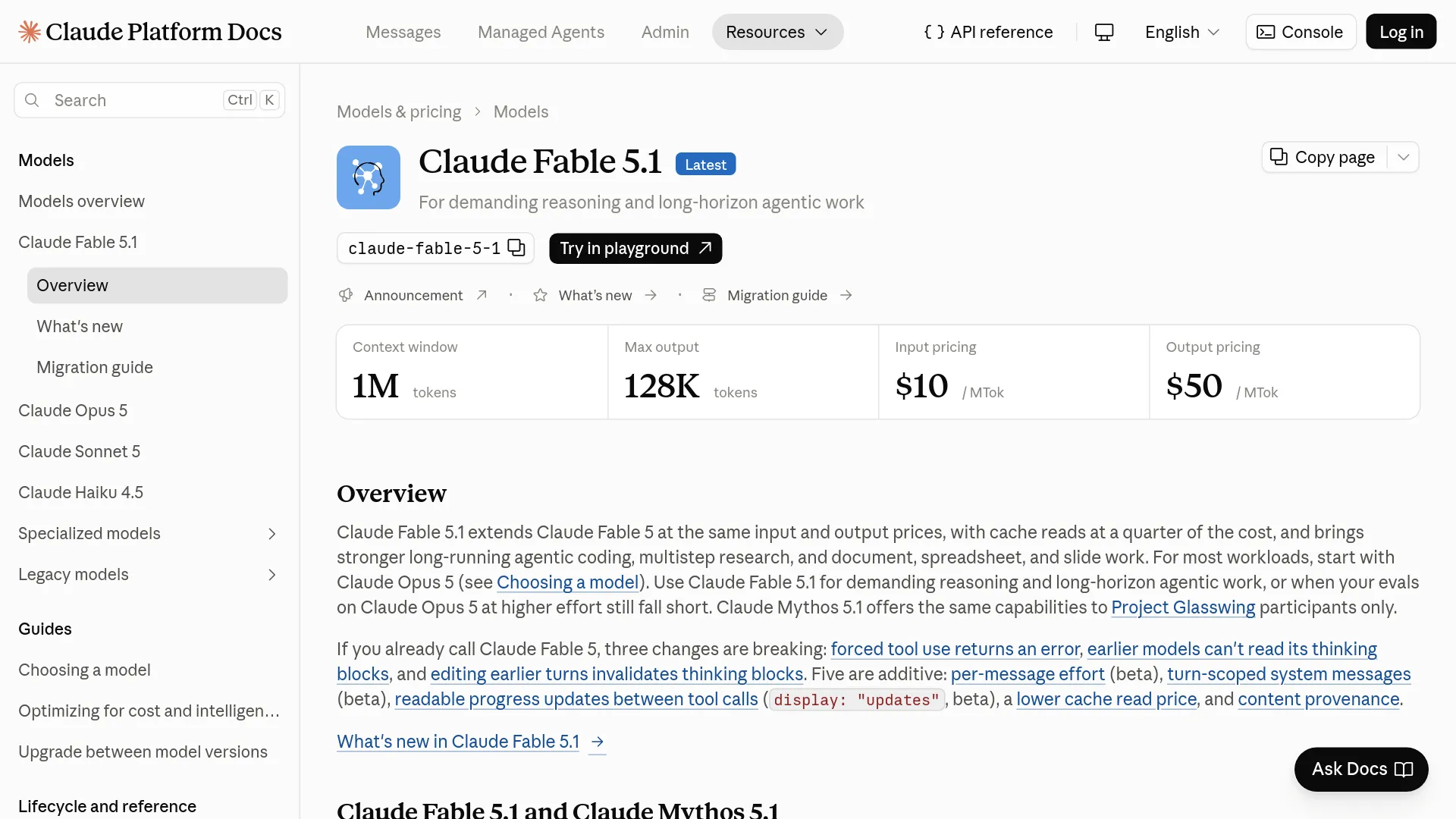
| Specification | Claude Fable 5.1 | Claude Opus 5 |
|---|---|---|
| API model ID | claude-fable-5-1 | claude-opus-5 |
| Context window | 1 million tokens | 1 million tokens |
| Maximum output | 128,000 tokens | 128,000 tokens |
| Input modalities | Text and images | Text and images |
| Output modality | Text | Text |
| Thinking | Adaptive, always on | Effort-controlled reasoning |
| Effort controls | low, medium, high, xhigh, max | Configurable effort levels |
| Anthropic’s positioning | Demanding reasoning and long-horizon agents | Most workloads and serious coding |
| Release status | Active/latest; released September 1, 2026 | Active Opus model; released July 24, 2026 |
For deployment-specific model IDs and availability, use the Fable 5.1 model page and the Claude Opus 5 product page.
The benchmark result is strong for Fable 5.1, but not universal
Anthropic’s published benchmark table gives Fable 5.1 the lead over Opus 5 on every listed row where both are reported. The table is vendor-run, so the results are useful evidence about the launch evaluation, not a production guarantee.
| Anthropic evaluation | Fable 5.1 | Opus 5 | Fable 5.1 lead |
|---|---|---|---|
| Terminal-Bench-Science 0.1 | 52.6% | 29.0% | 23.6 points |
| Terminal-Bench 4.0 | 55.8% | 52.3% | 3.5 points |
| GDPval-AA v2 | 1,853 Elo | 1,824 Elo | 29 Elo |
| OSWorld 2.0, strict | 41.7% | 39.6% | 2.1 points |
| Humanity’s Last Exam, with tools | 65.0% | 63.6% | 1.4 points |
| AutomationBench | 31.4% | 26.9% | 4.5 points |
| CursorBench 3.2.0 | 73.4% | 70.0% | 3.4 points |
Anthropic says production safeguards were enabled and that some interventions could produce zeroes or route work to fallback models. It also reports a standard error of roughly 3.5–4.5 percentage points per model on Terminal-Bench-Science 0.1. A 23.6-point gap is therefore more meaningful than a 1.4-point difference on Humanity’s Last Exam.
A third-party CodeRabbit evaluation of 45 tasks containing 105 known issue points found Fable 5.1 at 61.0% recall and 37.3% precision, versus Opus 5 at 55.2% recall and 39.3% precision; both produced 166 processed comments, but the authors warn that the setups differed.
“Fable 5.1 is a specialist reviewer.” — CodeRabbit’s description of its evaluation result (CodeRabbit)
API pricing changes the practical comparison
Fable 5.1 costs twice as much as Opus 5 for uncached input and output, but its cache reads cost half as much. That creates a crossover point for long, repetitive agent sessions; it does not make every Fable 5.1 request cheaper.
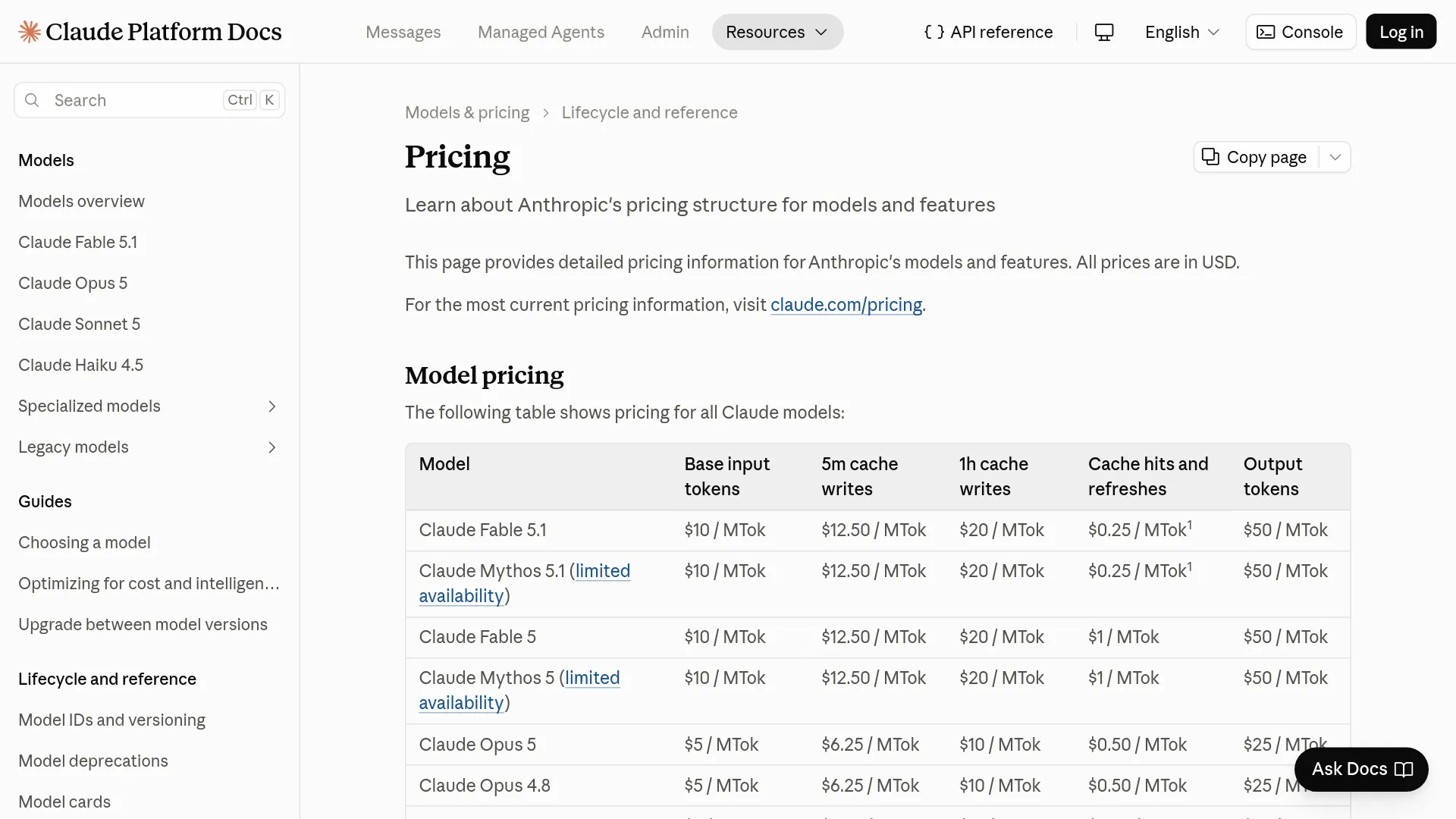
The following rates are from Anthropic’s current API pricing documentation, in USD per million tokens.
| Billing item | Claude Fable 5.1 | Claude Opus 5 |
|---|---|---|
| Base input | $10.00 | $5.00 |
| 5-minute cache write | $12.50 | $6.25 |
| 1-hour cache write | $20.00 | $10.00 |
| Cache read | $0.25 | $0.50 |
| Output | $50.00 | $25.00 |
| Batch input / output | $5.00 / $25.00 | $2.50 / $12.50 |
Fable 5.1’s input and output prices are unchanged from Fable 5. The change that drives the advertised savings is the cache-read rate: $0.25 per million tokens, down from Fable 5’s $1.00. Anthropic estimates roughly 25% lower typical workload cost and up to about 45% lower cost for highly agentic workloads, but those are workload estimates, not a universal discount.
A useful per-turn calculation makes the trade-off clearer. Let C be cached context, I be fresh input, and O be output, each measured in millions of tokens. Ignoring cache-write charges, Fable 5.1 costs 10I + 0.25C + 50O; Opus 5 costs 5I + 0.50C + 25O.
Fable’s cheaper cache reads outweigh its higher fresh-input and output rates only when:
0.25C > 5I + 25O
For a 2,000-token fresh prompt and a 1,000-token response, I = 0.002 and O = 0.001. The cached context must exceed roughly 140,000 tokens before the read-only arithmetic favors Fable. Adding cache-write costs moves the crossover farther out.
This is why short extraction, classification, rewriting, and one-shot coding calls should not be upgraded to Fable 5.1 for price reasons. There is little or no reusable prefix to discount, and every generated token is billed at twice Opus 5’s rate.
Where each model fits in real workflows
The practical split is between bounded execution and long-horizon persistence. Opus 5 is easier to justify when the task is clearly specified or output-heavy; Fable 5.1 becomes more interesting when an agent must maintain a plan, use tools repeatedly, recover from failures, and carry a large context through many turns.
Coding agents: choose based on completed work, not benchmark position
Opus 5 is the better first test for ordinary repository work: scoped bug fixes, defined refactors, code review, and tasks where lower cost lets you retry or increase effort. Fable 5.1 deserves a pilot for multi-file changes, migrations, system-level debugging, and asynchronous coding sessions where a late failure is more expensive than a slower response.
The community feedback points to two different operational risks. In a large r/ClaudeCode discussion, user u/CyCoCyCo wrote:
“The only way I’ve had success is to have it make goal prompts and run that end to end.” — u/CyCoCyCo on Reddit
That is evidence of a prompting and workflow complaint, not proof that Opus 5 fails for every codebase. Other users in the same discussion described problems during longer context-heavy tasks, including instruction drift and fixes that introduced new defects.
Fable 5.1 has a different complaint profile: in a release discussion, users reported unusually fast token or quota consumption. The report is anecdotal and does not establish a universal subscription limit, but it is a reason to track usage during a pilot rather than judge the model from output quality alone.
A sensible coding-agent pilot records:
- Tasks completed without human intervention.
- Reopened bugs or regressions after the model reports success.
- Total input, cached-input, and output tokens.
- Wall-clock time and number of tool calls.
- Human correction time and the cost of failed late-stage runs.
Research and document-heavy work: Fable has the clearer case
Fable 5.1 is the stronger candidate when the job involves a very large document set, repeated tool calls, visual charts, multi-step research, or a deliverable that must survive several rounds of revision. Anthropic specifically positions it for documents, spreadsheets, slides, diagrams, tables, and long-running research.
Opus 5 has the same 1-million-token context capacity and is also described by Anthropic as capable of complex documents and sophisticated agents. If the work is a single analysis with substantial generated output, the lower Opus rate may matter more than Fable’s cache advantage. Run a representative sample before treating Fable’s benchmark lead as a production requirement.
Computer use and business automation: test the full trajectory
Fable 5.1 leads Opus 5 in Anthropic’s OSWorld and AutomationBench rows, but these tasks measure a sequence of actions rather than a single answer. For a browser or business-process agent, evaluate whether the model reaches the correct end state, how often it needs recovery, and whether a failed action invalidates the rest of the run.
The relevant unit is cost per completed outcome, not cost per million tokens alone. A model that prevents repeated retries on a long workflow can be economical despite a higher rate; a model that consumes the usage budget before reaching the end state is not.
The integration details teams should check before switching
Fable 5.1’s migration documentation describes changes to forced tool use, thinking blocks, and conversation-history validation. Teams that rely on their own message router should test these before changing the default model.
| Change | What can happen | Migration action |
|---|---|---|
| Forced tool use | tool_choice: {"type":"any"} or a named-tool choice can return HTTP 400. | Use auto with clear tool instructions, or use structured outputs where appropriate. |
| Thinking-block portability | Earlier models cannot read Fable 5.1 thinking blocks; fallback turns may drop them. | Audit model switching and fallback paths. |
| Conversation edits | Editing an earlier message, system prompt, or tool list can invalidate later thinking blocks. | Treat the history as append-only or use supported turn-scoped controls. |
| Thinking configuration | Fable 5.1 uses adaptive thinking and does not support disabling thinking in the same way as Opus 5. | Control spend with effort settings and retest token usage. |
The fallback detail matters in mixed-model routers. A Fable 5.1 request may continue with its reasoning context, but a fallback to Opus 5 cannot consume Fable 5.1 thinking blocks. If the router silently drops them, the fallback may replan, adding latency and tokens. Test both the success path and the failure path with production-like histories.
A small evaluation beats a large model claim
Use the same prompts, tools, context, effort policy, and acceptance tests for both models; otherwise a model comparison can become a harness comparison.
- Bounded lane: run scoped bug fixes, extraction, structured writing, and code review. Track useful output, correction time, and cost.
- Long-horizon lane: run a multi-file feature, migration, research task, or browser workflow. Track end-state success, recovery, regressions, and wall-clock time.
- Cache-heavy lane: repeat a stable system prompt, tool set, and repository or document prefix. Track cache-hit ratio and total bill, including cache writes and output.
Start Opus 5 at the effort level you would actually deploy. Then test higher Opus effort before moving the task to Fable 5.1. For Fable, test at least medium and high; do not assume that an effort name transfers directly between models. Anthropic says effort settings control the depth/cost trade-off, and third-party testing found that higher reasoning did not automatically improve aggregate code-review results.
Fable 5.1 vs Opus 5 FAQ
Which model is better for coding?
Fable 5.1 leads Opus 5 on Anthropic’s published Terminal-Bench and CursorBench results, but Opus 5 is the better starting point for most scoped and cost-sensitive coding. Use a representative repository evaluation to decide whether Fable’s higher completion quality offsets its price and latency.
Is Fable 5.1 worth twice the API price?
Not by default. Its input and output rates are twice Opus 5’s, while cache reads are half the price; Fable becomes financially interesting when the workload repeatedly reuses a large context and produces comparatively little output.
Does Fable 5.1 have a larger context window?
No. Anthropic lists a 1-million-token context window and 128,000-token maximum output for both models. Fable’s distinction is its positioning for longer-horizon reasoning and agent trajectories, not a larger published window.
Should I raise Opus 5 effort before switching?
Yes. Anthropic’s model guidance recommends evaluating higher-effort Opus 5 before moving to Fable 5.1. Compare the added token cost with the quality improvement instead of running every request at maximum effort.
Can I fall back from Fable 5.1 to Opus 5 safely?
You can build that fallback, but do not assume the conversation state is portable. Earlier models cannot read Fable 5.1 thinking blocks, and Fable 5.1’s history validation can expose routers that edit prior turns; test the fallback with real tool schemas and message histories.
Where can developers access Fable 5.1 and Opus 5?
Anthropic lists both models for Claude plans and developer access through its platform and cloud-marketplace integrations. The exact model IDs and availability can differ by provider, so verify the deployment-specific identifier in the Fable 5.1 documentation or the Opus 5 product page.
The practical pick is a routing rule, not a permanent upgrade
| Decision | Use Opus 5 | Use Fable 5.1 |
|---|---|---|
| Default model for mixed traffic | Yes | Only after an eval |
| Short one-shot calls | Yes | No price case |
| Output-heavy generation | Yes | Usually no |
| Large cached prefixes | Compare carefully | Potential cost case |
| Long-running autonomous coding | Pilot first | Strong candidate |
| Strictly bounded refactors | Usually | If Opus misses acceptance tests |
| Browser or multi-step automation | Pilot first | Strong benchmark case |
| Custom fallback router | Simpler baseline | Requires migration testing |
Keep Opus 5 as the baseline, run both models on the same bounded and long-horizon task set, and route to Fable 5.1 only when it improves completed work per dollar.
For the model-specific cost details, see Claude Fable 5.1 API pricing; for the broader model reference, see Claude Opus 5.