 AIREITER
A 200,000-token context read 100 times costs $20 at Claude Fable 5’s cache rate and $5 on Fable 5.1. That is the pricing story: the $10 input and $50 output rates did not move, but repeated context got 75% cheaper.
The live Claude Fable 5.1 API price sheet
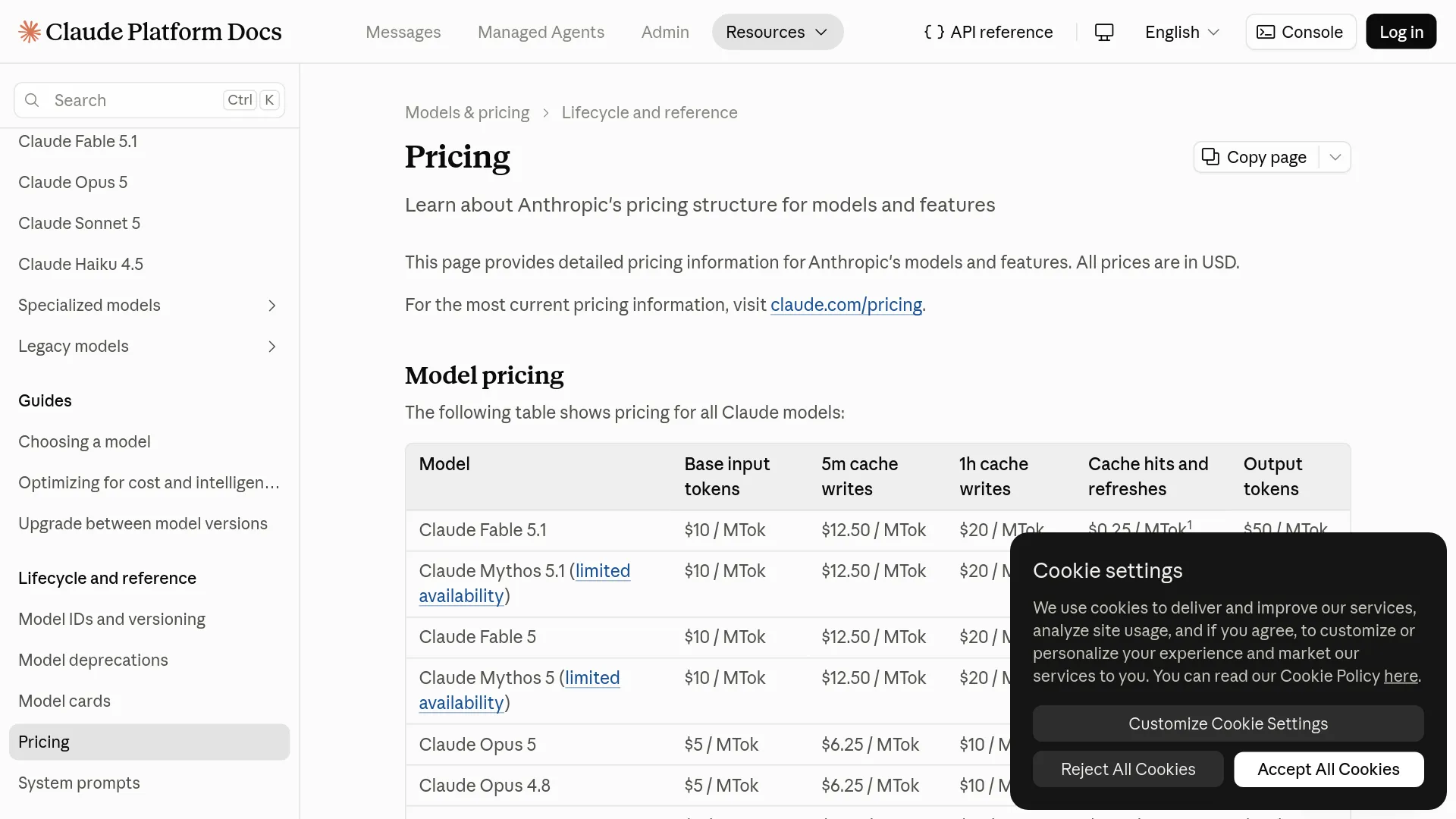
Claude Fable 5.1 costs $10 per million input tokens and $50 per million output tokens. Its 5-minute and 1-hour cache-write rates remain $12.50 and $20 per million tokens, while cache reads fall to $0.25 per million tokens.
Anthropic lists the model in its official Claude Fable 5.1 announcement and in the live Claude Platform pricing documentation. The API model name is claude-fable-5-1.
| Model | Input / MTok | 5-minute write / MTok | 1-hour write / MTok | Cache read / MTok | Output / MTok |
|---|---|---|---|---|---|
| Claude Fable 5.1 | $10.00 | $12.50 | $20.00 | $0.25 | $50.00 |
| Claude Fable 5 | $10.00 | $12.50 | $20.00 | $1.00 | $50.00 |
| Claude Opus 5 | $5.00 | $6.25 | $10.00 | $0.50 | $25.00 |
| Claude Sonnet 5 | $2.00 | $2.50 | $4.00 | $0.20 | $10.00 |
The table uses USD per million tokens, or MTok. The Fable 5.1 cache-read rate is an exception to Anthropic’s standard 0.1× cache-read multiplier: $0.25 is 0.025× its $10 base input rate.
What actually changed from Claude Fable 5
Claude Fable 5.1 is not a general 75% price cut. Input, output, and cache-write rates stay at the Fable 5 levels; only cache reads move from $1 to $0.25 per million tokens.
That distinction matters because output is billed at $50 per million tokens. A workload that generates long reasoning traces, large patches, or repeated tool results can remain expensive even when its reusable prompt is heavily cached.
Savings matter only when a large stable prefix is reused through cache hits across multiple model turns. A one-shot request with a short prompt receives little benefit; a long-running agent that rereads the same context can reduce its input-side bill.
Cache economics: when $0.25 per MTok matters
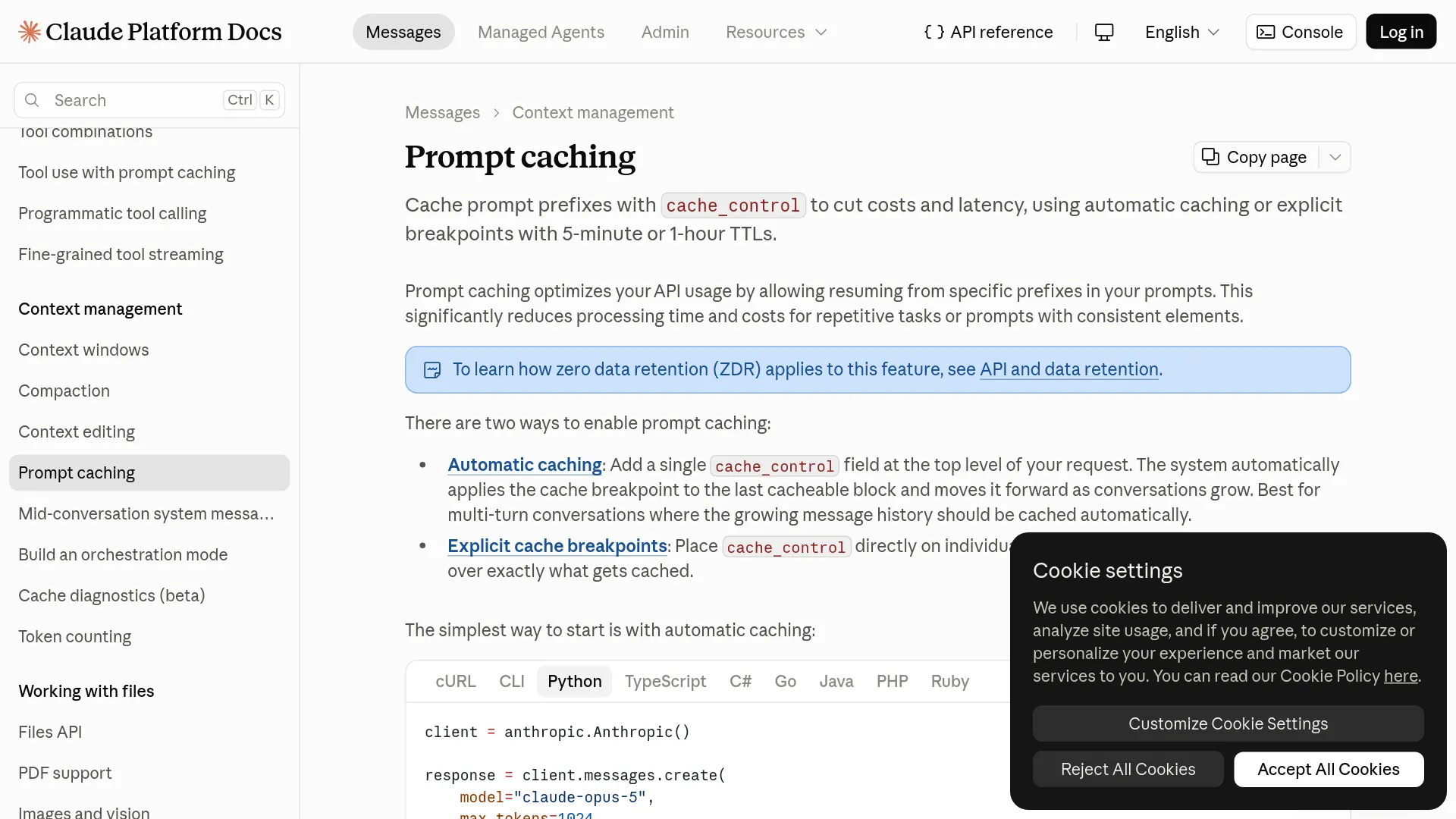
Anthropic’s prompt-caching documentation defines these operations:
| Operation | Fable 5.1 price | Cache lifetime or condition |
|---|---|---|
| Uncached input | $10.00 / MTok | Processed normally |
| 5-minute cache write | $12.50 / MTok | 1.25× base input price |
| 1-hour cache write | $20.00 / MTok | 2× base input price |
| Cache read or refresh | $0.25 / MTok | 0.025× base input price |
The default cache duration is five minutes. A cache read refreshes the entry without an additional refresh fee, and Anthropic also supports a one-hour duration at the higher write price. Fable 5.1 has a 512-token minimum cacheable prompt length; shorter prompts are processed without caching rather than producing a cache error.
A cache breakpoint covers the reusable prefix up to that point. Put stable tools, system instructions, examples, and background context before the changing user request. If a timestamp or per-request instruction is included inside the cached prefix, the changing content can cause a miss and a new write.
Worked example: 200,000 tokens read 100 times
Assume an agent reuses a 200,000-token prefix across 100 later requests. The cache-read volume is 20 million tokens.
| Cache-read rate | Calculation | Cache-read component |
|---|---|---|
| Claude Fable 5 | 20 × $1.00 | $20.00 |
| Claude Fable 5.1 | 20 × $0.25 | $5.00 |
The cache-read saving is $15, or 75%. This example excludes the initial cache write, uncached request content, output tokens, tool charges, taxes, regional modifiers, and retries. It is a component comparison, not a promise that the full agent run will cost $15 less.
A user discussion focused on the same workload-level implication:
“Cache reads now cost 75% less, or $0.25 per million tokens. That is a much bigger deal...” — u/ProfessionalJackals, r/ClaudeAI
The cache write can still erase a careless saving
For the same 200,000-token prefix, a 5-minute cache write costs $2.50 and a 1-hour cache write costs $4.00 at Fable 5.1’s listed rates. A cache that expires before the next request can trigger another write.
For this prefix, one later 5-minute cache hit makes caching cheaper than two uncached reads. The 1-hour option becomes cheaper from the second later reuse, because its $4.00 write plus two $0.05 reads is less than three uncached reads at $2.00 each.
Use the cache duration that matches the traffic pattern:
- Use the 5-minute duration when the same prefix is reused within short interactive gaps.
- Use the 1-hour duration when requests are separated by longer pauses but still belong to one working session.
- Skip caching for one-shot or widely spaced requests where the prefix will not be read again before expiry.
- Check
cache_creation_input_tokensandcache_read_input_tokensin usage data instead of assuming that a marked block produced a cache hit.
The bill beyond the headline rate
Claude Fable 5.1 API pricing is token-based, but the visible answer is only one part of a tool-using request. Anthropic states that tool definitions, tool-use blocks, tool-result blocks, and the special tool system prompt add input tokens. Server-side tools can add separate usage fees.
| Cost driver | What to include in a Fable 5.1 budget |
|---|---|
| Uncached input | System prompt, conversation, files, tool schemas, and fresh context at $10 / MTok |
| Cached input | Reused eligible prefixes at $0.25 / MTok when reported as cache reads |
| Output | Visible output plus billable reasoning/output tokens at $50 / MTok |
| Web search | $10 per 1,000 searches, plus token charges for search context |
| Batch API | 50% discount on input and output token prices for asynchronous jobs |
| US-only inference | 1.1× multiplier on applicable input, output, cache-write, and cache-read charges |
| Cloud route | AWS, Google Cloud, and Microsoft Foundry may use their own published billing mechanics |
Batch discounts, cache pricing, and data-residency modifiers can stack according to Anthropic’s pricing documentation. Fast mode is a separate research-preview feature for supported Opus models, not a Fable 5.1 shortcut.
Estimate output, reasoning, tool, and context tokens—not final prose alone. At 500,000 output tokens, the output component is $25, which can exceed a $15 cache-read saving.
A useful production formula is:
estimated cost = uncached input
               + cache writes
               + cache reads
               + output/reasoning tokens
               + server-tool fees
               + route or geography modifiers
API access and migration checks
Use the exact model ID claude-fable-5-1 and verify that the active provider exposes it. The official announcement says Fable 5.1 is available through Anthropic’s platform and major cloud routes, but a model appearing in Anthropic’s catalog does not guarantee identical availability, limits, or billing on every partner route.
Before changing a production integration, run these checks in a staging environment:
- Confirm the model ID returned by the provider’s live catalog or route-specific documentation.
- Record input, cache-write, cache-read, output, and tool usage for a fixed test set.
- Test the existing
tool_choicesettings and structured-output path. - Test a multi-turn conversation that contains prior thinking blocks.
- Test fallback routing from Fable 5.1 to a lower-cost model without silently losing required state.
- Test any code that edits earlier messages, system prompts, or tool definitions between turns.
- Compare the accepted-task cost, not only the token rate, after the migration.
Anthropic notes that new API accounts cannot manually edit prior context while retaining the transcript of Claude’s prior thinking. Test this behavior in staging; do not assume that every Fable 5.1 request will fail.
When Fable 5.1 is worth its premium
Choose Claude Fable 5.1 when repeated large-context work produces enough cache hits and enough accepted-task improvement in your evaluation to offset its higher base token rates. Stay with a lower-cost model when the workload is one-shot, output-heavy, latency-sensitive, or simple enough for Sonnet 5; Opus 5 remains a lower nominal-cost option at $5 input and $25 output per million tokens.
Use a small evaluation set with known acceptance criteria. Compare these measurements:
| Measurement | Why it changes the decision |
|---|---|
| Successful runs | A cheaper failed run is not necessarily cheaper work |
| Output tokens | Fable 5.1 output is five times its base input rate |
| Cache-read share | The $0.25 rate only applies to reported cache hits |
| Tool turns | Extra turns add tokens, latency, and possible server-tool fees |
| Human correction time | A model that needs less repair can have lower total task cost |
| Route and geography | Partner billing and US-only inference can change the invoice |
The API price should not be confused with Claude Pro or Max subscription limits. The $0.25 figure is an API cache-read rate; Anthropic’s announcement does not say that subscription message limits or usage allowances fall by 75%.
Frequently asked questions
Does the 1-million-token context window mean 1 million free tokens?
No. The context window is a capacity limit. Tokens inside it are billed according to the provider’s input, cache, and output categories.
Does the cache discount apply to Claude Pro or Max?
No API pricing rule should be applied to a subscription plan without a plan-specific statement. The $0.25 rate is an API cache-read price, not a published change to Pro or Max limits.
How can I verify that a request used the cache?
Inspect the response usage fields, especially cache_creation_input_tokens and cache_read_input_tokens. A cache-control marker alone does not prove that the request met the minimum length or matched a prior cached prefix.
Should I replace Claude Fable 5 immediately?
No. Run a fixed staging evaluation, measure cache hits and output tokens, and compare the cost per accepted task with the existing model and route before switching production traffic.