 AIREITER
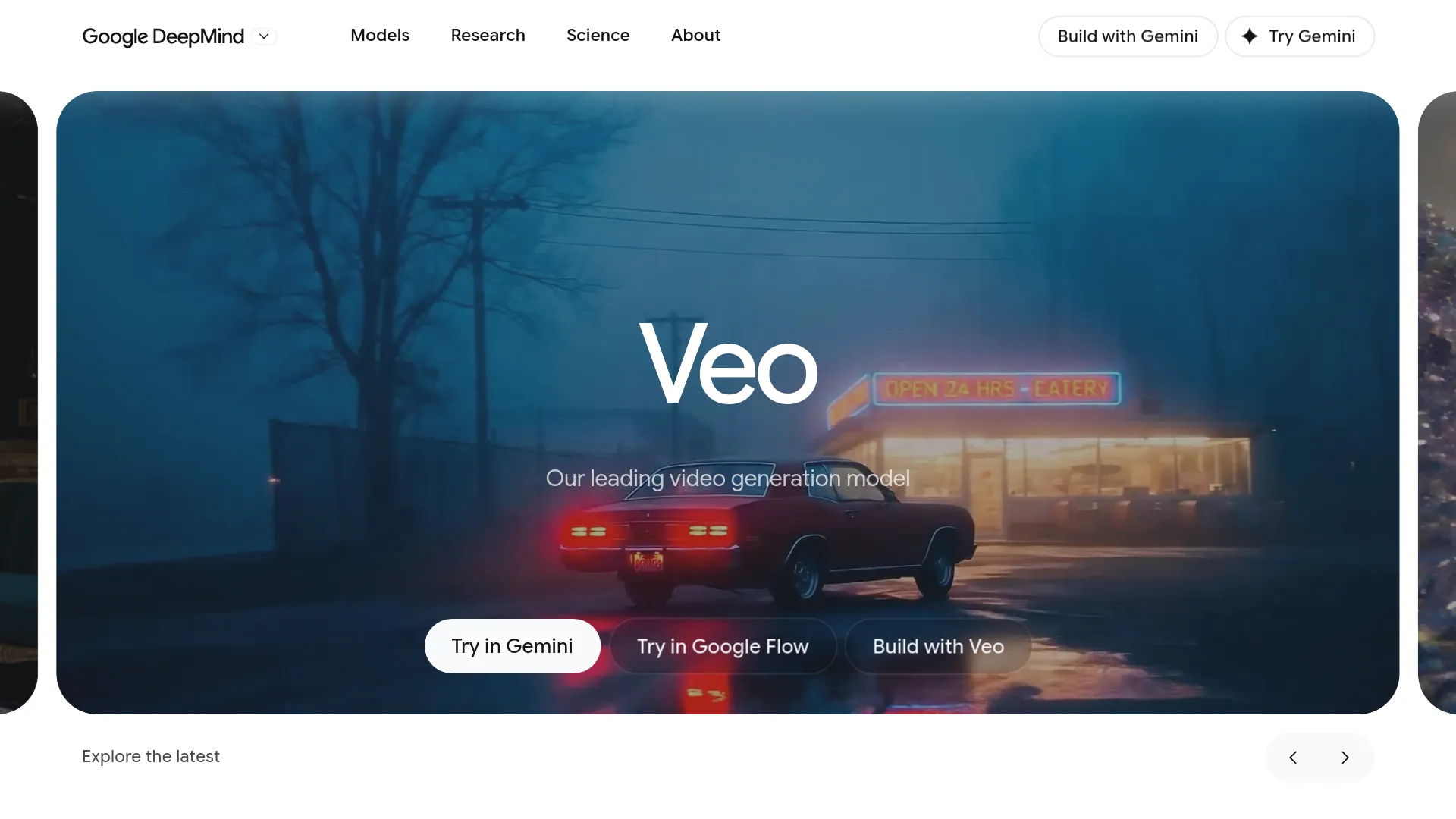
Google I/O 2026 ended without a Veo 4 announcement. The official Google DeepMind Veo page still lists Veo 3.1 as the latest model, released in October 2025. Yet several third-party sites already promise "Veo 4" features-4K output, 30-second clips, zero-shot avatars-with zero sourcing from Google. Veo 4 is not a product Google has acknowledged, and it may never arrive under that name.
What Veo 3.1 Actually Delivers Today
Google's current shipping video model is Veo 3.1, available through Vertex AI, the Gemini app, and Google Flow. The DeepMind page describes it as a model "designed to empower filmmakers and storytellers" with the following confirmed capabilities:
| Specification | Veo 3.1 (confirmed) |
|---|---|
| Resolution | 720p, 1080p (4K tier available on Standard) |
| Clip length | 8 seconds, chainable |
| Native audio | Yes-dialogue, sound effects, ambient noise |
| Image inputs | First-frame and last-frame references |
| Availability | Vertex AI, Gemini app, Google Flow |
| Pricing (Standard 1080p + audio) | $0.40/sec ($3.20 for an 8-second clip) |
The Google Cloud Vertex AI pricing page breaks costs down further. The Lite tier starts at $0.03/sec (video only, 720p), making a full 8-second clip cost under $0.25. Adding native audio roughly doubles the per-second rate across all tiers. For comparison, Veo 3.1 Fast at 1080p with audio runs $0.12/sec-$0.96 for 8 seconds-roughly a quarter of the Standard tier.
Any rumor about Veo 4 promising "lower cost per second" needs to be measured against a baseline that already starts at $0.03/sec for budget work.
The Release Pattern That Predicted Veo 4-and Then Broke
For two years, Google's Veo release cadence looked predictable:
- May 2024 (Google I/O): Veo 1 announced
- May 2025 (Google I/O): Veo 3 announced
- October 2025: Veo 3.1 released off-cycle
Two annual data points convinced many observers that Veo 4 would land at Google I/O 2026 in May. It didn't. The October 2025 Veo 3.1 release broke the I/O pattern, and Google I/O 2026 replaced the expected model-number announcement with something entirely different: Gemini Omni.
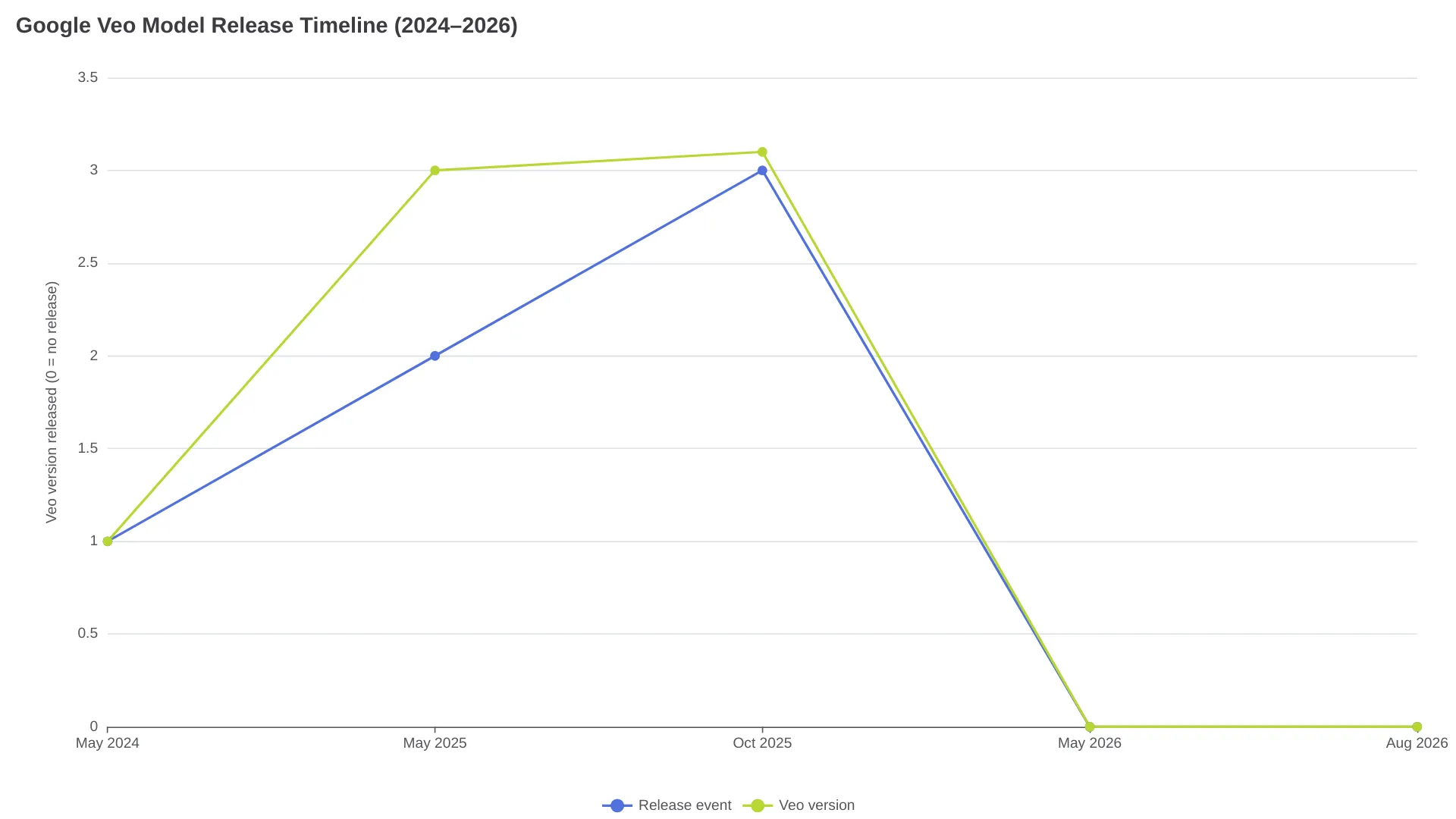
Two annual announcements were not a reliable cadence. Veo 3.1's off-cycle October release already signaled that Google wasn't locked into the I/O schedule, and the Omni pivot suggests the model line itself may be restructuring.
What Real Users Want From Veo 4
Reddit discussions about Veo 3.1 surfaced several recurring demands that map onto the model's actual limitations:
| What users want (Reddit) | Veo 3.1 current state | Gap |
|---|---|---|
| Longer clips (15-30 seconds) | 8-second max per generation | Clips must be chained manually |
| Better motion physics | Good, but struggles with complex motion | Artifacts in fast movement |
| Character consistency across cuts | Moderate; requires image references | Identity drift in multi-shot sequences |
| Improved faces, hands, skin | Generally strong; occasional artifacts | Visible in close-ups and rapid motion |
| Stronger prompt adherence | Improved over Veo 3, still imperfect | Complex prompts get partially ignored |
| Multicamera storytelling | Not supported natively | Each shot is a separate generation |
A Reddit thread on r/VEO3 titled "Veo 4 Soon I think!" captures the frustration:
"Veo 3.1 hasn't kept pace for production work. We need a substantial quality jump-better motion, better people rendering, better image-to-video performance. The competition isn't waiting."
That competitive pressure is real. Kling 3.0 added native audio support at 12 credits/sec for 1080p, and Seedance 2.5 reportedly supports 30-second clips and 4K output, according to third-party analysis. Google's Veo line has been quiet for over nine months.
Rumored Features: Signal vs. Noise
Multiple third-party sites (pollo.ai, veo40.net, tryveo4.io, aiveo4.ai) list an overlapping set of Veo 4 features. Here is each rumored capability, its source, and a reality check:
| Rumored feature | Status | Reality check |
|---|---|---|
| 4K resolution output | Unconfirmed | Veo 3.1 already has a 4K pricing tier on Google Cloud; this may already be available, not a Veo 4 feature |
| 30-second clips | Unconfirmed | No Google source. Seedance 2.5 already offers 30-second clips per third-party reports |
| Native storyboarding | Unconfirmed | The cited Google documentation does not describe multi-scene generation in a single API call |
| Zero-shot personalized avatars | Unconfirmed | No Google announcement; likely confused with Omni's multimodal input capabilities |
| Better lip-sync and multilingual audio | Unconfirmed | Veo 3.1 already generates native dialogue; improvement is plausible but undocumented |
| Lower cost per second | Unconfirmed | Veo 3.1 Lite already starts at $0.03/sec; further reduction would need a new efficiency breakthrough |
| Advanced multi-angle camera control | Unconfirmed | Veo 3.1 offers camera direction via prompts; no evidence of a dedicated control system |
These features are asserted without links to Google sources, and release dates are guessed without citation. The Pollo AI article even contradicts itself, listing Veo 3 clips as both "roughly 8 seconds" and "8-15 seconds" on the same page.
Gemini Omni: Why Veo 4 Might Not Arrive the Way You Expect
The most significant development at Google I/O 2026 wasn't a Veo 4 announcement-it was Gemini Omni, described on the DeepMind site as a system that can "create anything from anything." Omni combines Gemini's reasoning layer with Google's generative media stack, including Veo, Nano Banana, and Genie.
This changes the strategic picture. Google may keep iterating Veo as an independent model line, or fold video generation into a unified multimodal system. Omni's positioning-conversational video editing, physics understanding, multi-input fusion-suggests the latter direction, though Google has not confirmed this.
If Omni becomes Google's primary video interface, future Veo improvements could ship under a different product name rather than as a standalone "Veo 4." Google has not stated whether the Veo naming scheme will continue. For anyone building on Veo today, the practical lesson is to use a provider-agnostic approach where your pipeline calls a video generation API without hard-coding model names, so you can switch between Veo 3.1, Kling, or whatever Omni exposes without rework.
What to Use Right Now Instead of Waiting
Three currently available models are worth comparing:
| Model | Max clip length | Resolution | Native audio | Pricing |
|---|---|---|---|---|
| Veo 3.1 | 8 sec | 1080p (4K tier) | Yes | $0.03-$0.40/sec by tier |
| Kling 3.0 | 10 sec | 720p, 1080p, 4K | Yes (12 credits/s at 1080p) | 6-30 credits/s; dollar cost plan-dependent |
| Seedance 2.5 | ~30 sec (reported) | 1080p, 4K | Yes | ~$0.66-$1.80 per clip (est.) |
Veo 3.1 is the best-documented option if native audio matters, with transparent per-second pricing on Vertex AI. If longer single-pass clips are the priority, Seedance 2.5's 30-second generation far exceeds Veo 3.1's 8-second limit. You can experiment with Veo 3.1 through our Veo 3.1 video generator without provisioning a Vertex AI project.
Three Signals That Would Confirm Veo 4 Is Real
Until one of these appears, Veo 4 remains a search query, not a product:
- A Vertex AI changelog entry that explicitly names "Veo 4" as a new model or model version
- A Google DeepMind research paper that uses the Veo 4 designation in its title or model section
- A Google Cloud product page with Veo 4 pricing, API specs, or a model card
The absence of all three-eight months after the expected I/O announcement window-is itself informative. Google has not confirmed whether Veo 4 exists as a product name or whether its video capabilities will be delivered through Omni instead.
FAQ
Is Veo 4 officially released?
No. As of August 2026, Google has not announced, released, or acknowledged a product named Veo 4. The official DeepMind Veo page lists Veo 3.1 as the latest model. See the three confirmation signals above for what would change this status.
When will Veo 4 come out?
There is no official release date. The annual Google I/O release pattern (Veo 1 in 2024, Veo 3 in 2025) was broken by Veo 3.1's October 2025 off-cycle release and further disrupted by the Gemini Omni announcement at I/O 2026. Google may release the next Veo model at any time, or fold its capabilities into Omni instead.
What is the latest Google Veo model?
Veo 3.1, released in October 2025. It supports 1080p output, 8-second chainable clips, and native audio generation (dialogue, sound effects, ambient noise). It is available through Vertex AI, the Gemini app, and Google Flow.
Should I wait for Veo 4 or use Veo 3.1 now?
Use Veo 3.1 now if native audio and Google ecosystem integration matter most to your workflow. The release timeline is uncertain, the product name itself is in question due to the Gemini Omni pivot, and Veo 3.1 is a capable, documented, and priced production model. If longer clips are your priority, Seedance 2.5 and Kling 3.0 already offer 10-30 second generation today.
Will Veo 4 be available through Gemini or Google Flow?
Google has not confirmed Veo 4's existence or distribution channels. Veo 3.1 is available through the Gemini app and Google Flow, and Gemini Omni, which integrates Veo technology, was announced at I/O 2026 as a Gemini-layer product. Any next-generation Veo capability will most likely appear first through these surfaces.