 AIREITER
SWE-2 Flash looks like the right default for routine Devin queues — 200 tokens per second at one-fifth the SWE-2 cost — unless the workload looks like Terminal-Bench 4.0, where SWE-2 Flash still scores 20.0% against 27.3% for SWE-2 and 40%+ for the leaders.
Verdict: Flash for the queue, SWE-2 for the hard 10%
SWE-2 Flash earns the default slot for high-volume, low-ambiguity engineering work inside Devin. SWE-2 Flash trades benchmark-specific quality gaps for 3x generation speed and substantially lower spend per task.
| Task shape | Route to | Why |
|---|---|---|
| Automations, code review, small features, doc updates | SWE-2 Flash | Cognition positions SWE-2 Flash for everyday work; speed matters more than deep planning |
| Large refactors, novel repos, Terminal-Bench-4.0-like terminal work | SWE-2 | SWE-2 leads SWE-2 Flash 27.3% to 20.0% on Terminal-Bench 4.0 and 73.0% to 60.1% on DeepSWE 1.1 |
| Security-sensitive or on-prem work | Wait | SWE-2 Flash weights are not public; only a future secure-share program is promised |
Free access in Devin Desktop and CLI through November 30, 2026 makes the test cheap. Start new routine queues on SWE-2 Flash and measure rework before committing.
What SWE-2 Flash actually is: Inkling-Small plus mid-training
SWE-2 Flash is Cognition's fast coding model built on Inkling-Small from Thinking Machines. SWE-2 Flash pairs a 276B-total / 12B-active mixture-of-experts base with a new Cognition mid-training stage before reinforcement learning.
The mid-training stage picked data mixes with token-efficiency plots, then trained over a few trillion tokens in three phases with the scarcest data last. Held-out loss fell at a stable log-linear rate, and follow-on reinforcement learning with audited tasks lifted Terminal-Bench 4.0 from 0.9% to 20.0% and FrontierCode 2.0 from 3.2% to 24.0%, per Cognition's November 4, 2026 post. Cognition also reports 200 tokens per second for SWE-2 Flash against 60 tokens per second for SWE-2.
"Cognition latest is here, SWE-2 Flash! 276B total and 12B active parameters flash model. I didn't think we will be seeing a flash model for SWE-2, i'm surprised but appreciated. Looks great on benchmark, it's not that far away from 2.8T SWE-2 model." — @ItsmeAjayKV, real user first reaction
Benchmarks disagree with each other — read them by suite
SWE-2 Flash benchmark results split cleanly by suite. SWE-2 Flash looks strong on structured software tasks and materially weaker on open-ended terminal work, so a single average misleads.
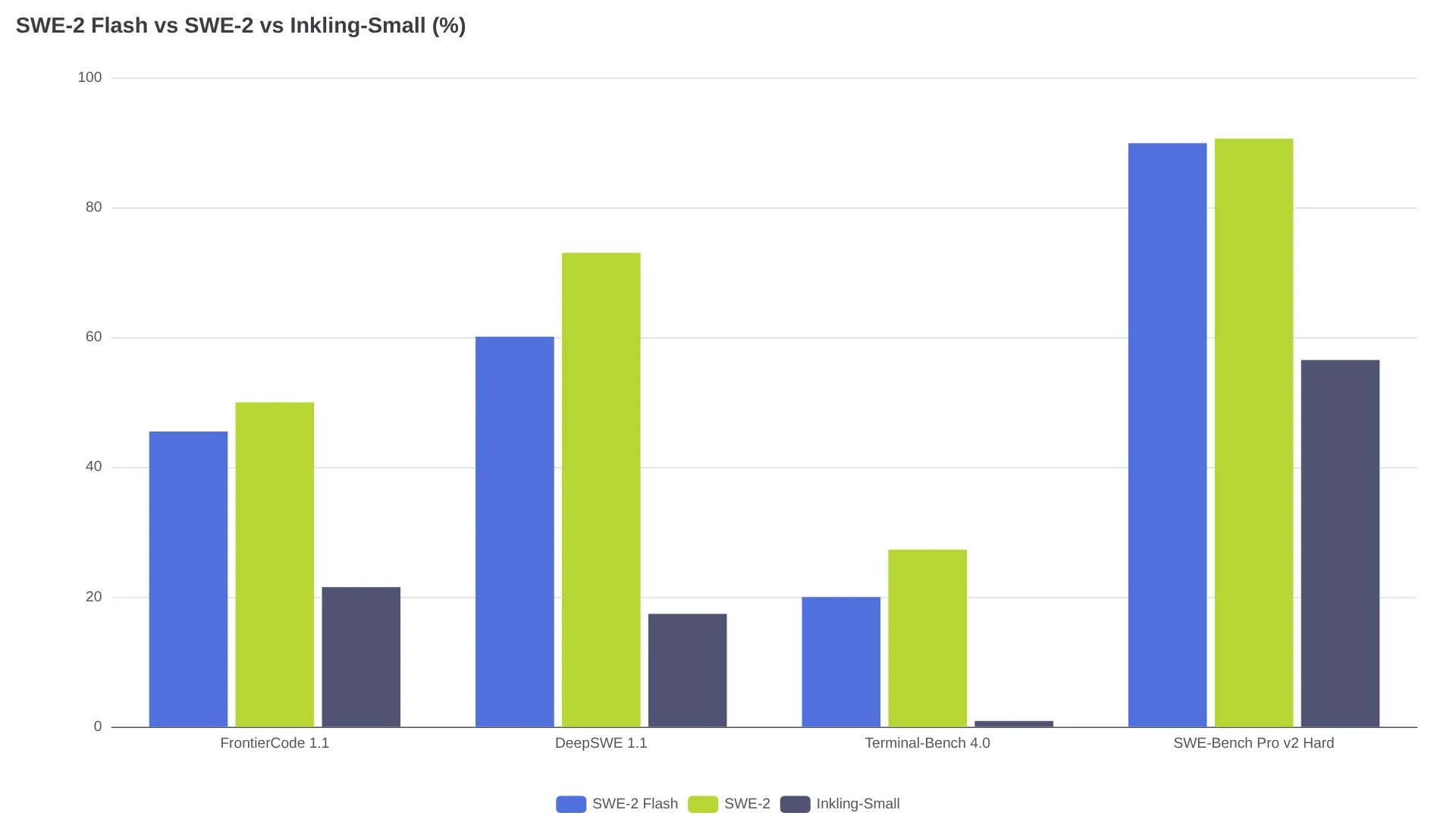
| Benchmark | SWE-2 Flash | SWE-2 (2.8T-A104B) | Inkling-Small | Best in Cognition table |
|---|---|---|---|---|
| FrontierCode 1.1 Main | 45.5% | 50.0% | 21.5% | 50.0% SWE-2 |
| FrontierCode 2.0 | 24.0% | 23.8% | 3.2% | 27.7% Claude Haiku 5.5 |
| DeepSWE 1.1 | 60.1% | 73.0% | 17.4% | 77.0% DeepSeek V4.1 Flash |
| Terminal-Bench 2.1 | 89.2% | 92.8% | 64.7% | 94.4% Claude Haiku 5.5 |
| Terminal-Bench 4.0 | 20.0% | 27.3% | 0.9% | 42.3% DeepSeek V4.1 Flash |
| SWE-Bench Pro v2 Hard | 89.9% | 90.6% | 56.5% | 90.6% SWE-2 |
| SWE-Atlas QA | 50.0% | 56.3% | 27.4% | 71.0% DeepSeek V4.1 Flash |
| ExploitBench | 34.8% | 36.1% | 11.3% | 44.7% GPT-6 Luna |
The lift is bounded. SWE-2 Flash more than doubles Inkling-Small on FrontierCode 1.1 Main (45.5% vs 21.5%) and jumps on SWE-Bench Pro v2 Hard from 56.5% to 89.9%, essentially matching SWE-2 at 90.6%.
Flash does not fix SWE-2 weak spots. Do not extrapolate SWE-Bench Pro success to long terminal sessions; GLM 5.3 Flash posts 41.8% on Terminal-Bench 4.0 in the same table.
The open-weight claim needs context. SWE-2 Flash beats Muse Spark Open on most rows (60.1% vs 60.0% on DeepSWE 1.1, 24.0% vs 6.2% on FrontierCode 2.0), but DeepSeek V4.1 Flash and GLM 5.3 Flash beat SWE-2 Flash on Terminal-Bench 4.0, SWE-Atlas QA, and DeepSWE 1.1. All figures are vendor-reported, each model at its best effort setting, and harnesses differ across vendors.
What one-fifth the price means when there is no price list
There is no per-token rate because there is no standalone endpoint. The only price signal is Cognition's task-cost ratio: one-fifth the dollars per rollout of SWE-2, including model, harness, and serving stack.
That ratio is useful but incomplete. Cognition never published SWE-2 per-task dollars either; OrcaRouter's SWE-2 breakdown could only cite Fable 5.1 at $3.28 per FrontierCode task at medium effort and $12.83 at max as reference points. Devin plans listed there were Free $0, Pro $20 per month, Max $200 per month, and Teams $80 plus $40 per seat — subscription billing, not metered tokens. A one-fifth task cost does not automatically appear as a lower Devin invoice.
Practical reading: the free window through November 30, 2026 in Devin Desktop and CLI covers Pro, Max, and Teams users and is the cheapest way to measure actual consumption. Track completed tasks per week and rework rate, not tokens. If SWE-2 Flash finishes routine tickets in one pass at 200 tok/s, the 1/5 claim understates the saving; if it needs escalation to SWE-2, the saving evaporates.
Who gets in: Devin-only access and a weights program that is not open weights
SWE-2 Flash availability is narrow today. Cognition lists current availability as Devin Desktop and Devin CLI.
There is no public API identifier, no Hugging Face weights, and no self-host path. Cognition frames the restriction as cyber-risk management: SWE-2 Flash training deliberately targeted cybersecurity work, lifting ExploitBench from 11.3% to 34.8%, and the same capability could aid attackers. The proposed fix is a program to securely share weights with trusted industry partners and research labs, with details promised in a few weeks. Treat that as a controlled-access plan, not an open-weights commitment.
Outside Devin, SWE-2 Flash cannot be evaluated directly today: there is no public endpoint or self-host path.
Run Flash or SWE-2? A task-level routing rule
Volume goes to SWE-2 Flash; ambiguity goes to SWE-2.
Use SWE-2 Flash first for automations, dependency bumps, test additions, review responses, small features with clear acceptance criteria, and documentation updates. These map to the suites where SWE-2 Flash is within a few points of SWE-2: FrontierCode 2.0 at 24.0% vs 23.8% and SWE-Bench Pro v2 Hard at 89.9% vs 90.6%.
Escalate to SWE-2 when the task needs multi-file planning, long terminal sequences, or exploit-adjacent reasoning. The gaps there are material: DeepSWE 1.1 trails by 12.9 points, SWE-Atlas QA by 6.3 points, and Terminal-Bench 4.0 by 7.3 points. HamiRev's SWE-2 review describes SWE-2 as tuned for fewer steps and earlier edits than SWE-1.7, a bias toward short tasks that SWE-2 Flash extends further.
Start every ticket on SWE-2 Flash with a two-loop cap, then escalate stalled work to SWE-2. Revisit after the November free period, when real Devin spend replaces the 1/5 ratio. The unresolved trade-off is transparency: the secure weights program could unlock private deployment, but regulated teams cannot plan around SWE-2 Flash until its terms appear.
SWE-2 Flash FAQ
Is SWE-2 Flash available via API?
No standalone SWE-2 Flash API exists. Access is through Devin Desktop and Devin CLI, free for Pro, Max, and Teams through November 30, 2026.
Is SWE-2 Flash open weights?
No. Cognition cites cyber risk and promises only a future secure-share program for selected partners and research labs.
How does SWE-2 Flash compare to SWE-2?
SWE-2 Flash runs at 200 tok/s vs 60 tok/s and costs one-fifth per Cognition's task-cost math. SWE-2 still leads on DeepSWE 1.1 (73.0% vs 60.1%) and Terminal-Bench 4.0 (27.3% vs 20.0%).
What is the context window for SWE-2 Flash?
Cognition has not published context-window, max-output, or modality specs for SWE-2 Flash. Do not assume it inherits Inkling-Small limits.
What happens after the November 30 free period?
Cognition has not stated post-promotion SWE-2 Flash billing. Expect Devin subscription consumption rather than a separate token price.