 AIREITER
Several sites sell something called a “Suno API key,” but the credential may belong to Suno, a gateway, or an unofficial browser wrapper. The safest route is to start at Suno Platform; use a third-party Bearer key only when you can verify its issuer, billing, rights, and exit plan.
Checked September 7, 2026. The Suno Platform page confirms a REST API but does not expose a public key-creation flow or API price list before login.
Start by separating the three things called a Suno API key
A Suno API key is not one universal credential. The same search phrase currently points to a first-party Suno account, independent API gateways, and wrappers that use a browser session cookie instead of a key.
| Route | What authenticates the request | What is publicly confirmed | Best use |
|---|---|---|---|
| Suno Platform | Suno Platform account | Suno describes a REST API for original songs, covers, and mashups and tells users to sign in with the Google account linked to Suno | A first-party relationship |
| KIE Suno API | KIE-issued Bearer token | KIE documents its own API host, task workflow, callbacks, and key-management page | A documented prototype or gateway integration |
| SunoAPI.org | SunoAPI.org-issued Bearer token | Its docs use api.sunoapi.org, an API-key management page, and asynchronous generation endpoints | Testing a provider-specific music workflow |
| Self-hosted wrapper | A copied Suno browser-session cookie | The wrapper documentation explicitly says it does not use an official API key | A controlled experiment, not a default production route |
Provider-issued keys authenticate to that provider, not necessarily to Suno.
For the broader first-party status question, see Does Suno Have an API?.
How to get a Suno API key without using a leaked credential
Use this sequence when you need an API credential for a real application:
- Choose the issuer first. Open Suno Platform if you require a direct Suno relationship. Open KIE or SunoAPI.org only if you accept an independent gateway and can review its current terms.
- Create the account on the issuer’s domain. Do not buy a key from a forum post, a shared spreadsheet, or a seller who cannot identify the billing entity.
- Use the issuer’s dashboard to create the key. KIE’s documentation points to
kie.ai/api-key; SunoAPI.org’s quickstart refers to its API Key Management page. Store the credential in a password manager or deployment secret. - Test with a server-side request. Keep the credential in an environment variable. A browser app should call your server, not expose the provider key in JavaScript.
- Check the first bill and task log. Confirm whether one request creates one track or multiple variations, whether retries consume credits, and whether failed tasks are refunded.
- Rotate or revoke the key after testing. If a key appears in a commit, screenshot, log, or support ticket, treat it as compromised and replace it.
A documented gateway request generally has this shape, although the endpoint, fields, and billing rules belong to that gateway—not automatically to Suno:
curl -X POST "https://api.kie.ai/api/v1/generate" \
  -H "Authorization: Bearer $KIE_API_KEY" \
  -H "Content-Type: application/json" \
  -d '{
    "customMode": false,
    "instrumental": false,
    "model": "V5_5",
    "prompt": "A quiet acoustic folk song about a train leaving at dawn"
  }'
KIE’s music-generation documentation describes an asynchronous flow: a successful request returns a taskId, and the result is retrieved through polling or a callback. It says generated media is retained for 14 days, so a successful response is not a substitute for downloading the audio to storage you control.
A five-minute legitimacy check
Before paying for a “Suno API key,” verify these eight items on the provider’s own pages:
- Issuer: Does the dashboard clearly name the company issuing the credential?
- Domain: Does the API host match the documentation and billing account?
- Authentication: Is the key a normal Bearer token, or is the service asking for your Suno password or full browser cookie?
- Billing unit: Is the price per request, per generation, per track, per variation, or per credit?
- Failure policy: Are filtered, timed-out, or retried jobs charged?
- Retention: How long do audio URLs remain usable? SunoAPI.org documents 15-day file retention; KIE documents 14 days.
- Rights: Who grants commercial-use rights, and do those rights cover your app, clients, ads, games, or streaming distribution?
- Exit plan: Can you download audio and metadata, preserve prompts and task IDs, and switch providers if upstream access changes?
A working endpoint proves authentication, not authorization, licensing, stability, or credential safety.
Suno API key pricing: compare the unit before the headline number
There is no single public price that can honestly be called “the Suno API key price.” The official Suno Platform login page does not publish API rates before sign-in, while independent gateways publish their own prices and billing units.
| Channel | Public price evidence checked | Billing caveat | Editorial confidence |
|---|---|---|---|
| Suno Platform | No API price list visible on the public login page | Do not infer API costs from the consumer subscription page | High for “not publicly shown”; low for post-login price |
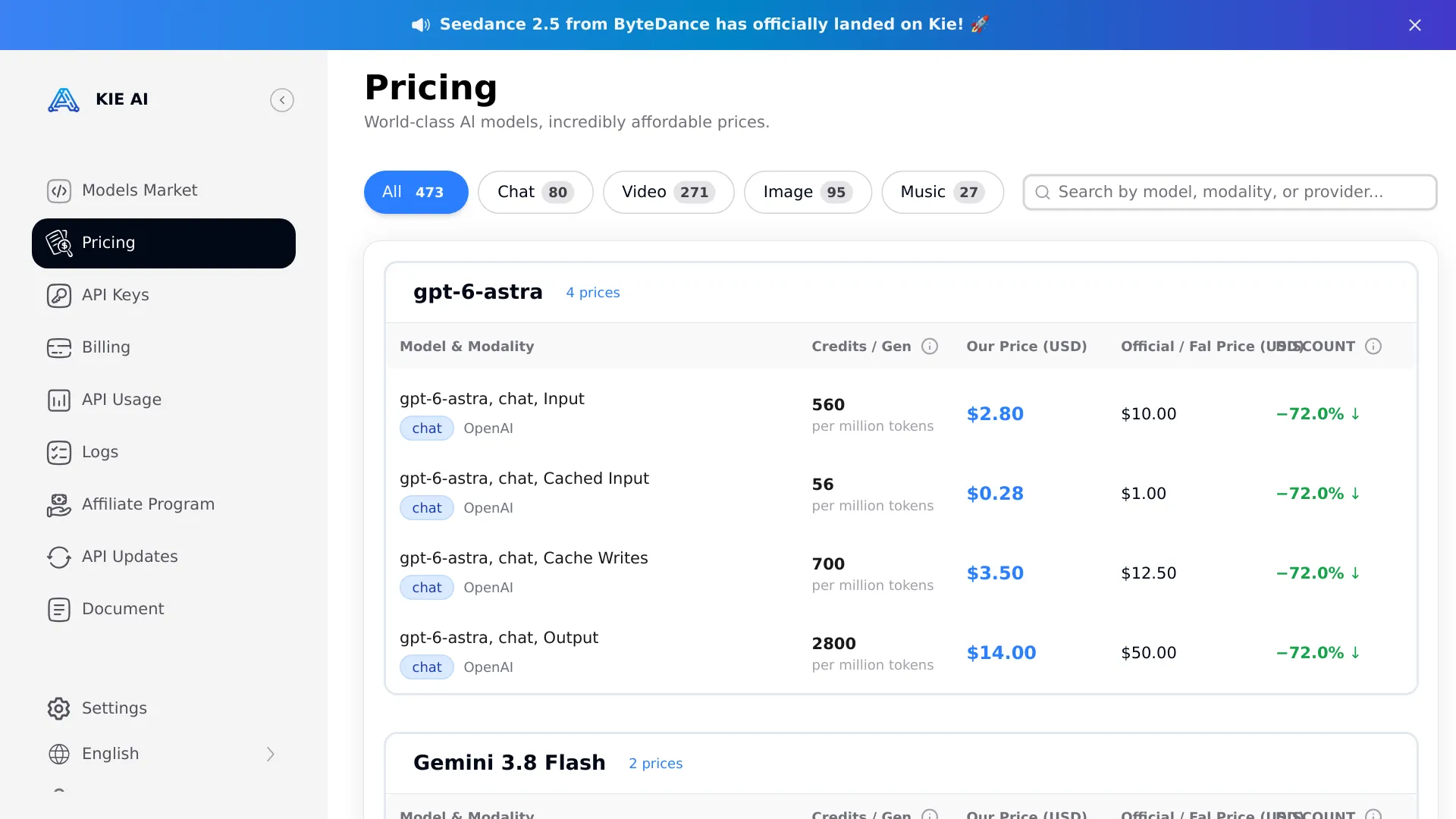
| KIE Suno API | KIE’s public homepage lists Suno v5.5 at $0.002/request | KIE says prices can change; “request” does not establish the number of finished tracks or variations | Medium; verify the live rate card |
| SunoAPI.org | Its pricing page lists chirp-v3-5 at about $0.017 per generation / 100 credits | The page does not establish that the older model, credit package, or output behavior matches another provider’s unit | Medium; provider-specific |
| Cookie wrapper | No comparable API price; the quickstart also requires a separate 2Captcha key for its workflow | You bear session, CAPTCHA, maintenance, and policy risk | Low for production budgeting |
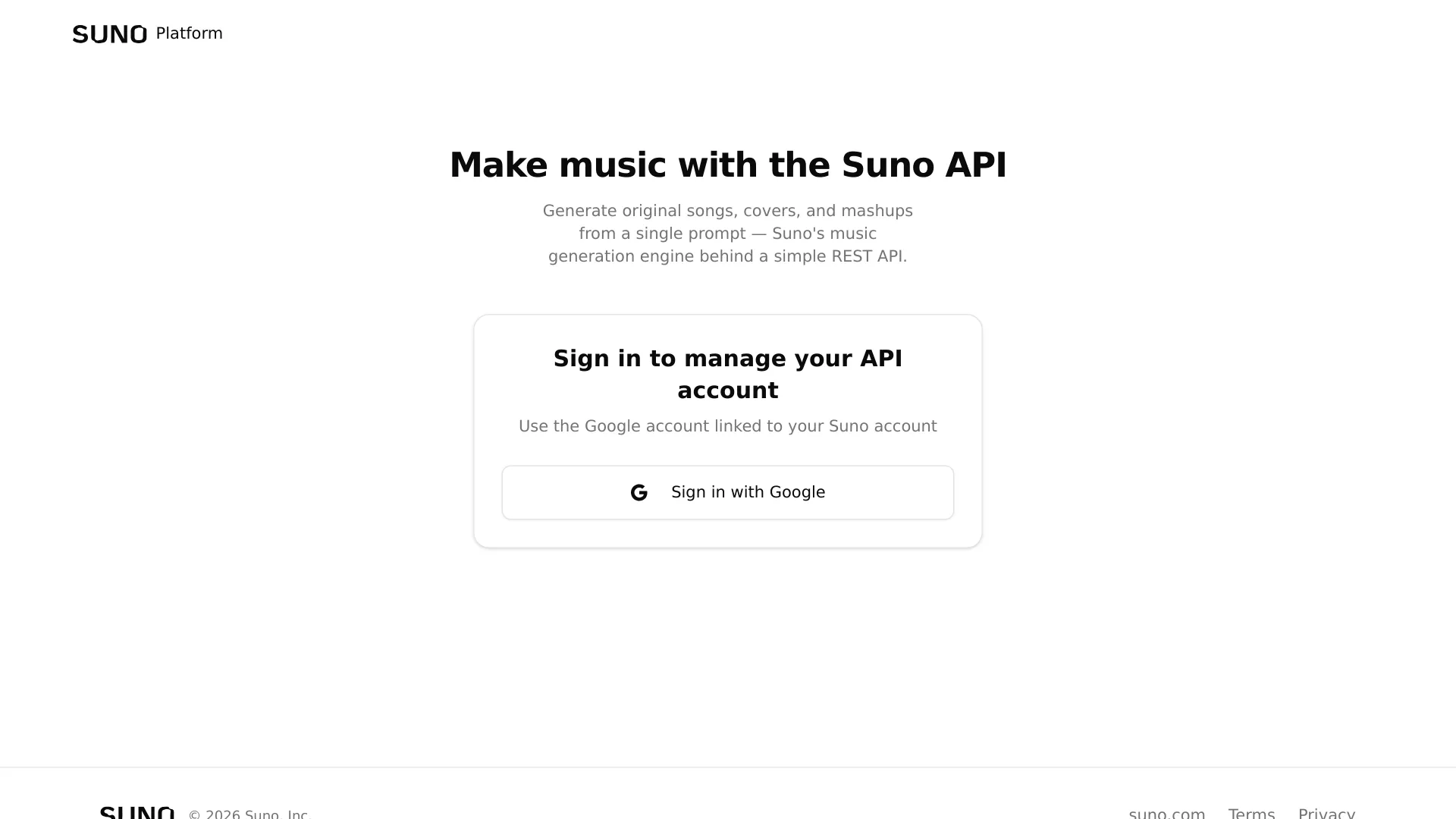
Do not compare these prices until you know what each unit produces and whether retries or failures are charged. The SunoAPI.org quickstart does not expose a complete dollar-denominated price table.
Suno consumer plans are not API pricing
Suno’s official consumer pricing page currently lists Free at $0/month, Pro at $8/month, and Premier at $24/month. It lists 50 credits that renew daily for Free, 2,500 monthly credits for Pro, and 10,000 monthly credits for Premier.
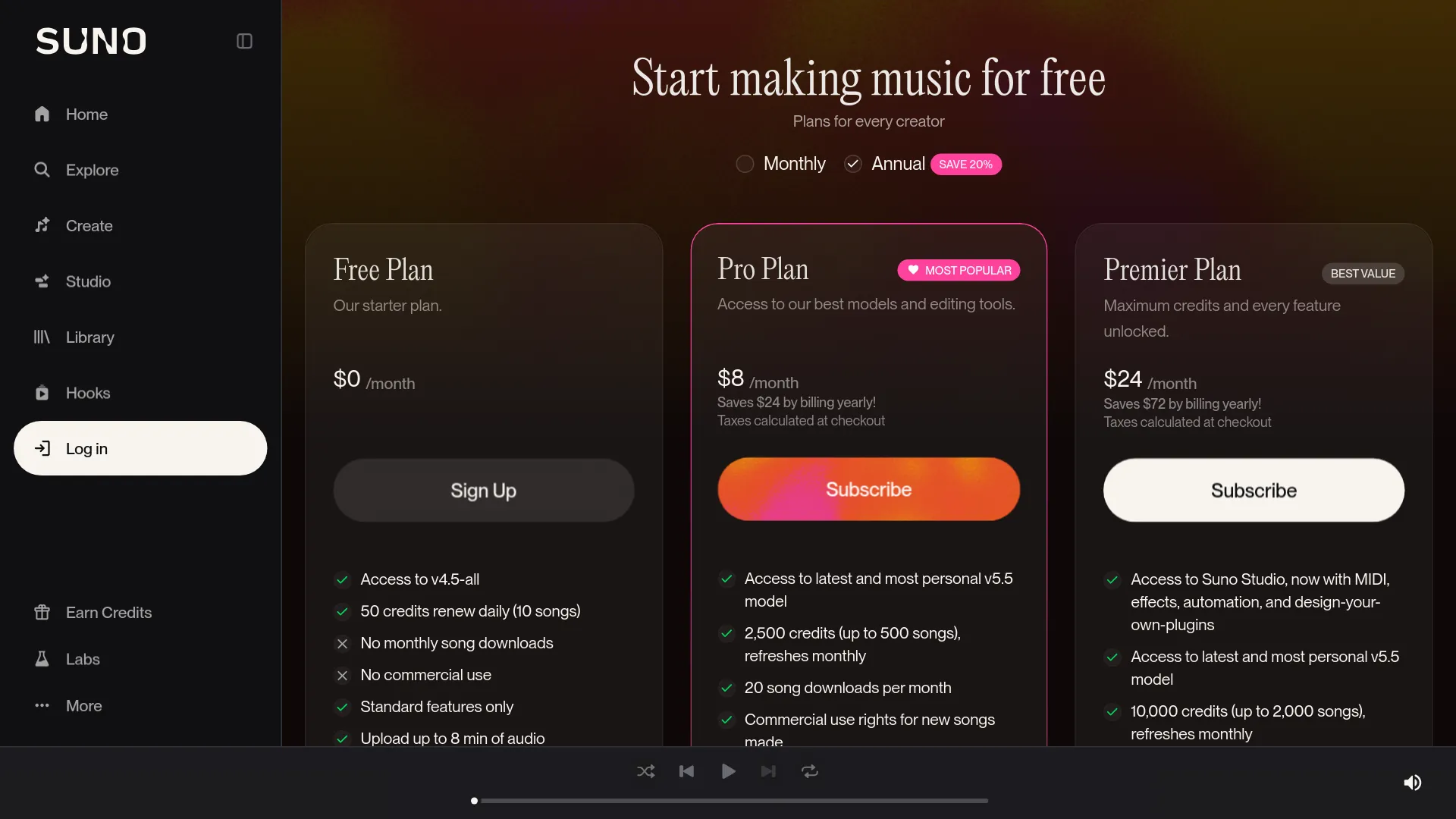
Those web-product credits are not documented as API credits. Suno presents its API on a separate platform.suno.com login flow, and neither page says that Pro or Premier credits automatically work with API calls.
Suno’s paid-plan help page says songs downloaded while subscribed to a paid plan receive commercial-use rights, while its free-plan help page says free-plan creations are intended for personal, non-commercial use and cannot be monetized. Those consumer policies do not establish the license attached to a third-party API gateway.
Which channel is reliable for each use case?
| Your requirement | Recommended route | Why |
|---|---|---|
| You need a direct Suno relationship | Start with Suno Platform | It is the first-party API entry point; verify the post-login agreement, key flow, quotas, and API rights before budgeting |
| You need a documented prototype quickly | Compare KIE and SunoAPI.org | Both publish Bearer-token workflows, task handling, and music-generation documentation, but they are separate providers |
| You want to self-host an experiment | Use a non-production account and a wrapper only if you accept the risk | The wrapper relies on a browser session cookie and private web-session behavior, not a stable official key |
| You are building a paid SaaS, game, or client workflow | Require written rights and a fallback provider | Price and a successful test request do not establish licensing, continuity, or account safety |
The gcui-art Suno API wrapper says its authentication replays a logged-in browser session cookie and refreshes the short-lived token while the underlying cookie remains valid. Its quickstart also says Suno presents an hCaptcha challenge and the setup uses 2Captcha.
A browser cookie is a session credential, not an API key, and should never be pasted into a hosted “API key checker” or third-party dashboard.
“Suno AI has no public API for song generation - so I showed this agent the workflow once. It reverse-engineered the requests and built a reusable API I can call infinitely all in less than 5 mins.” — @mamagnus00, X post, December 1, 2025.
This user workaround explains why wrappers appear in search results; it is not evidence that Suno authorizes the integration.
Before you paste a key into production
Run one small, disposable test and record the facts that a landing page usually omits:
- Submit one prompt and record the provider, model, task ID, request time, and number of returned variations.
- Wait for completion through the documented callback or status endpoint; do not assume HTTP 200 means the audio is ready.
- Check usage before and after the test. SunoAPI.org documents
GET https://api.sunoapi.org/api/v1/generate/creditfor the current credit balance; KIE’s dashboard logs at kie.ai/logs show task status and credit consumption. - Download the audio, image, lyrics, and metadata before the documented retention window ends.
- Trigger one controlled failure or content-policy rejection and check whether credits are restored.
- Ask support who grants commercial rights and whether those rights survive cancellation, provider changes, or downstream distribution.
- Remove the key from the test environment, revoke it, and create a restricted production key only after the answers are acceptable.
Suno API key FAQ
Where do I get an official Suno API key?
Start at Suno Platform and sign in with the Google account connected to your Suno account. The public page confirms API-account management after login, but not the post-login key steps or prices.
Is a SunoAPI.org key the same as a Suno key?
No. SunoAPI.org issues its own Bearer token for its own host and credit system; that credential is not public evidence of a Suno-operated service.
Can I use my Suno Pro or Premier credits through an API?
Do not assume that you can. Suno’s consumer credits and its separate API account are not publicly documented as interchangeable.
Is a Suno browser cookie safe to use as a key?
No: it is a session credential, not an API key. The wrapper documentation warns that it must be treated like a password and depends on private Suno/Clerk behavior.
Is KIE’s $0.002 price the cost of a full song?
Not necessarily. KIE labels it per request, but the public price does not define the number of finished tracks, variations, retries, or downstream operations included.
Can I use API-generated music commercially?
Only after confirming the specific provider’s written terms. Suno’s paid consumer policy does not automatically grant commercial rights for an independent gateway or a cookie-based wrapper.
The practical default is simple: use Suno Platform when first-party access matters; use a provider-issued Bearer key for a replaceable prototype; never treat a copied browser cookie as a normal API key.