 AIREITER
On August 25, 2026, Alibaba's ModelScope posted a countdown page for Qwen3.8-Flash-Next — a model that ships a new architecture before the product family it's meant for even exists. As of this writing, the weights were expected to drop on August 26 at 23:00 UTC+8. The entire point is to give the open-source inference ecosystem time to build kernels, quantizations, and serving support before Qwen4 arrives.
What Qwen3.8-Flash-Next actually is (and what it isn't)
Qwen3.8-Flash-Next is a multimodal Mixture-of-Experts (MoE) model built on the architecture intended for the upcoming Qwen4 family. It is not Qwen4 itself. Think of it as a technology demonstrator — a working model that exposes the new attention mechanisms, layer structure, and sparsity patterns so that inference frameworks can add support before the full Qwen4 rollout.
The Qwen team's Hugging Face page lists it as an "Upcoming release" and "A Preview of the Qwen4 Architecture." ModelScope's countdown page carried the tagline "Onward to the Next-Gen — Lightning-Fast." Both are official Qwen channels, so the release is confirmed — just not yet complete at the time of writing.
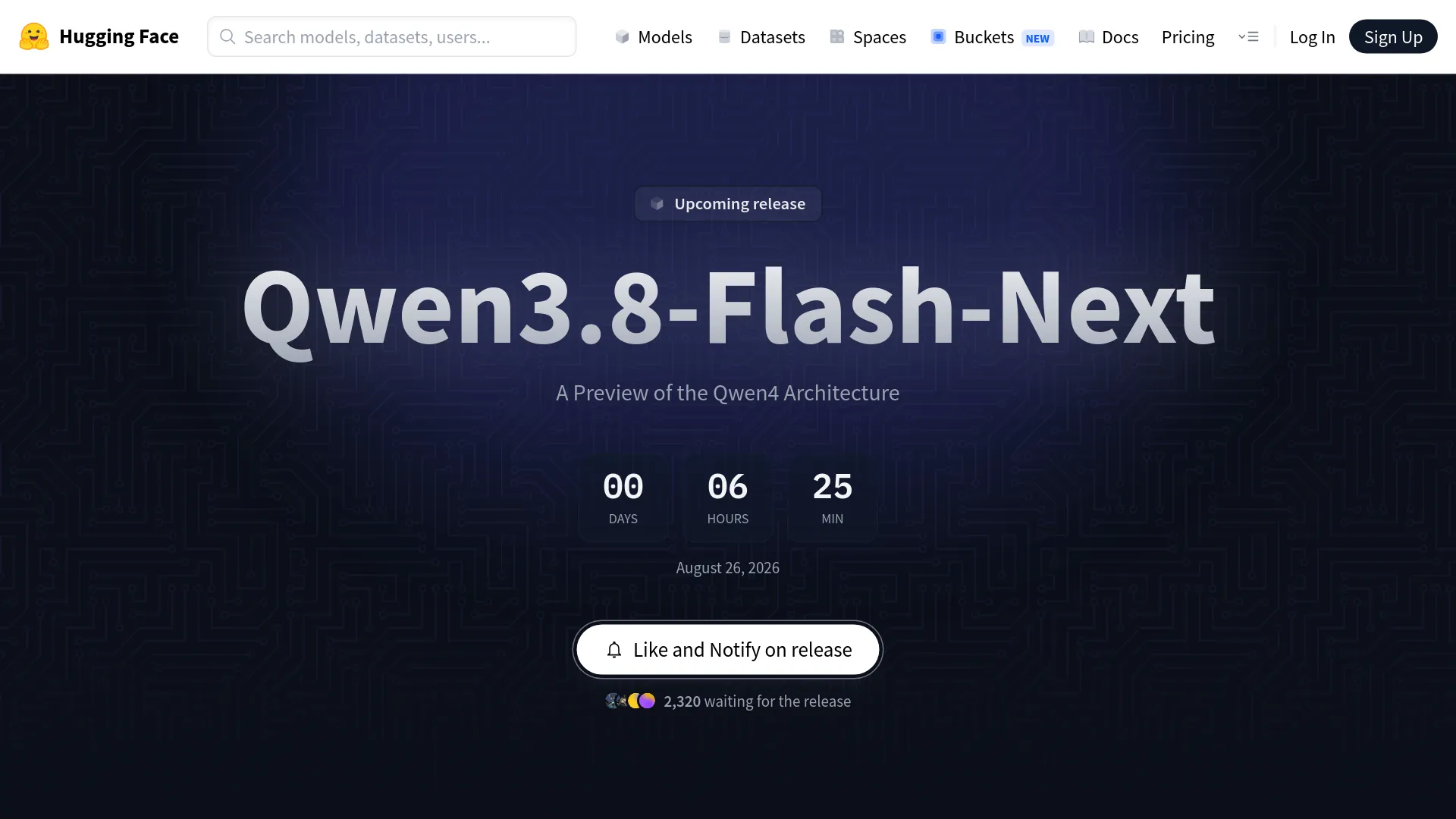
The confirmed facts versus what's still community speculation:
| Confirmed through official channels | Still unconfirmed |
|---|---|
| Open-weight release on ModelScope and Hugging Face | Final parameter counts (125B/6B/51B) |
| Multimodal (vision + text) | License (likely Apache 2.0 based on precedent) |
| GDN hybrid architecture and Qwen Sparse Attention | Benchmark scores of any kind |
FP8 variant (Qwen/Qwen3.8-Flash-Next-FP8) | API pricing or availability |
| Architecture preview for Qwen4 | Context length (speculated at 256K native, stretchable to 1M) |
The parameter counts everyone is quoting — 125B total, 6B active per token, 51B n-gram embeddings — were captured from a ModelScope card that was briefly shown and then trimmed by the Qwen team. They're plausible and consistent across multiple independent observers, but they are not durable official documentation. As SaaSCity founder ghosty put it:
"Anyone posting a benchmark chart for this model today made it up."
The architecture that changes how inference frameworks work
Three architectural components make Qwen3.8-Flash-Next materially different from anything in the current Qwen lineup. Each one requires inference frameworks to support new kernel code, not just a configuration tweak.
GDN layers: fixed-size recurrent state, lower long-context memory
Gated Delta Network (GDN) replaces standard attention in most layers. Unlike standard transformer attention, which stores a KV cache that grows with sequence length, GDN uses a fixed-size recurrent state. In the GDN layers, memory stays constant regardless of context length and computation scales linearly instead of quadratically. The full-attention layers in the hybrid architecture still use a KV cache for precise retrieval.
The practical implication: long-context workloads become dramatically cheaper. A conversation that spans 100K tokens doesn't need 100K tokens' worth of KV cache memory. The reported layer mix for the Qwen3.8 architecture is 69 GDN layers to 23 full-attention layers — a roughly 3:1 ratio — based on community analysis of the briefly-visible ModelScope card. The full-attention layers preserve global retrieval quality while the GDN layers handle the bulk of sequence processing.
This isn't entirely new to Qwen. Qwen3-Next (September 2025) introduced Gated DeltaNet at 80B total / 3B active, and the Qwen3.5/3.6/3.7 family reportedly maintained a similar hybrid pattern. What's new in Flash-Next is the scale: 125B total parameters with this architecture, and the addition of the next two components.
QSA: sparse attention, but nobody knows how yet
Qwen Sparse Attention (QSA) is named on the card but not explained. The community consensus is that it replaces dense attention with a sparse pattern — each token attends to only a subset of other tokens rather than the full sequence. What's unknown is whether QSA uses learned sparsity, block sparsity, sliding windows, or a combination. The technical report, when it drops, will determine whether QSA is an incremental improvement or a genuinely new attention primitive.
The 51B n-gram table: speculative decoding without a draft model
The most unusual feature is a 51B-parameter n-gram embedding table. The working hypothesis in the community is that this functions as a fast token-lookup mechanism — essentially an integrated draft model for speculative decoding. Instead of running a separate small model to predict the next few tokens and then verifying with the main model, the n-gram table provides cheap next-token candidates directly.
The open questions are significant: does the table need to live in VRAM, or can it be memory-mapped? How does it behave under quantization? Is it included in the 125B figure or separate? Until the technical report or first community benchmarks answer these, treat the 51B number as a deployment-planning variable, not a fixed cost.
Where Flash-Next fits in the Qwen family tree
Flash-Next is a parallel track rather than the next step in a linear progression:
| Model | Released | Total params | Active params | Role |
|---|---|---|---|---|
| Qwen3-Next | Sep 2025 | 80B | 3B | First GDN architecture test |
| Qwen3.8-27B | Aug 2026 | 27B (dense) | 27B | Mid-range dense workhorse |
| Qwen3.8-Max | Aug 2026 | ~2.4T | ~95B | Flagship, open-weight |
| Qwen3.8-Flash-Next | Aug 26, 2026 | ~125B | ~6B | Architecture preview for Qwen4 |
| Qwen4 | TBD (months) | Unknown | Unknown | Full next-gen family |
The heuristic the community is using: sqrt(125B x 6B) = 27B. If it holds, Flash-Next might deliver quality roughly comparable to a 27B dense model while spending inference compute closer to a 6B model. As Lucas Souza at Beer And Code noted, this is a rule of thumb, not a theorem — routing quality, data quality, and the n-gram table's contribution all remain unmeasured.
The strategy — described across multiple community analyses as a "platform play, not a benchmark play" — is to let inference frameworks like llama.cpp, vLLM, and SGLang add kernel support before Qwen4 ships. Unsloth has announced they're working on day-zero support.
Can you actually run it? The hardware reality check
| Format | Approximate weight memory |
|---|---|
| BF16 / FP16 | ~250 GB |
| FP8 | ~125 GB |
| Q4 / 4-bit | ~65–70 GB |
These are weights only, before context, KV cache, or runtime overhead. A Q4-quantized model would need roughly 65–70 GB for the main weights, plus whatever the 51B n-gram table requires. If the n-gram table must live in VRAM, the total climbs beyond what most single-machine setups can handle. If it can be memory-mapped to system RAM, a system with 128GB+ unified memory — Mac Studio (M2 Ultra / M3 Ultra maxed), AMD Strix Halo, NVIDIA DGX Spark — could be viable. A single RTX 4090 or 5090 won't cut it.
On Reddit, u/KURD_1_STAN pushed back on the "local-friendly" framing: "Ram prices this high, how can u call this local friendly?" The gap between "6B active" marketing and 250GB memory requirements is real. On X, @Dicklong1999 noted that the sparse activation pattern means generation speed might be reasonable for those who do have the hardware, but "125B, ordinary people can basically forget about running it locally."
What to expect from API availability and pricing
API pricing and availability for Qwen3.8-Flash-Next were not announced at publication. Qwen3.8-Max is priced at $2.00/M input and $6.00/M output (as listed on Qwen's official pricing page); with 6B active parameters, Flash-Next should be substantially cheaper. The FP8 variant halves weight memory versus BF16, making it a natural API-serving format. Availability depends on inference framework support — check provider catalogs after the weights drop.
What to do before the weights drop
If you're a developer or researcher evaluating whether Qwen3.8-Flash-Next matters for your stack, here's the checklist:
1. Verify your hardware. If you plan to run locally, confirm you have 128GB+ of unified memory or a multi-GPU setup. If you don't, plan on API access.
2. Watch the Hugging Face repo. The model card will be the first source of ground truth on actual specs, license, and context length. Bookmark huggingface.co/Qwen/Qwen3.8-Flash-Next.
3. Prepare your eval pipeline. Have your benchmark prompts and evaluation scripts ready before the weights drop. The first 24 hours of community benchmarks will tell you more than any official numbers.
4. Don't switch production workloads. No independent benchmarks exist yet. The architecture is novel, the runtime support is immature, and the license is unconfirmed. Use it for evaluation, not for anything that costs money if it breaks.
5. If you maintain inference tooling, start now. The GDN + QSA combination requires kernel work, not configuration changes. The earlier you understand the architecture, the faster you can ship support.
FAQ
When will the weights be available?
The ModelScope countdown pointed to August 26, 2026, at approximately 23:00 UTC+8. Hugging Face mirrors typically appear within hours of a ModelScope release. The Qwen team confirmed the timing through official channels — @Alibaba_Qwen teased "what surprise we're dropping tonight" and @QwenDevs directly named the model.
Is this Qwen4?
No. It's a preview of the Qwen4 architecture using the Qwen3.8 naming convention. Qwen4 itself is expected in months, not weeks. Flash-Next exists so the ecosystem can prepare runtime support before the full family arrives.
What license does it use?
Not confirmed. Recent Qwen open-weight releases (Qwen3.8-27B, Qwen3.8-Max) have used Apache 2.0, which is the most likely outcome. Verify on the model card once weights are live.
Can I run it on an RTX 4090?
No. Even at Q4 quantization, the main weights alone need ~65–70 GB. A single RTX 4090 has 24 GB. You need a system with 128GB+ unified memory (Mac Studio, Strix Halo) or multiple high-VRAM GPUs.
Does it beat Qwen3.8-27B?
Unknown. There are no benchmarks. The sqrt(125B x 6B) = 27B heuristic suggests comparable quality to a 27B dense model, but this is an estimate, not a measurement. Wait for independent evaluations on your specific use case.
How fast will it be?
The 6B active parameter count per token suggests generation speed closer to a small model than a 125B behemoth. But the n-gram table's memory access pattern and the GDN kernel efficiency are unknown variables. First community benchmarks will answer this.
Will it be available on API platforms?
Almost certainly. The FP8 variant is purpose-built for API serving. AIReiter and other platforms typically add Qwen models within days of a weight release. The bottleneck is framework support for the novel attention mechanisms.
What happened to last year's Qwen3-Next?
Qwen3-Next launched in September 2025 with 80B total / 3B active parameters and introduced Gated DeltaNet. It was a smaller-scale architecture test that proved the GDN hybrid approach worked. Flash-Next is the scaled-up sequel. One user on X, @LufzzLiz, noted that last year's Next series "was a letdown" — which is exactly why waiting for benchmarks matters this time around.