 AIREITER
OpenRouter is still the fastest way to call a hundred models behind one API key, but it tops out the moment you need image or video generation, cheaper tokens, or production-grade guardrails. On GPT-5.6 Sol, some alternatives charge half of what OpenRouter passes through. Here's where to go instead, mapped to the specific reason you're leaving.
Why people actually leave OpenRouter
Most "OpenRouter alternative" roundups list ten names and move on. The more useful question is why you're switching. OpenRouter's weaknesses cluster into four concrete gaps, and each one points to a different replacement.
- It's effectively text-only. OpenRouter's catalog is deep on LLMs but thin on generation models. If your app renders images, video, or audio, you end up running a second provider anyway.
- No production governance. There's no built-in observability, guardrails, PII redaction, or per-team RBAC. The request hops through a third-party aggregator, which complicates compliance for anyone in regulated industries.
- Pass-through pricing with a fee on top. OpenRouter charges provider rates and adds roughly a 5.5% fee when you buy credits (not a per-token surcharge), and it doesn't discount the model rates. You pay what the upstream provider charges.
- Single route per model. Failover and latency-based routing are limited, so a flaky upstream provider means a flaky response to your users.
The thread that comes up first in search captures the typical ask:
"Are there any API providers who have a similar service [to] OpenRouter where for the price of $10 you can have a thousand requests a day?" — r/RooCode
People aren't leaving because OpenRouter is bad. They're leaving because one specific thing it doesn't do now matters to them. The seven options below are grouped by that gap.
The 7 alternatives, by what OpenRouter is missing
If you need image and video generation
AIReiter (aireiter.com) is a multimodal API hub built around the gap OpenRouter leaves. It exposes text models through an OpenAI-compatible endpoint and ships 40+ dedicated image and video models: Nano Banana and Nano Banana Pro, GPT-Image 2, FLUX.2 Pro, Seedream 5, plus video models like Seedance 2.0, Kling 3.0, Sora 2, and Veo 3.1. If your workload is generation-heavy (product shots, ad creative, short-form video), this is the one alternative that doesn't make you bolt on a second vendor. The trade-off is a curated catalog of production models rather than the bleeding-edge research models Replicate aggregates.
Replicate (replicate.com) runs the widest catalog of community and research models on per-second billing. Best for experimentation and one-off generation tasks. The trade-off is cold-start latency of 10 to 60 seconds on less-popular models, which hurts if you need consistent response times in production.
fal.ai (fal.ai) is optimized for fast media inference: image and video generation with low latency, popular with developers shipping creative pipelines. Strong on speed, with a narrower catalog than Replicate.
If you need production governance
Portkey (portkey.ai) is the production control plane for teams who've outgrown OpenRouter's "experiment" tier: full observability, guardrails, prompt management, policy-as-code, and MCP governance. Best for SRE/DevOps teams who need traceability and compliance. It's a gateway, not a model aggregator, so you bring your own provider keys.
LiteLLM (github.com/BerriAI/litellm) is the open-source proxy to pick when the requirement is "self-hosted, full control, no third party sees our traffic." It normalizes dozens of providers behind one OpenAI-shaped interface and runs in your own VPC. The cost is engineering time: you operate it yourself, and observability is basic unless you add it.
If you need cheaper tokens
AIReiter discounts rather than passing through: OpenAI-series models list at 50% off official pricing, Anthropic models at roughly 30% off. On flagships this is the largest single saving in the set. See the price table below.
DeepInfra (deepinfra.com) competes aggressively on open-source model pricing (DeepSeek, Qwen, GLM) with low per-token rates and its own inference infrastructure. Best when your workload is open-weights models and cost-per-token is the only metric that matters.
Together AI (together.ai) is the pick for fast inference on open-weights models at scale, running its own optimized kernels (FlashAttention, speculative decoding) on DeepSeek, Qwen, and Llama. Best when you want open-source model quality with low time-to-first-token. The trade-off is a text-and-code focus, with no media generation.
If you need reliability and failover
For multi-provider failover and latency-based routing, Portkey and AIReiter both abstract over a single flaky upstream. Portkey does it at the gateway layer for teams; AIReiter does it via channel tiers (base / plus / advanced / max) that trade price for stability. OpenRouter's own routing exists but is less configurable than either.
What they actually cost (verified August 2026)
Most comparisons of these tools describe pricing as "pay-as-you-go" and stop there. Here are real per-1M-token prices, pulled from OpenRouter's public model API and each provider's published pricing on 2026-08-02. Input / output, USD. (Replicate and fal.ai bill per media job, and Portkey and LiteLLM are gateway or self-hosting products, so they don't sit on a per-text-token table — the comparison below is the text models where OpenRouter and a discounting reseller compete head-on.)
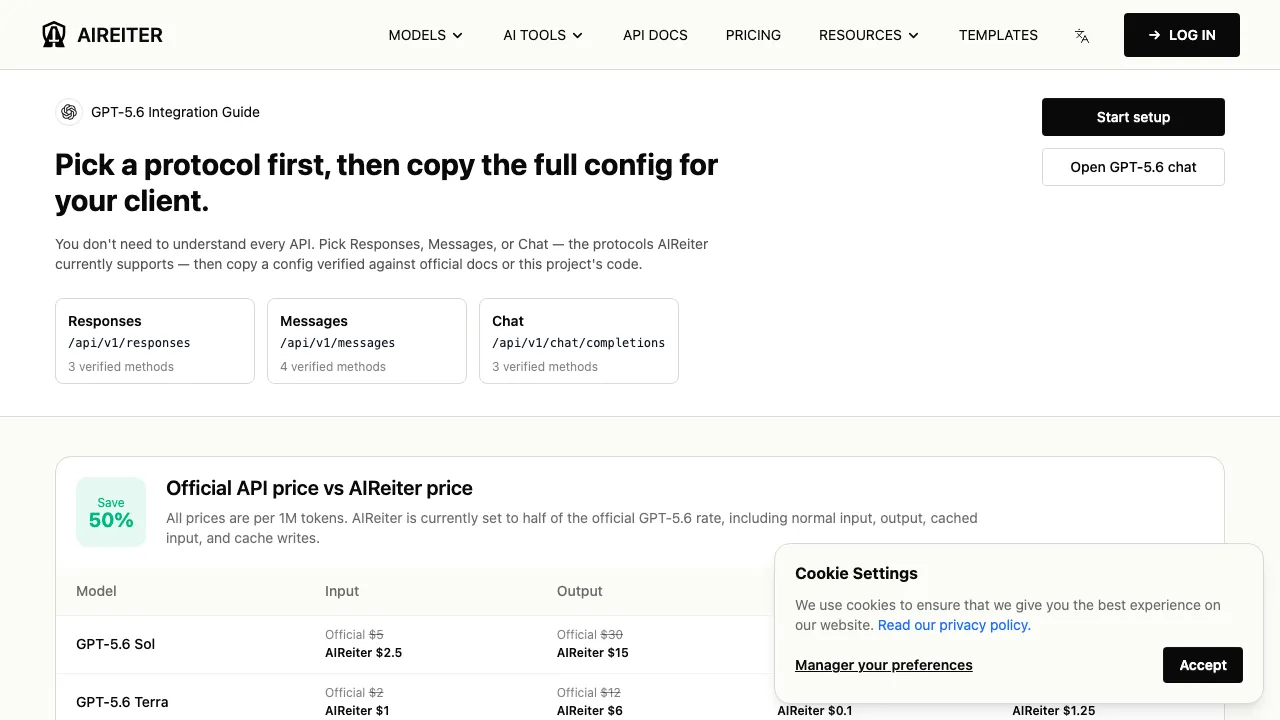
| Model | OpenAI official | OpenRouter | AIReiter | AIReiter vs OpenRouter |
|---|---|---|---|---|
| GPT-5.6 Sol | $5 / $30 | $5 / $30 | $2.5 / $15 | −50% |
| GPT-5.6 Luna | $0.2 / $1.2 | $0.1 / $0.6 | $0.1 / $0.6 | same |
| GPT-5.6 Terra | $2 / $12 | $1 / $6 | $1 / $6 | same |
| Claude Opus 5 | $5 / $25 | $5 / $25 | $3.5 / $17.5 | −30% |
| Claude Fable 5 | $10 / $50 | $10 / $50 | $7 / $35 | −30% |
| Claude Sonnet 5 | $2 / $10 | $2 / $10 | $1.4 / $7 | −30% |
Sources: OpenRouter's public model API (openrouter.ai/api/v1/models) and AIReiter's /llm-api pricing pages, accessed 2026-08-02. The figures are per-model token rates before OpenRouter's ~5.5% credit-purchase fee, so your effective OpenRouter cost sits slightly above the table. That fee, plus no discounting on the model rate, is why a reseller like AIReiter undercuts it. The honest counterweight: OpenRouter still has the broadest single catalog, a large pool of free models, and transparent per-provider pricing, and few cheaper options match that breadth.
Which one should you pick?
- Multimodal generation + lower token cost → AIReiter. The one option here that pairs image/video models with discounted text pricing. Best fit if your app renders media.
- Enterprise governance, observability, compliance → Portkey. A gateway you run production traffic through, not a model source.
- Self-hosted, full control, air-gapped → LiteLLM. Open-source proxy in your own VPC; you trade cost for operating it.
- Cheapest open-source models → DeepInfra or Together AI. DeepSeek, Qwen, GLM at aggressive per-token rates; Together AI if low time-to-first-token matters.
- Sticking with OpenRouter is fine if your priority is maximum model breadth, free models, and you don't need generation, governance, or the cheapest possible flagships.
The decision comes down to which of OpenRouter's four gaps bites you. Pick the alternative that closes that specific gap.
FAQ
Is there anything better than OpenRouter?
Depends on what "better" means. Few services match OpenRouter for one-key access to the widest model catalog with free tiers. But if you need image/video generation, production guardrails, or cheaper flagship tokens, AIReiter, Portkey, and DeepInfra each beat it on that specific axis. See the breakdowns above.
What is the best free OpenRouter alternative?
LiteLLM is the strongest free alternative if you can self-host: open-source, unlimited, you bring provider keys. Hosted options (AIReiter, Portkey, DeepInfra) aren't free but undercut OpenRouter's pricing on paid usage.
How do I switch away from OpenRouter?
The OpenAI-compatible text options here (AIReiter, DeepInfra, Together AI, and LiteLLM's proxy) make migration a base-URL swap. Headers, message format, and streaming carry over, though model IDs and some features differ by provider. Point your client at the new /v1/chat/completions endpoint with a new key:
from openai import OpenAI
client = OpenAI(
    base_url="https://your-new-provider/v1",
    api_key="YOUR_NEW_KEY",
)
What's the difference between OpenRouter and Portkey?
OpenRouter is a model aggregator: one key, many models, pay-as-you-go, optimized for breadth and easy access. Portkey is a production gateway: you bring your own provider keys, and it adds observability, guardrails, routing, and governance on top. OpenRouter gets you started fast; Portkey runs the traffic once you're at scale.