 AIREITER
OpenArt entered 2026 with renamed plans and higher annual prices: Starter, Plus, Pro, and Wonder now bill at $13–$175 per month on annual terms, and the $7–$120 figures that predate the restructure no longer apply (current numbers verified against OpenArt's pricing page, August 16, 2026; credit costs below come from long-term user reports). The verdict is split: worth it for image-first creators at the Plus tier, risky for video-first users on a budget, and the 40-credit free trial is too small to reveal which side you're on.
OpenArt's 2026 Repricing: What the Plans Cost Now
OpenArt's four individual plans are Starter ($14/month), Plus ($34), Pro ($56), and Wonder ($240), with annual billing at $13, $27, $44, and $175 per seat per month (pricing page). The old Essential/Advanced/Infinite tiers are gone, the flat 50% annual discount is gone, and the page now advertises "up to 27% off". Starter's discount is 10%. Wonder's annual price climbed from $120 to $175, roughly 46% more than the old rate.
OpenArt is a browser-based creation suite aggregating 100+ premium image, video, and audio models — Flux 2 Pro, Nano Banana, GPT Image 2, Sora 2, and Kling among them (ClipVerdict's model check) — alongside editing tools, character training, and story features, with no local GPU or ComfyUI graph required. Every plan, Starter included, ships Director, OpenArt MCP, watermark-free output, and the editing suite.
| Plan | Monthly | Annual (per mo) | Credits/mo | ~Images | ~Videos* | Parallel jobs |
|---|---|---|---|---|---|---|
| Starter | $14 | $13 | 4,000 | 4,000 | 50 | 8 |
| Plus | $34 | $27 | 12,000 | 12,000 | 150 | 16 |
| Pro | $56 | $44 | 24,000 | 24,000 | 300 | 32 |
| Wonder | $240 | $175 | 106,000 | 106,000 | 1,300 | 32 |
*OpenArt's own video estimates explicitly exclude Director usage.
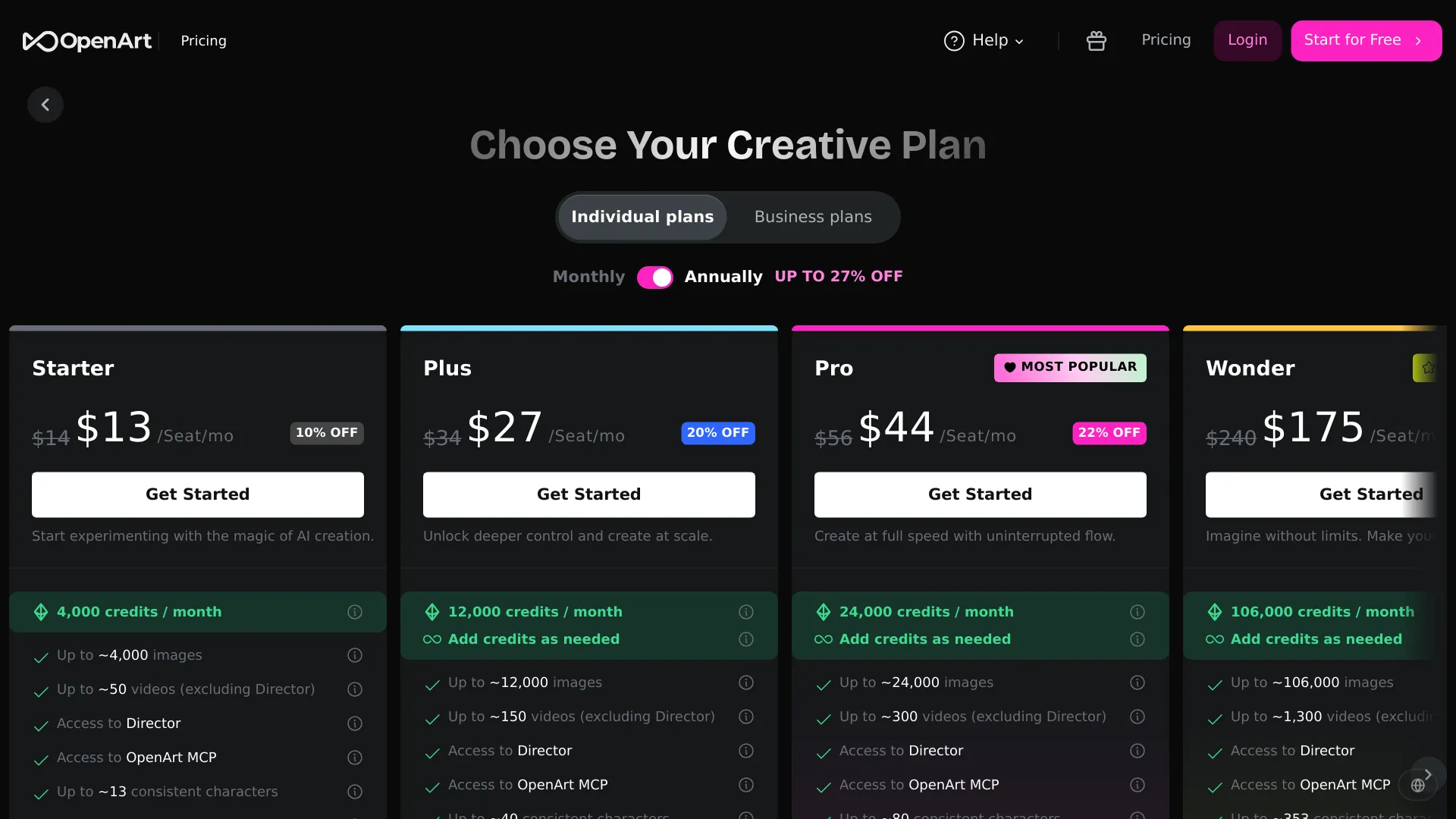
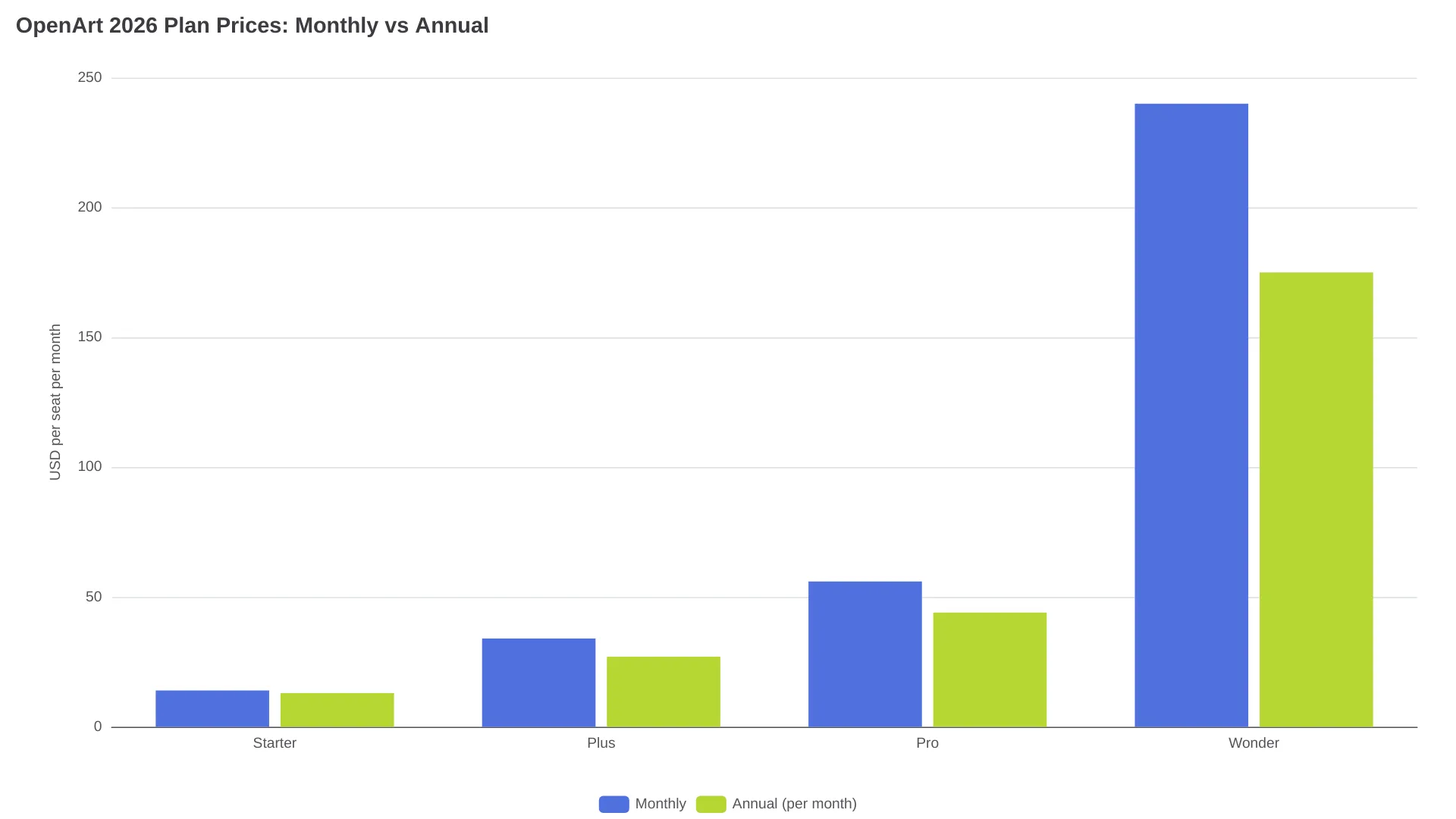
Two gating changes matter more than the headline prices. Commercial-use rights are listed only from Plus upward; Starter's plan card doesn't state them, so anyone selling client work starts at $27/month annual, not $13. The Extra Credit add-on ($15/month per 5,000 credits) now requires a Plus subscription or higher ("Subscribe to Plus to unlock"), so Starter users who run dry mid-month have no top-up path.
How OpenArt Credits Work (and Where They Disappear)
Subscription credits reset every month and do not roll over; a basic image costs 1–2 credits, premium-model images run 5–10, standard video clips about 100, and custom model training up to roughly 2,000. Add-on credit packs are the exception: those roll over, but only Plus and above can buy them.
OpenArt doesn't post a full per-action rate card, so the cost ranges below come from measured long-term reviews (RoboRhythms, FreemiumVisuals, DroidCrunch):
| Action | Reported credit cost |
|---|---|
| Basic image generation | 1–2 |
| Premium-model image (Flux 2 Pro, GPT Image 2 tier) | 5–10 |
| Standard 5-second video (Kling 2.1, Sora 2, Veo 3) | ~100 |
| Higher-resolution video | 150–400 |
| Premium 5-second video clip | 1,500+ |
| Custom model (LoRA) training | 500–2,000 |
That table is why plan choice is really a video decision. At Starter's 4,000 credits, you get roughly 4,000 basic images but only two or three premium video clips. Effective credit pricing also improves steeply with tier: $3.50 per 1,000 credits on monthly Starter, $1.83 on annual Pro, $1.65 on annual Wonder. One reviewer who scored the platform 4.3/5 overall still gave credit transparency 3.2/5:
"Credit transparency is the only thing holding it back from a perfect score." — FreemiumVisuals, May 2026
Image Generation: 100+ Models, Uneven Quality
OpenArt's image side is the strongest part of the product: 100+ models, all watermark-free on paid tiers and usable from one prompt window. The catalog spans Flux 2 Pro, Nano Banana, and GPT Image 2, Ideogram V3 (the pick for legible typography), DALL·E 3, and SDXL. Magic Prompt rewrites loose descriptions into model-appropriate syntax — it's on by default, so check what it did to your prompt.
The consistent caveat in the long-term reviews: quality and behavior vary substantially from model to model across the large catalog (FreemiumVisuals). Flux output matched what reviewers got elsewhere; older checkpoints didn't. The editing suite covers inpainting, outpainting, background and object removal, and Creative Upscale up to 8K. Small inpaint fixes land reliably, while large fills on detailed faces and hands often need multiple attempts, and re-rolls bill like any other generation.
Character Consistency and Custom Model Training
You build characters from 2–3 reference images, three-plus angles recommended, and custom LoRA training accepts 4–128 images and takes 10–15 minutes, costing roughly 500–2,000 credits per run. Personalized-model slots scale from ~13 on Starter to ~353 on Wonder, and One-Click Stories from ~5 to ~150, per OpenArt's own plan quotas.
This is the feature that justifies the subscription for serialized content. One 30-day test trained a model on 20 product photos and got consistent lighting and angles without extra prompting; the same reviewer noted consistency degrades on demanding poses and outfit changes, so budget credits for re-rolls.
Training at 2,000 credits eats half a Starter month — one more reason image-heavy trainers land on Plus or Pro.
Video and Director: Where the Credits Go
Standard clips are reasonably priced: about 100 credits for a 5-second Kling 2.1 generation, similar for Sora 2 and Veo 3 at standard resolution, 150–400 at higher resolutions, with editing extras like lip-sync, character swap, and extend available afterward. The budget risk is Director, the agent feature that plans and assembles multi-shot videos. It is metered separately, excluded from OpenArt's official per-plan video estimates, and user reports show Director runs can exceed their estimates by two orders of magnitude:
"OpenArt Said 120 Credits. It Charged Me 14,000 Instead. Beware." — r/generativeAI thread
A second thread reports Director consuming 10,000 credits on an incomplete 90-second video, and a self-described unlimited-plan user describes still being charged credits for 2K output.
Until OpenArt discloses Director's metering, cap your exposure by experimenting on a small credit balance. And don't evaluate Director on the free trial: the smallest reported overrun, 10,000 credits, is 250× the entire 40-credit allowance.
Aggregator vs Going Direct: When OpenArt Loses
Subscribe to OpenArt if your work spans many models, needs trained characters, and benefits from one browser workspace; go direct when your volume concentrates on a single model, a single medium, or an automated pipeline. OpenArt has no public API, a limitation multiple reviews flag, so anything programmatic is off the table regardless of plan.
| Your need | Better route | Why |
|---|---|---|
| Raw still-image polish | Midjourney, from $10/mo | ClipVerdict's testing summary: "Midjourney produces higher raw image quality for still images" |
| Multi-model + training in one place | OpenArt | 100+ models, LoRA slots, One-Click Stories under one credit pool |
| Video-heavy output under $30/mo | Kling direct, from ~$6.99/mo | Per-clip pricing on a dedicated plan, no separate planning agent to fund |
| Cinematic effect presets | Higgsfield, from $5.99/mo | Bullet-time, earth-zoom and similar one-click effects |
| Multi-model breadth, cheaper | Leonardo.Ai, from $12/mo | 150 free daily tokens; closest feature overlap per reviewer comparisons |
| Automated / API pipelines | Per-generation API pricing | No subscription expiry; pay only for images actually generated |
On the last row: models in OpenArt's catalog, like Nano Banana, are also available through per-generation APIs. At volume, running Nano Banana through an image API bills per image with no monthly expiry, versus $13+/month whether you generate or not.
Should You Subscribe? A Scenario Decision Table
Subscribe at Plus ($27/month annual) if your monthly volume fits within 12,000 credits — roughly 12,000 basic images or 120 standard video clips — and you need commercial rights. Stay away if you're video-first on a tight budget, building automated pipelines, or planning to decide from the free trial alone.
| Your situation | Verdict |
|---|---|
| Marketer or social creator shipping images weekly | Plus - 12,000 credits and commercial rights |
| Indie creator with recurring characters | Plus or Pro - training plus One-Click Stories |
| Video-first creator under $30/month | Skip - Kling direct (~$6.99/mo) or Higgsfield ($5.99/mo) |
| Developer automating generation | Skip - no API; per-generation pricing fits better |
| Evaluating on the free plan | Expect little - 40 credits, 7 days, no commercial use |
Product Hunt holds OpenArt at 4.2/5 across 19 reviews, praising prompt-to-image speed and character consistency. Trustpilot's pattern: model variety and ease of use praised, with recurring complaints about credit consumption, refunds, and cancellations.
"The Free plan is nearly too limited to function as a real trial." — RoboRhythms, 30-day test
OpenArt AI Review FAQ
Is OpenArt AI legit or a scam?
OpenArt is a real product with an active user base: 4.2/5 on Product Hunt across 19 reviews. The "scam" threads linked in this review trace to credit-burn surprises and refund friction, not a fake product.
Is the free plan enough to evaluate OpenArt?
No. You get 40 one-time credits valid for 7 days, enough for a few dozen basic images, but a single premium video clip can cost 1,500+.
Which OpenArt plans include commercial rights?
Plus and above ($27/month annual). Starter's plan card doesn't list commercial-use rights, so client work starts at Plus.
Do OpenArt credits roll over?
Subscription credits do not; they reset monthly. Add-on credits ($15 per 5,000/month) do roll over, but only Plus and higher plans can buy them.
Does OpenArt have an API?
No public API. All plans include OpenArt MCP access for connecting external tools to your workspace, but there's no per-generation API pricing for pipelines.
Can you cancel OpenArt and get a refund?
You can cancel anytime via subscription settings. OpenArt publishes no refund guarantee, and refund outcomes in the Trustpilot reviews and Reddit threads are mixed. Private Mode assets are deleted after cancellation unless published publicly, so export before you cancel.
Related reading: Best AI image generator comparison 2026 · Kie AI review · Higgsfield AI review: pricing vs API