 AIREITER
A coding agent that can edit files, install packages, and call APIs needs more than a warning in its system prompt. NVIDIA OpenShell puts those permissions outside the agent in a policy-enforced sandbox, but the project still leaves you with the hard work of writing complete policies and validating your deployment.
The short verdict: OpenShell is a runtime boundary, not an agent framework
NVIDIA OpenShell is an open-source runtime for autonomous agents. Its 0.1.x documentation describes a Gateway, per-sandbox Supervisor, kernel-enforced filesystem and process controls, mediated networking, credential binding, and policy review tools. It is designed to wrap agents such as Codex and Claude Code without rewriting them, according to NVIDIA's September 28, 2026 technical blog (NVIDIA Technical Blog).
The useful distinction is containment versus intelligence: OpenShell can block an unauthorized file write or network request, but it cannot make an incomplete policy understand every indirect route to the same business action. I would pilot it for controlled coding and agent infrastructure, not treat a sandbox as proof that a production agent is safe.
What OpenShell actually controls
OpenShell separates fleet management from the workload. The Gateway manages sandboxes and policies, the Supervisor mediates requests outside the workload, and the Sandbox runs the agent with operating-system restrictions (NVIDIA Technical Blog).
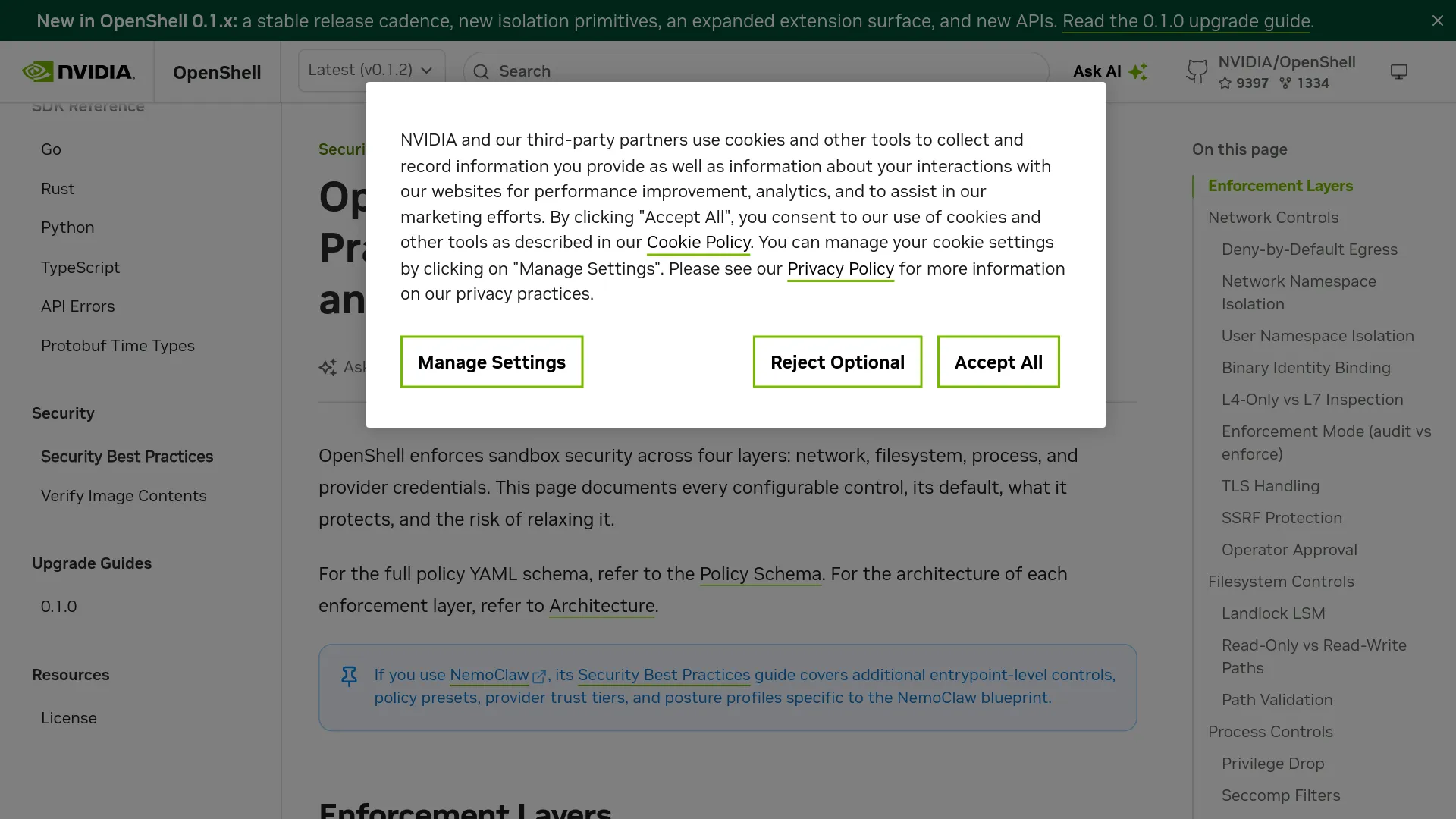
| Layer | What it protects | Can it change while running? |
|---|---|---|
| Filesystem | Files and directories | No; recreate the sandbox |
| Process | Privilege and system-call behavior | No; recreate the sandbox |
| Network | Hosts, ports, binaries, and selected API operations | Yes |
| Provider credentials | Secrets used at approved endpoints | Yes |
OpenShell enforces policy below the application layer and keeps reusable credentials outside the agent, attaching them only to approved requests (OpenShell README).
“OpenShell is the safe, private runtime for fleets of autonomous AI agents.” — NVIDIA OpenShell README (source)
The security model is strongest at the boundary—and weakest in policy design
OpenShell's documented controls are useful because they fail closed at several infrastructure boundaries. They are not a substitute for modeling the actions your agent is allowed to combine.
Filesystem, process, and network controls in one operational view
The latest security guide describes Landlock for filesystem access, seccomp and privilege dropping for process restrictions, and a CONNECT proxy with OPA policy evaluation for outbound traffic (OpenShell Security Best Practices). Unlisted filesystem paths are inaccessible, outbound traffic is denied by default, and network rules can bind access to a binary identity.
Network rules can go beyond host-and-port checks. REST policies can inspect methods and paths; GraphQL policies can inspect operations and root fields; WebSocket policies can inspect handshakes and messages. The trade-off is operational: broad rules are easier to keep working, while narrow rules are easier to defend.
Filesystem and process restrictions are fixed when the sandbox starts. Network permissions can be updated on a running sandbox, but an approval becomes a durable policy revision for that sandbox instance. That makes iteration convenient without making every control mutable.
Credentials are mediated, not magically made harmless
Credential mediation limits exposure, but it cannot make an overly permissive endpoint safe. A read-only API policy can narrow a credential that technically has write access; it cannot repair a policy that already permits destructive operations.
The security guide recommends starting L7 rules in audit mode, reviewing actual requests, then moving to enforce. Audit mode logs violations but forwards them, so it is a discovery step—not a production block.
How to evaluate OpenShell without confusing a demo with a security result
NVIDIA's official tutorial uses curl and the unauthenticated GitHub REST API to show denied access, read-only rules, and live policy replacement; it is a learning path, not an independent benchmark (NVIDIA Technical Blog).
Use the tutorial to answer three setup questions:
- Can your agent start with no network access and receive only the endpoints it needs?
- Can you express the important distinction between read and write operations for your APIs?
- Can your operations team review denials and policy revisions without granting the agent permission to approve its own request?
For a real pilot, add adversarial cases: symlink and path traversal attempts, package installation, shell child processes, alternate binaries, credential placeholders sent to the wrong host, and combinations of individually allowed actions. The public materials do not provide latency, startup-overhead, or independent escape-rate measurements, so collect those numbers in your own environment rather than borrowing the product's architecture claims as test results.
What can block a production decision
Three constraints should shape a production decision:
- Maturity and compatibility. The repository lists Linux, Apple Silicon macOS, and Windows through experimental WSL 2, with Docker, Podman, or host virtualization as execution options. Kubernetes requires a CNI that enforces
NetworkPolicy; Kubernetes user namespaces also require recent kernel, Kubernetes, and runtime versions, while GPU compatibility in that combination is unverified (OpenShell README; Security Best Practices). - Policy composition. A real-user test by @liyun0016 reported that explicit deny tests passed, but editing a repository, modifying CI, and triggering CI could combine into an unauthorized production path (post). OpenShell enforces the rules you write; it does not define forgotten business-level rules.
- Evidence quality. NVIDIA reports long-horizon adversarial experiments with no protected-repository writes, but does not publish model counts, baselines, false-positive rates, or independent reproduction in the cited technical material. Treat that as vendor evidence, not certification.
“OpenShell is clearly good at enforcing the rules you give it. But ... the policy layer feel like the real bottleneck.” — @liyun0016 (source)
Who should use NVIDIA OpenShell now?
| Situation | Decision |
|---|---|
| Local coding agent with sensitive files | Worth piloting if Linux/macOS runtime requirements fit and policies start narrow |
| Team agent fleet with multiple workspaces | Fit when teams need isolated workspaces, shared policy review, and credential mediation |
| GPU-heavy Kubernetes deployment | Pilot carefully; user-namespace and GPU compatibility needs separate validation |
| Unattended production agent with broad business authority | Do not rely on OpenShell alone; add business approvals, action-level controls, logging, and rollback |
| Need for a simple Python code sandbox only | Compare a purpose-built sandbox; OpenShell may be more control plane than you need |
My recommendation is a bounded pilot, not a blanket migration: choose one agent, one workspace, a deny-by-default network policy, and a small set of reversible tasks. Measure blocked-request noise, startup time, policy maintenance, and whether a sequence of allowed actions can cross a business boundary.
NVIDIA OpenShell FAQ
Does NVIDIA OpenShell require an NVIDIA GPU?
The README documents CPU and GPU execution paths and lists Docker, Podman, and host virtualization. The runtime is not presented as requiring an NVIDIA GPU, but validate the exact driver and deployment combination you need.
Is OpenShell production-ready?
OpenShell 0.1.x has a documented release line, but the official materials do not provide independent security certification or broad performance benchmarks. Treat it as infrastructure to validate in your own threat model, not as a universal production guarantee. The repository lists Apache License 2.0; budget your own compute, gateway operations, policy maintenance, and security testing (OpenShell README).
Overall verdict: Pass.
Can OpenShell run Claude Code or Codex?
NVIDIA's technical blog names Claude Code and Codex among compatible agents. The runtime is intended to wrap existing agent workloads rather than require a rewrite.
Can filesystem rules change without recreating a sandbox?
No. The security guide classifies filesystem and process controls as static. Network policies and provider assignments can change while the sandbox is running.
What is the difference between OpenShell and Docker?
Docker supplies a containerization primitive. OpenShell adds an agent-oriented policy layer for filesystem, process, network, API-operation, credential, and policy-review controls. They can also appear together in the same deployment.