 AIREITER
Multi-vector embedding models became a first-class citizen of Sentence Transformers this week - version 6.0, announced August 18, 2026, ships a MultiVectorEncoder alongside dense, sparse, and reranker models. Hugging Face's own launch benchmarks are more sober than the hype: late interaction won 9 of 13 NanoBEIR datasets against an identical dense twin, but the average gap was about one NDCG@10 point - while the raw index in their worked example runs 42x the 384-dimensional MiniLM baseline, and still 21x a same-size dense model. Whether that trade is worth taking depends almost entirely on the shape of your queries.
What Multi-Vector (Late Interaction) Embeddings Are
A multi-vector embedding model keeps one vector per token instead of collapsing the whole document into a single pooled vector. In Hugging Face's supported lineup, token vectors are conventionally 128-dimensional, versus 384, 768, or 1,024 dimensions for a typical dense embedding. At scoring time, the MaxSim operator takes each query token's highest dot product against any document token, then sums those per-token maxima: MaxSim(Q,D) = Σᵢ maxⱼ(qᵢ · dⱼ). For these L2-normalized models, each component lands in [-1, 1], and the final score scales with query length.
That puts late interaction between the two architectures it borrows from:
| Architecture | Document side | Scoring | Cost profile |
|---|---|---|---|
| Dense bi-encoder | One pooled vector, precomputed | Single dot product | Fastest retrieval; pooling discards token detail |
| Late interaction | One vector per token, precomputed | MaxSim over token pairs | Rich matching; index grows with document length |
| Cross-encoder | Nothing precomputed | Full forward pass per query-document pair | Ranked most accurate per pair in Hugging Face's launch post; too expensive as a first stage |
The original ColBERT paper formalized this as "contextualized late interaction."
The payoff shows at token level. In Hugging Face's lightonai/mLateOn example, the query token "live" matched the document token "inhabit" at 0.94 similarity - a semantic alignment with zero lexical overlap.
Where Multi-Vector Wins
The short-passage benchmarks understate where these models earn their keep. The strong cases repeat across the five sources compared for this article - Hugging Face's launch post, TopK, Qdrant's engineering writeup, the Data AI Hub production guide, and Suhas Bhairav's production-search comparison:
- Exact identifiers inside semantic search. Product codes, function names, surnames, error strings, clause numbers. A pooled vector blurs them; per-token vectors keep them addressable.
- Multi-part queries. "X with Y and Z" - each query token can independently find its supporting document token, so no constraint gets averaged away.
- Long documents where the answer is a minor passage. On the multilingual long-document benchmark MLDR, the multi-vector
mLateOnscored 77.92 versus 51.59 formDenseOn- a gap an order of magnitude larger than the short-passage averages. - PDFs, tables, and scanned pages. ColPali-family models index page images directly with text queries, skipping OCR - Hugging Face's launch post calls visual document retrieval late interaction's state-of-the-art territory, and TopK's analysis reports a compact multi-vector retriever beating a single-vector model 80x its size by +34% recall on ViDoRe v3, with industrial-document recall jumping from roughly 42% to 76%.
- Out-of-domain vocabulary. Hugging Face's launch post reports gains on out-of-domain data, where a dense model's learned compression may discard details your production queries need.
Hugging Face's numbers hint at why visual retrieval fits so well: a rendered page produces around 755 token vectors for colqwen2.5-v0.2, versus about 125 for an average text passage. The richer the page (charts, layout, tables), the more a single pooled vector would have to throw away.
The Quality Gain Is Real, but Narrower Than the Hype
The cleanest evidence comes from LightOn's matched pair: LateOn and DenseOn share the same 149M-parameter ModernBERT backbone and the same training data. The only difference is the head - 128-dimensional token vectors versus one 768-dimensional document vector.
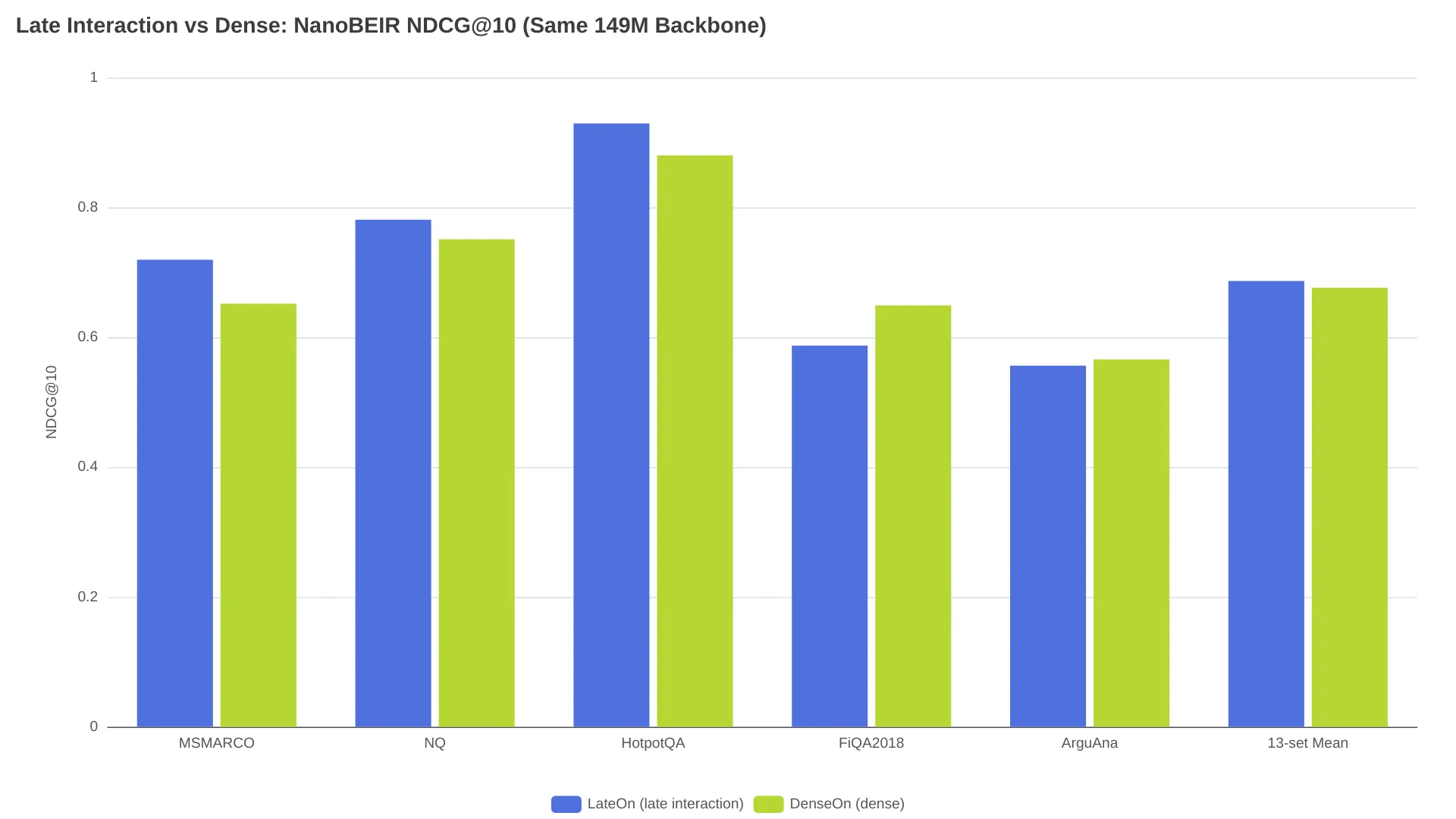
LateOn wins 9 of 13 NanoBEIR datasets and the mean, 0.6868 versus 0.6764 NDCG@10. On the full 15-dataset BEIR it is 57.22 versus 56.20. DenseOn still wins ArguAna, FiQA2018, SCIDOCS, and SciFact outright. That is the honest shape of the result: a meaningful average gain at identical model size, not a category upgrade.
After maintainer Tom Aarsen announced v6.0, developer @saen_dev asked the question practitioners kept repeating: "How does it benchmark against bi-encoders on domain-specific corpora?" (thread). The honest answer is about one point on average, with large gains concentrated on long documents - and Hugging Face's own launch post tells users to evaluate on their own retrieval task because the gains vary per dataset.
The Storage Bill: 42x Before Compression
Hugging Face's worked example sizes an index over 4,874 Natural Questions passages. lightonai/LateOn produces 608,414 token vectors from them - 124.8 vectors per passage on average.
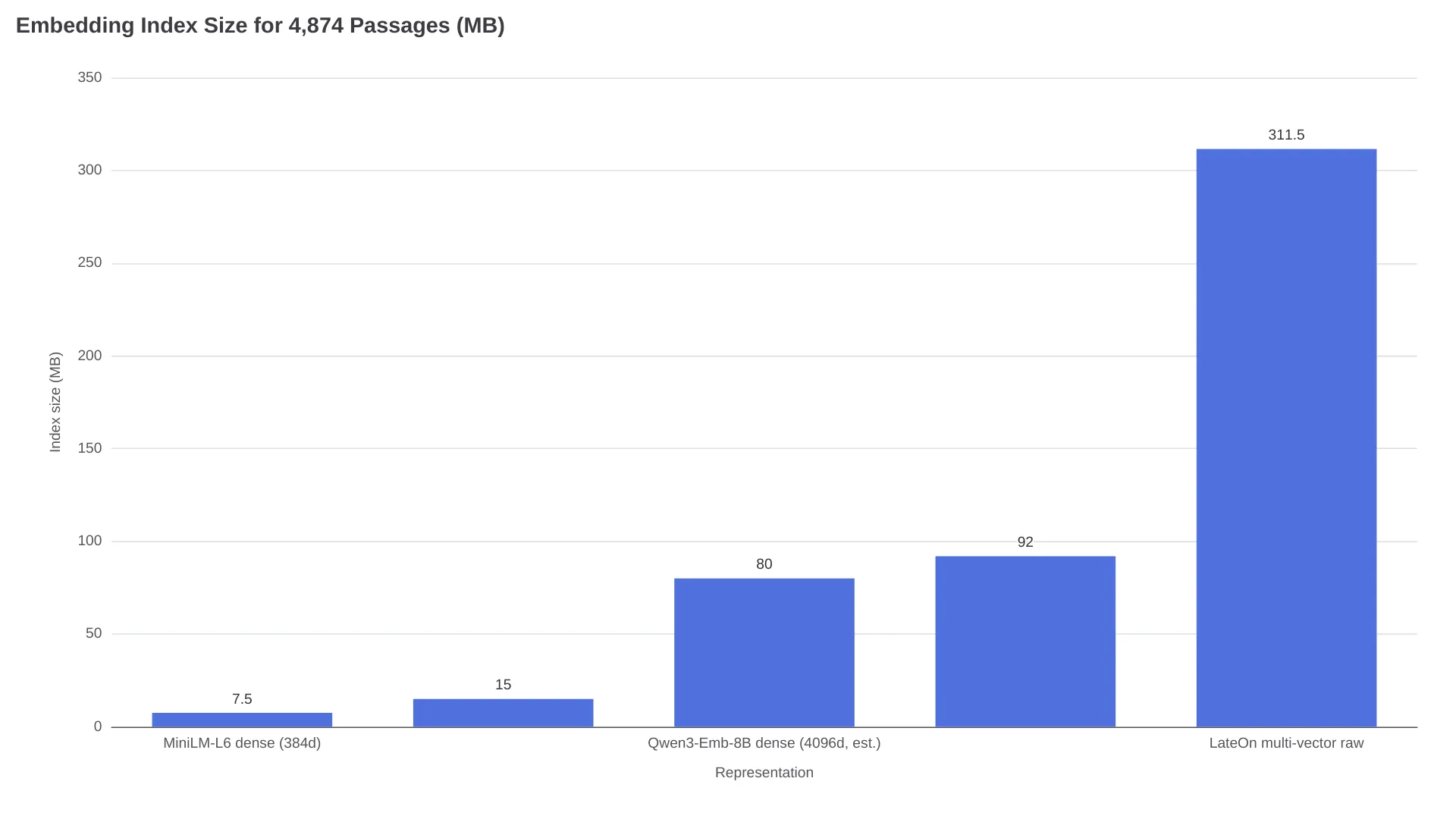
The raw float32 multi-vector index is 311.5 MB. The same passages under all-MiniLM-L6-v2 dense need 7.5 MB - a 42x gap, or 62 KiB per passage. Against gte-modernbert-base, a same-class 768-dimensional dense model, the gap is 21x (15 MB). TopK quotes a 10–100x range depending on document length and precision, and estimates thousands of times more scoring work per query than a single-vector comparison.
The day of the release, one developer put the production concern bluntly:
Token pooling is the part that decides if this ships. Late interaction usually dies on index size and memory, not on accuracy. - @JudeJobs on X
For scale: a 4,096-dimensional Qwen3-Embedding-8B dense index over the same corpus runs about 80 MB, near the 92 MB compressed late-interaction index below.
Three Ways to Shrink It
1. Token pooling. Sentence Transformers v6.0 ships HierarchicalTokenPooling, which clusters document token vectors with Ward linkage on cosine distance and replaces each cluster with its mean. Pooling defaults to documents only, since queries are short and distortion-sensitive. On the 608,414-vector corpus:
| Pool factor | Token vectors | float32 index | Reported retrieval retention |
|---|---|---|---|
| 1 (none) | 608,414 | 311.5 MB | 100% |
| 2 | 305,438 | 156.4 MB | 100.6% |
| 3 | 204,407 | 104.7 MB | 99.0% |
| 4 | 153,936 | 78.8 MB | ~98% trend |
Pooling ran in about 6 seconds for the full corpus. LightOn's regularized variant reports 99.4% quality at 5x compression in Hugging Face's post, though Hugging Face notes training with that regularizer is not yet integrated into the library as of the v6.0 release.
2. Compressed indexes. A fast-plaid (Rust PLAID) index of the same vectors occupies 92 MB, built in 5 seconds, answering in 11 ms on an RTX 3090 + i7-13700K. It is approximate - top scores drifted from 11.92 to 11.88 in Hugging Face's test - but the ranking held. Weaviate's MUVERA made ingestion 3x faster and queries 1.8x faster, though it dropped one correct result out of the top 50 in their test corpus.
3. Quantization and inference tuning. Qdrant's experiments with uint8 scalar quantization on token embeddings cut memory 4x while SciFact NDCG@10 moved from 0.70724 to 0.70297 - negligible. Hugging Face reports fp16 plus Flash Attention delivers 2.44x the fp32 encoding throughput with no measured quality loss, with int8 on CPU costing about 0.4% accuracy.
Stack pooling at factor 2–3 with a compressed index and the effective gap to dense shrinks from 42x to single digits, at the cost of two more knobs to tune.
Reranker-First Is the Default Architecture
Exhaustive MaxSim scored all 4,874 documents in 98 ms (122.7 ms end-to-end) on a single RTX 3090 - perfectly fine for a few thousand documents, linear-cost disaster for millions. The three deployment guides compared here converge on the same shape: a cheap dense or sparse first stage retrieves candidates, late interaction reranks them.
- Hugging Face's example retrieves the dense top 50, then reranks with MaxSim - documents are encoded once in a batch and scored by matrix multiplication, far cheaper than a cross-encoder's per-pair forward pass.
- Qdrant, which has shipped native multi-vector support since v1.10, recommends late interaction primarily for reranking a few hundred candidates, not full scans.
- The Data AI Hub production guide recommends hybrid retrieval of the top 150, late-interaction reranking down to 20, then optionally a cross-encoder for the final 5 sent to the LLM.
The rerank-only pattern has one hard ceiling: it cannot recover documents the first stage missed. And the surrounding pipeline is anything but settled:
there is hardly a universally good chunking, retrieval and re-ranking strategy. - u/gamerx88, r/MachineLearning
Which Databases Support It (and How Well)
Hugging Face's launch post benchmarks the major engines on the same 4,874-passage corpus. Numbers below are their test results, not vendor marketing:
| Engine | Native multi-vector since | Ingest / query (their test) | Caveats |
|---|---|---|---|
| Qdrant | v1.10 | 26.3 s / 18 ms | Exact MAX_SIM; server recommended |
| Weaviate | v1.29 | 41 s / 17 ms | MUVERA faster but dropped a correct result; no embedded mode on Windows |
| Vespa | "for years" | ~80 s / 75 ms warm | MaxSim as tensor expression; default second phase reranks only 100 candidates and missed 2 of the correct top 3 |
fast-plaid | - | 5 s / 11 ms | No server; approximate scores, ranking held |
| LanceDB | v0.15.0 | not benchmarked | Native MaxSim |
| Milvus | v2.6.4 | not benchmarked | Array-of-structs storage |
| VectorChord | - | not benchmarked | MaxSim operator for PostgreSQL |
| Elasticsearch / OpenSearch | - | - | Rescore-only; ES feature is a technical preview on the Enterprise tier |
turbopuffer's late-interaction indexing was listed as private beta in Hugging Face's comparison table.
What Sentence Transformers v6.0 Changes
Before August 18, 2026, running ColBERT-family models meant separate frameworks - PyLate, the Stanford ColBERT repo, or colpali-engine. Version 6.0 makes MultiVectorEncoder the library's fourth first-class model type, with training, inference, and interpretability built in. It loads Sentence Transformers, PyLate, Stanford ColBERT, and ColPali checkpoints; a bare transformer loads too, but with a random projection that requires training. Requirements are transformers v5.x, torch 2.2+, and huggingface-hub v1.x.
Three footguns from the launch documentation:
- Queries and documents are asymmetric.
encode_query()andencode_document()apply different prompts, length caps, and scoring masks. Calling a genericencode()on both is the fastest way to silently degrade results. - Truncation is silent. A 662-token passage sent through LateOn's 300-token document cap produced 273 vectors - the rest discarded. Raising the cap to 512 works but shifts the model away from its training distribution and grows the index.
- Flash Attention has exceptions. Models with non-attend query expansion, including
colbert-ir/colbertv2.0andanswerai-colbert-small-v1, need"sdpa"instead.
The supported-model menu spans two orders of magnitude, per Hugging Face's published scores:
| Tier | Example model (params) | Score (mean NDCG@10) |
|---|---|---|
| Edge text | mxbai-edge-colbert-v0-17m (17M) | 0.6407 NanoBEIR |
| Small text | answerai-colbert-small-v1 (33M) | 0.6550 NanoBEIR |
| Text leader | LateOn family (149M) | 0.6868–0.6897 NanoBEIR |
| Visual document | colqwen2.5-v0.2 (3.8B) / webAI-ColVec1.1-8b (8.4B) | 0.5402 / 0.6580 NanoViDoRe |
When Dense Single Vectors Are Still the Right Call
The failure mode to avoid is adopting multi-vector for workloads that do not need it. Skip it when queries are broad and topical ("articles about supply chains"), when texts are short (titles, FAQ pairs, tweets), when the task is clustering, deduplication, or recommendation - anything needing whole-item similarity - or when a dense-plus-reranker pipeline already meets your recall SLOs and the binding constraint is cost. Data AI Hub's guide adds: English-centric ColBERT checkpoints can underperform a multilingual bi-encoder-plus-reranker stack on multilingual corpora, and write-heavy, real-time corpora are a poor fit for token-level indexes.
Common Questions, Answered With Numbers
Can you use a regular dense model as a multi-vector model?
Sometimes, surprisingly well. Qdrant's experiments took the output token embeddings of BAAI/bge-small-en - a 33M dense model - and scored them with MaxSim: 0.73696 NDCG@10 on SciFact, beating colbert-ir/colbertv2.0 at 0.69579 and bge-small's own pooled vector at 0.68213. On ArguAna the order flipped and pooled dense won. A legitimate trick for adding a reranking stage without a new model, not a guarantee.
How much faster is a compressed multi-vector index?
On the 4,874-passage corpus: exhaustive MaxSim 98 ms versus fast-plaid 11 ms, at 92 MB instead of 311.5 MB.
Do multi-vector models replace cross-encoder rerankers?
On economics, yes: document representations are precomputed and scored with matrix multiplication instead of a forward pass per query-document pair. Hugging Face's launch post still ranks the cross-encoder as the most accurate option per pair, which is why demanding pipelines keep one for the final top 5–20.
Is late interaction worth it for RAG?
As a reranking stage over hybrid or dense candidates - the pattern all three deployment guides above recommend. As a first-stage retriever, only if measured first-stage recall is your failure mode and the token-vector index fits your budget.
The Decision Table
| Your workload | Recommendation |
|---|---|
| Identifier-heavy or multi-part queries, long documents, legal/technical text | Multi-vector retrieval or reranking - this is the +26-point MLDR territory |
| PDFs, scanned pages, tables, charts as page images | ColPali-family multi-vector; no OCR pipeline needed |
| Broad topical search, short texts, clustering/dedup/recsys | Dense single vectors; pooling losses are irrelevant here |
| Quality almost there, budget tight | Keep dense first stage, add MaxSim reranking of the top 50–150 |
| Millions of documents, cost-bound | Dense + cross-encoder reranker, or compressed late interaction (pooling factor 2–3 + fast-plaid) after measuring |
The unresolved trade-off @JudeJobs flagged: compression retention is measured on benchmarks, not on messy production corpora. Pool at factor 2, then let recall measured on your own data decide how far down the compression curve you go.