 AIREITER
MiniMax M3 and DeepSeek V4 Pro are close enough on quality that the deciding factor for most teams is cost — and cost flips depending on how your workload splits between input and output tokens. M3 has the cheaper input, DeepSeek V4 Pro the cheaper output, so the "cheaper" model changes with your usage pattern. M3 also reads images and video; V4 Pro is text-only. This comparison works through the price math first, because it's the part most head-to-heads skip, then covers where capability and speed break the tie.
The cost break-even nobody calculates
Both are open-weight Mixture-of-Experts models with a 1M-token context, priced per million tokens. The list prices (verified July 13, 2026) tell opposite stories on each side of the transaction:
MiniMax M3 | DeepSeek V4 Pro | |
|---|---|---|
Input / 1M | $0.30 | $0.43 |
Output / 1M | $1.20 (promo; $2.40 standard) | $0.87 |
Cached input / 1M | ~$0.06 | ~$0.0036 |
M3 wins on input, V4 Pro wins on output. So which is cheaper is a function of your output share — the fraction of your total tokens that are generated rather than sent in.
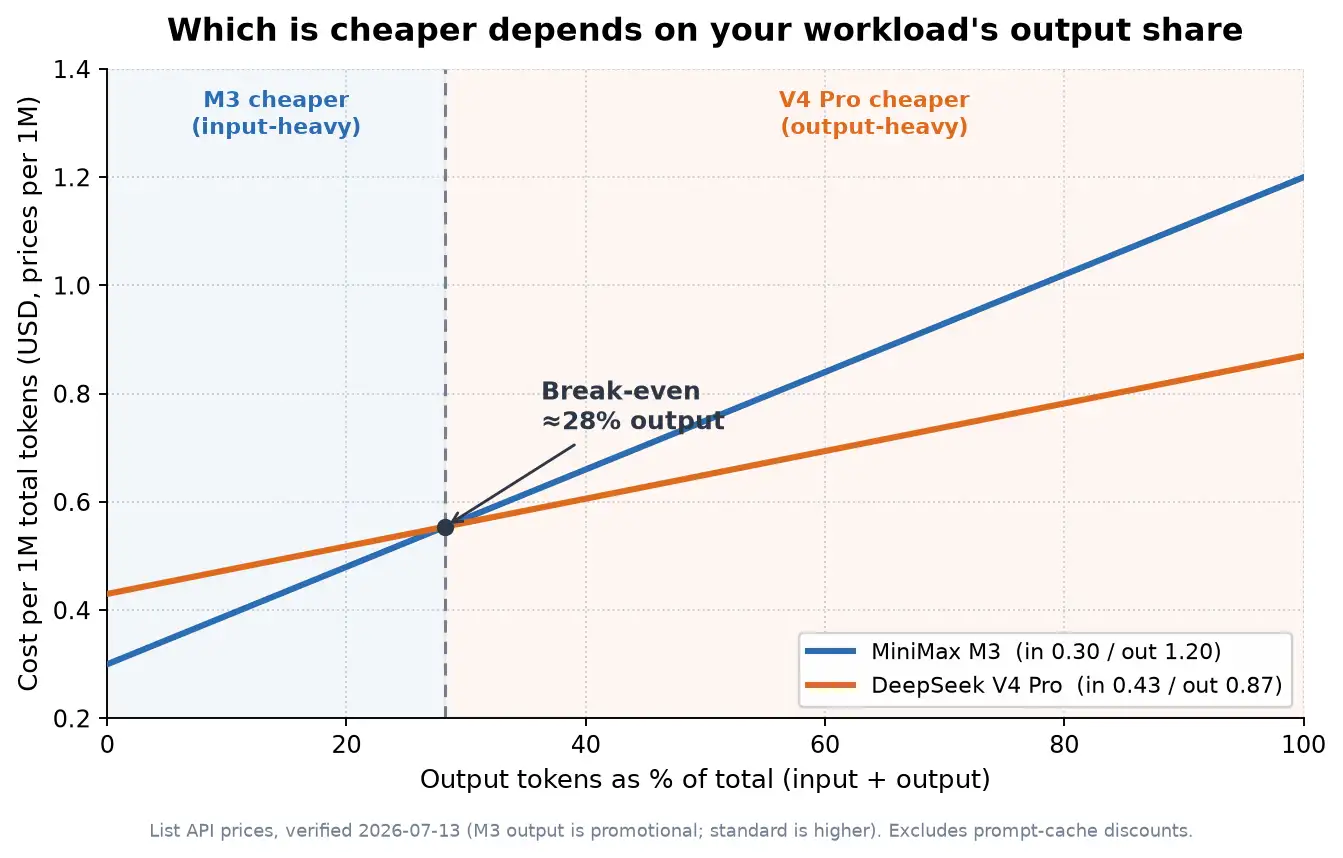
The math is simple enough to check yourself. For output share x (0 to 1), cost per million total tokens is M3 = 0.30(1 − x) + 1.20x and V4 Pro = 0.43(1 − x) + 0.87x; set them equal and the lines cross at x ≈ 0.28. Below that — input-heavy workloads — M3 is cheaper. Above it, V4 Pro is. In practice:
Input-heavy (M3 wins): retrieval-augmented generation, long-document analysis, agent loops that stuff large context in for short answers. These often run 10–20% output. M3 is the cheaper call.
Output-heavy (V4 Pro wins): content generation, long-form drafting, verbose reasoning traces. Once generation is more than about a quarter of your tokens, V4 Pro pulls ahead.
Where the price math shifts
Two caveats can move the break-even point:
Prompt caching favors DeepSeek, hard. Its cached input runs about $0.0036 per million against M3's ~$0.06 — roughly 16× cheaper. If you reuse the same long context across many calls (a fixed system prompt, a cached codebase, a RAG corpus), DeepSeek's cache pricing can flip an otherwise M3-friendly input-heavy workload back in its favor. Concretely: a RAG service that sends a cached 100K-token context with each 2K-token answer pays DeepSeek roughly $0.0036 × 0.1 + $0.87 × 0.002 ≈ $0.0021 per call, versus M3's $0.06 × 0.1 + $1.20 × 0.002 ≈ $0.0084 — about 4× more on M3, entirely because of the cache rate. Cache-heavy RAG is the one input-heavy case where V4 Pro is the cheaper call.
M3's output price is promotional. The $1.20 output rate is a promo; the standard rate is $2.40, which would push the break-even far lower and make V4 Pro cheaper for almost any workload with meaningful generation. Price this on the rate you'll actually be billed, not the promo.
Speed cuts the other way. M3 generates at roughly 45 tokens/sec versus about 21 for V4 Pro — close to 2× faster. For interactive or latency-sensitive products, that throughput can be worth more than a per-token discount, and it reduces the concurrency you need to provision.
Beyond price: capability, speed, modality
Cost only matters if both models clear your quality bar. Here they diverge in ways a price table hides.
Coding benchmarks. M3 reports 59.0% on SWE-Bench Pro and 93.5% on LiveCodeBench; V4 Pro lands around 52–55% on SWE-Bench Pro. One caveat matters for trust: M3's figures are vendor-reported, while V4 Pro's tend to be independently verified. M3 looks stronger on paper, but "vendor-reported vs independently verified" is exactly the gap you'd want to test on your own tasks before committing.
Size vs efficiency. V4 Pro is far larger — 1.6T total parameters (49B active) against M3's 428B total (23B active). M3 scoring higher on coding while activating half the parameters is the more efficient result, which is part of why its per-token pricing can go so low.
Modality. M3 is natively multimodal: it takes image and video input alongside text. V4 Pro is text-only. If your pipeline touches screenshots, documents-as-images, or video frames, this isn't a tiebreaker — it's the whole decision.
Ecosystem. DeepSeek is the more mature option to deploy, available across roughly 14 inference providers; M3 launched with far fewer. If provider redundancy or shopping for the cheapest host matters to you, V4 Pro has the edge today. Both publish open weights — M3's are on Hugging Face, and DeepSeek distributes V4 Pro through its own channels and partner hosts — though large-scale self-hosting of either needs multi-GPU hardware.
Which to pick, by workload
Choose MiniMax M3 if your workload is input-heavy (RAG, long-context analysis, agent orchestration), if you need image or video input, or if generation speed matters. It's also the simpler call when you want one strong model rather than a provider-shopping exercise.
Choose DeepSeek V4 Pro if your workload is output-heavy, if you lean on prompt caching for repeated context, if you want independently verified benchmark scores, or if you value a mature multi-provider ecosystem. Its lighter V4 Flash tier (284B total, 13B active) is worth a look if you want DeepSeek economics on simpler tasks.
For most teams the honest answer is to route by task: input-heavy and multimodal jobs to M3, output-heavy and cache-heavy jobs to V4 Pro. Neither is a blanket winner.
What's next
MiniMax isn't standing still: reporting points to a much larger successor, with the rumored MiniMax M3 Pro said to reach 2.7 trillion parameters and target Q3 2026. If it ships with open weights, the comparison above resets — a 2.7T M3 Pro would be aimed at a different tier than V4 Pro. For now, both M3 and V4 Pro are shipping models you can call today.
FAQ
Is MiniMax M3 cheaper than DeepSeek V4 Pro?
It depends on your output share. M3 has cheaper input ($0.30 vs $0.43 per 1M) and DeepSeek cheaper output ($0.87 vs $1.20). They break even at roughly 28% output; below that M3 is cheaper, above it V4 Pro is.
Which is better for coding?
M3 reports higher coding benchmarks (59.0% SWE-Bench Pro vs ~52–55%), but its scores are vendor-reported while V4 Pro's are independently verified. Test both on your own repository before deciding.
How many parameters does DeepSeek V4 Pro have?
1.6 trillion total with 49B active per token, versus M3's 428B total and 23B active. V4 Pro is much larger; M3 is more parameter-efficient.
Does DeepSeek V4 Pro support images or video?
No. V4 Pro is text-only. MiniMax M3 is natively multimodal and accepts image and video input.
Are both models free and open source?
Both publish downloadable open weights, but their licenses differ — M3 follows MiniMax's M2.7 terms, which default to non-commercial use, so check each model's license before commercial deployment. "Open weight" means downloadable, not automatically unrestricted.