 AIREITER
MiniMax H3 Max API pricing looks inexpensive at the clip level, but a 24-hour stream changes the calculation completely. fal bills H3 Max by output second; retries, queueing, storage, and service orchestration sit outside that headline rate.
A 24-hour stream is a pipeline, not a model feature
A continuous 24-hour output contains 86,400 seconds of video. At the listed 768P H3 Max rates, producing that much footage would cost $3,456 during the launch promotion or $6,912 at the regular rate, before retries, storage, audio handling, and delivery infrastructure.
fal describes H3 Max as a clip-generation API with Playground, Agent, and API access; its materials do not promise a 24-hour mode, uninterrupted output, or a streaming SLA. A “24-hour AI TV” project should be budgeted as an application that repeatedly requests short clips.
If the application renders five-second clips, 24 hours requires 17,280 completed clips. At 768P, each clip costs $0.20 at launch and $0.40 at the regular rate. Completed retries or discarded takes can add to the total.
What MiniMax H3 Max actually is
MiniMax H3 Max is fal’s post-trained variant of the open-weights MiniMax H3 video model, not a new price tier inside MiniMax’s own API. fal says it tuned the model for prompt adherence, aesthetics, and throughput, then made it available through the fal Playground, fal Agent, and API on August 27, 2026. (fal’s launch announcement)
fal’s minimax/h3-max/text-to-video and MiniMax’s standard H3 API are separate products, so MiniMax H3 rates cannot automatically be applied to H3 Max.
| Question | H3 Max on fal | Standard MiniMax H3 |
|---|---|---|
| Provider | fal | MiniMax API Platform |
| Product relationship | fal post-trained H3 variant | MiniMax’s own H3 API |
| Listed video rates | 480P and 768P | 768P and 2K |
| Main access path | fal Playground, Agent, and API | MiniMax API platform |
| Best-supported pricing use | Fast hosted clip budgeting | Official MiniMax H3 output budgeting |
| 2K price in the reviewed official listing | Not listed for H3 Max | $0.13 per output second |
fal’s model page labels the endpoint for commercial use and exposes controls for duration, resolution, aspect ratio, and prompt expansion. Those controls show how to submit a clip; they do not establish a continuous-service guarantee.

MiniMax H3 Max API pricing, in plain numbers
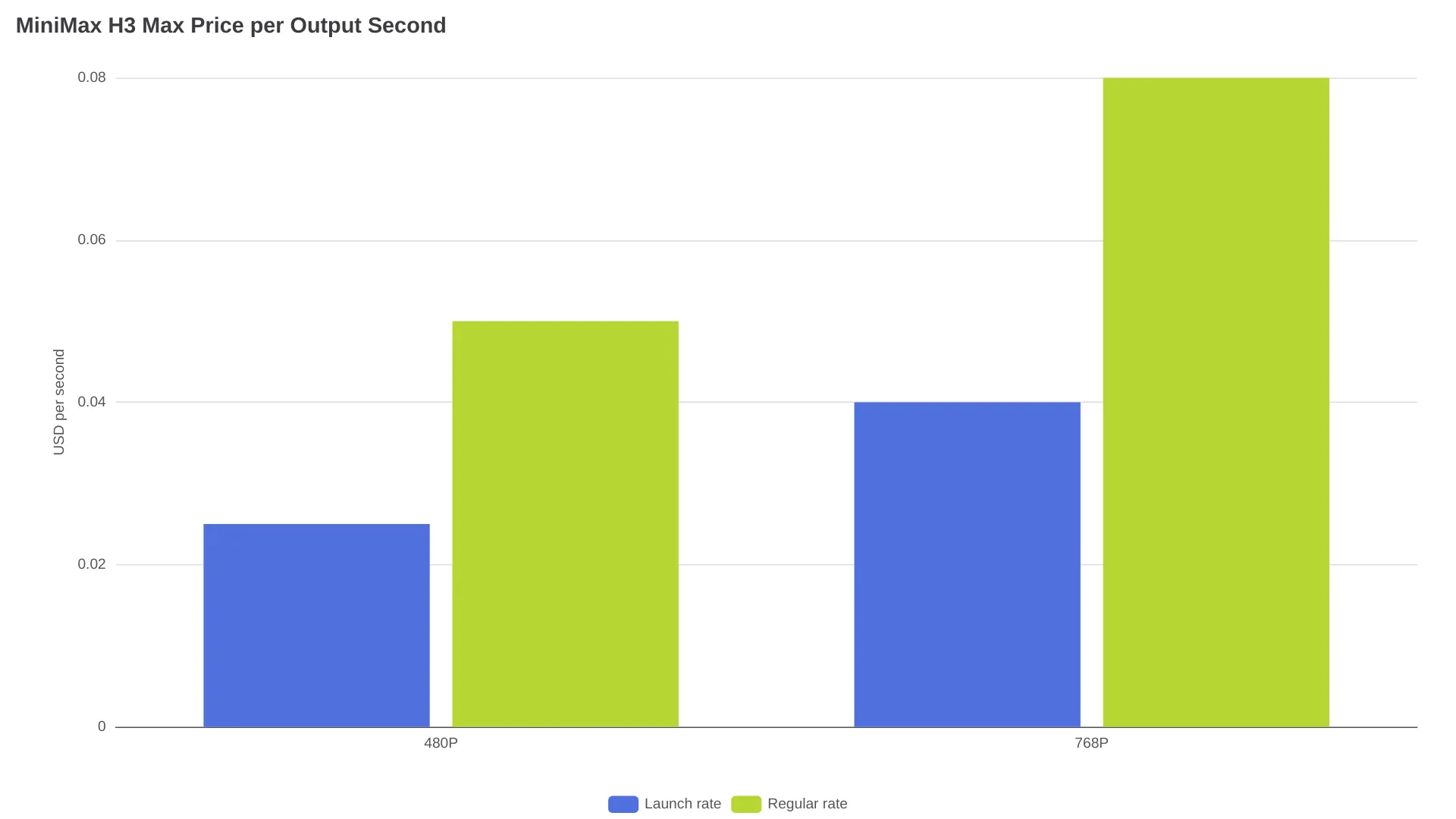
The fal pricing page reviewed for this article lists H3 Max at $0.025 per second for 480P and $0.04 per second for 768P during the launch promotion. It lists regular rates of $0.05 and $0.08 respectively. fal’s announcement describes the discount as 50% off for the first week, so the launch prices should not be treated as permanent production assumptions. (fal H3 Max API page)
| Output | Launch rate | Regular rate | 5-second clip | 10-second clip | 15-second clip |
|---|---|---|---|---|---|
| 480P | $0.025/sec | $0.05/sec | $0.125 / $0.25 | $0.25 / $0.50 | $0.375 / $0.75 |
| 768P | $0.04/sec | $0.08/sec | $0.20 / $0.40 | $0.40 / $0.80 | $0.60 / $1.20 |
Clip prices are rate × duration; slash-separated values show launch first and regular second, excluding separate input, account, or application costs.
The launch discount is temporary
fal’s announcement says H3 Max was offered at 50% off for the first week. At review time, the model page listed September 1 as the promotion end date, but the date and rate can change with the provider’s billing configuration. Check the live fal page before creating a production budget.
Keep promotional and regular rates in separate spreadsheet columns. If a workflow works only at $0.04 per 768P output second, it has not been proven viable at the listed regular rate of $0.08.
What a 24-hour output would cost on paper
| Scenario | Rate | 86,400 output seconds | Arithmetic total |
|---|---|---|---|
| 480P launch | $0.025/sec | 86,400 | $2,160 |
| 480P regular | $0.05/sec | 86,400 | $4,320 |
| 768P launch | $0.04/sec | 86,400 | $3,456 |
| 768P regular | $0.08/sec | 86,400 | $6,912 |
These totals assume every generated second becomes usable exactly once. They exclude retries, rejected generations, clip stitching, CDN delivery, audio continuity, and the cost of keeping a worker online for a full day.
The costs the per-second rate does not answer
The published H3 Max rate covers output duration, but not every cost a continuous application creates. A five-second generation and a 24-hour service have different failure surfaces.
- Retries and discarded takes: The reviewed official fal pages do not state a universal failed-generation billing rule. Treat each completed retry as potentially billable until the account’s terms or support response confirms otherwise.
- Queue time: fal reports approximately three seconds to generate a five-second video in its launch material, but one result does not guarantee batch throughput. Queue depth, concurrency, and account limits can change completion time. (fal’s launch announcement)
- Prompt expansion: The fal page exposes prompt-expansion modes. Measure preprocessing latency separately from inference when the application is trying to maintain a live cadence.
- Input media: The H3 Max page does not provide a complete input-media billing table in the retrieved product copy. Do not copy MiniMax H3’s image or video-input rules into an H3 Max estimate without confirmation.
- Audio continuity: A clip with generated sound is not the same as a continuous audio track. A 24-hour system needs a plan for transitions, repeated voices, silence, and synchronization.
- Storage and delivery: 17,280 five-second clips create 86,400 seconds of output files. Object storage, transcoding, stitching, and CDN delivery are outside the model’s per-second generation price.
For comparison, MiniMax’s official H3 pricing page lists $0.08 per second for 768P and $0.13 per second for 2K output. It also lists separate input-material rules, including free audio input and charges for image or video references. Those numbers help budget standard MiniMax H3, but they are not evidence of H3 Max billing rules. (MiniMax official pricing)
What real users are questioning about H3 Max
Community discussion shows why access and pricing are easy to conflate. In a Reddit discussion about H3 Max, user u/DrKyoumasaur221 focused on hosted access:
“Hope I'm wrong, but apparently it's only available via API as of right now.” (Reddit, r/StableDiffusion)
That is a user observation; confirm the endpoint, account limits, and current billing with the provider before treating fal H3 Max and standard MiniMax H3 as interchangeable.
H3 Max or MiniMax H3 for your workflow?
H3 Max fits a hosted workflow that values rapid 480P or 768P iteration through fal. Standard MiniMax H3 is the clearer reference when the requirement is MiniMax’s official API, 2K output pricing, or a broader H3 workflow documented by MiniMax. The choice is driven by endpoint and output requirements, not by treating “H3 Max” as a universal replacement name.
| Choose this path | When it fits | What to verify first |
|---|---|---|
| H3 Max on fal | Hosted text-to-video or image-to-video iteration at 480P/768P | Current rate, concurrency, prompt-expansion latency, and retry billing |
| Standard MiniMax H3 | The official MiniMax API or a 2K budget | Current API schema, input-material charges, task limits, and output availability |
| A short prototype first | A stream concept or prompt loop is untested | Completed-clip cost, usable-clip rate, queue time, and storage growth |
For the standard H3 route, the MiniMax H3 model page on AIReiter provides a separate hosted reference. It should not be read as an H3 Max endpoint unless the model identifier is explicitly shown.
A safer way to budget a live-video prototype
Use a completed-clip budget before committing to continuous runtime. A small prototype can expose the variables that a per-second estimate hides.
- Start with five-second clips. Budget $0.125 or $0.25 for 480P, and $0.20 or $0.40 for 768P, depending on the active rate.
- Record submitted and usable clips. The important ratio is usable output seconds divided by completed attempts.
- Test the queue at intended concurrency. A single Playground result cannot establish batch throughput. Measure completion time across the parallel jobs the application will use.
- Add storage and delivery separately. Keep generation, stitching, object storage, CDN, and monitoring as separate budget lines.
- Scale only after the retry rate is known. If one usable five-second clip requires two completed attempts, treat that as a two-attempt scenario and double the model-generation line before scaling to hours.
A simple production worksheet is:
model cost = completed output seconds × provider rate
retry allowance = model cost × observed discarded-take ratio
24-hour generation estimate = 86,400 × provider rate × retry multiplier
full service budget = model cost + retry allowance + storage + delivery + operations
MiniMax H3 Max API pricing FAQ
How much does a 5-second MiniMax H3 Max clip cost?
At the listed launch rates, a five-second clip costs $0.125 at 480P or $0.20 at 768P. At regular rates, the same clips cost $0.25 and $0.40.
How much would 24 hours of H3 Max output cost?
The dedicated 24-hour table above gives the four arithmetic totals. They exclude retries, queueing, storage, stitching, and delivery.
Is H3 Max the same as MiniMax H3?
No. fal describes H3 Max as a post-trained MiniMax H3 variant served through fal, while MiniMax’s official pricing page lists its own H3 API. Their model IDs, access paths, and published pricing should remain separate.
Does H3 Max have a 2K API price?
The fal H3 Max pricing page reviewed here lists 480P and 768P rates, not a 2K H3 Max rate. MiniMax’s official page lists standard H3 at $0.13 per 2K output second; that is not a verified H3 Max price.
Is the H3 Max launch discount permanent?
No. fal’s launch announcement describes 50% off for the first week, and the model page listed September 1 as the promotion end date at review time. Use the regular rate in a long-term budget unless the live billing page confirms a new promotion.
Is there an official 24-hour H3 Max live-stream product?
No continuous product or uptime promise appears in the official fal materials reviewed here. Treat a 24-hour stream as an application that repeatedly generates and assembles short clips, not as a built-in model mode.
Can I access H3 Max through the standard MiniMax H3 endpoint?
The sources reviewed expose H3 Max through fal’s model/API page and standard H3 through MiniMax’s official platform. Use the exact provider endpoint and model ID shown in the account documentation rather than substituting MiniMax-H3 for the fal H3 Max path.