 AIREITER
MiniMax H3 is the multimodal video model MiniMax showed at WAIC 2026. It takes text, images, video, and audio as input and returns a clip up to 15 seconds long in native 2K, with the sound generated in the same pass. It is not the M3 language model that keeps showing up in search results for it. The pitch is not the sharpest frames on the market (Kling already ships native 4K); it is 2K plus audio plus heavy reference control at $0.13 per generated second, roughly a quarter of Sora 2 Pro's rate.
One thing tempers that. The weights went public on July 28, 2026, but what you can download is H3-Base, which tops out at 768p; the 2K pass and the input-processing layer that MiniMax calls critical to output quality both stay on its servers. Self-hosting gets you most of H3, not the version the marketing describes.
What MiniMax H3 is (and why it isn't M3)
MiniMax H3 comes from Shanghai-based MiniMax (稀宇科技), the company behind the Hailuo video line, and carries a "Next-Generation Open-Weights" label with a July 2026 date on the official site.
The model it keeps getting confused with is M3, a ~428-billion-parameter (23B activated) language and coding model with a 1-million-token context, whose weights are on HuggingFace alongside H3's. M3 is text; H3 is video. They launched at the same WAIC 2026 event, which is why Google's "People Also Ask" answers an H3 query ("Is MiniMax 3 free?") with M3 facts. "Hailuo 3.0" is a third-party name; MiniMax's own site uses only "MiniMax H3," and it follows Hailuo 02 and Hailuo 2.3 in the same lineage.
MiniMax is not a newcomer, either: a January 2026 Hong Kong IPO raised roughly $619 million at around a $4 billion valuation, with Alibaba and Tencent among its backers.
Verified specs: 2K, 15 seconds, synced audio
On paper, H3 generates 4–15 second clips (integer lengths only) at native 2K and a fixed 24 frames per second, with stereo audio (dialogue, effects, and ambience) produced in the same pass rather than dubbed on later. A 768P tier is also priced. These figures come from MiniMax's API documentation, verified August 4, 2026.
| Spec | Value |
|---|---|
| Native resolution | 2K (768P tier available) |
| Clip length | 4–15 seconds |
| Frame rate | 24 FPS |
| Audio | native stereo, same-pass |
| First/last frame | 0, 1, or 2 images |
| Omni-reference | ≤9 images, ≤3 videos, ≤3 audio; 12 files max |
| Aspect ratios | 21:9, 16:9, 4:3, 1:1, 3:4, 9:16, plus adaptive |
| File limits | video ≤50MB, image ≤30MB, audio ≤15MB |
| Prompt length | up to 7,000 characters |
The "omni-reference" input is where H3 puts its complexity: up to nine images, three video clips, and three audio clips at once, used as style, character, motion, or voice guidance rather than forced keyframes. The same model handles lip sync, voice-timbre transfer, and instruction-based editing, swapping a character, object, background, or VFX element by describing the change instead of regenerating from scratch.
What H3 costs (verified, not rumored)
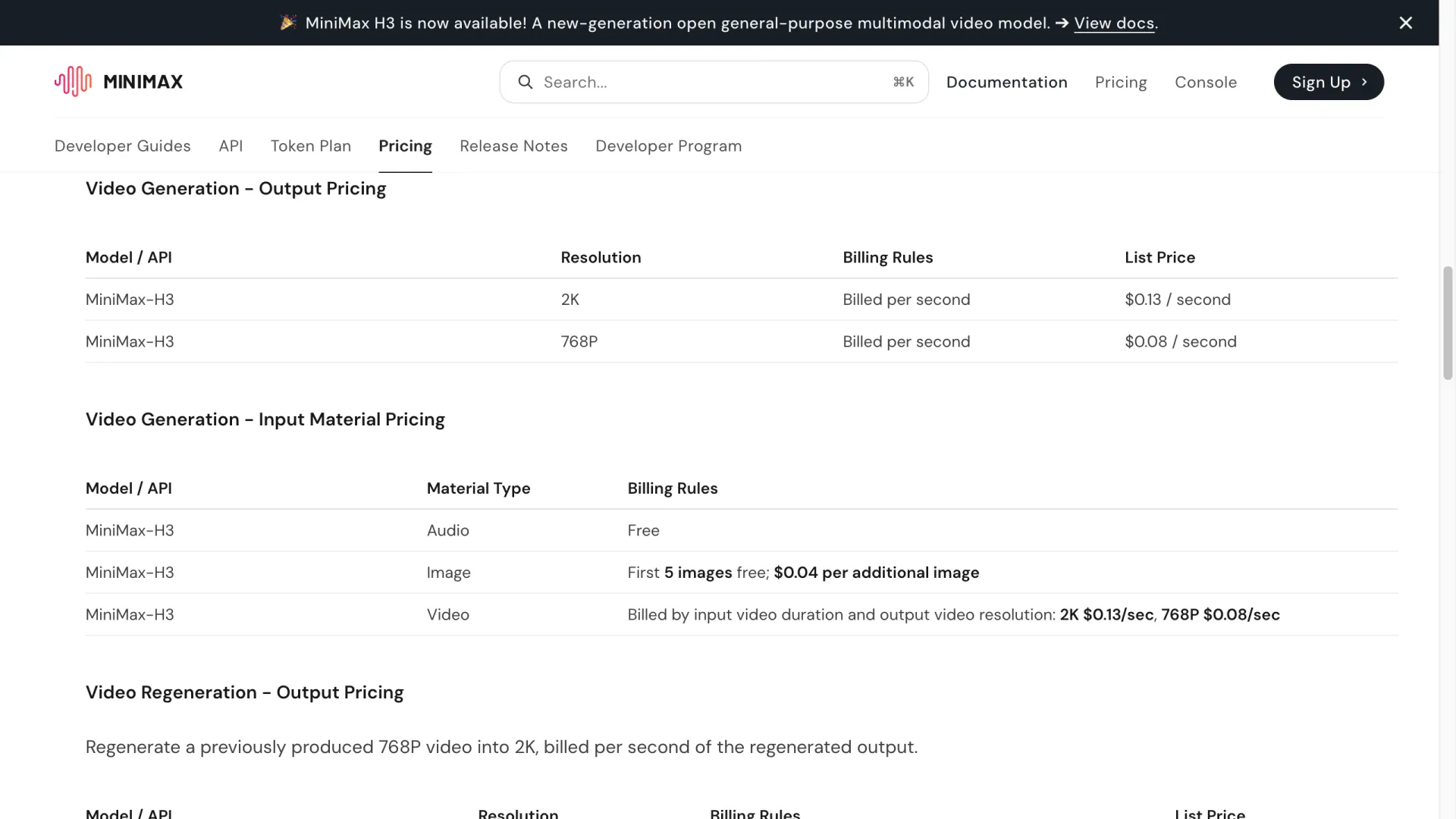
MiniMax publishes per-second rates on its pricing page: at 2K, H3 costs $0.13 per generated second; at 768P, $0.08. Audio input is free, the first five reference images are free, and each additional image is $0.04. Two line items sit outside that headline rate: regenerating a finished 768P clip to 2K is billed separately at $0.05/s and rebills the original inputs, and H3-Context-IR, the input-processing step MiniMax recommends running, is billed as tokens at $0.90/M in and $3.60/M out. Budget above $0.13/s, not at it. Verified August 4, 2026.
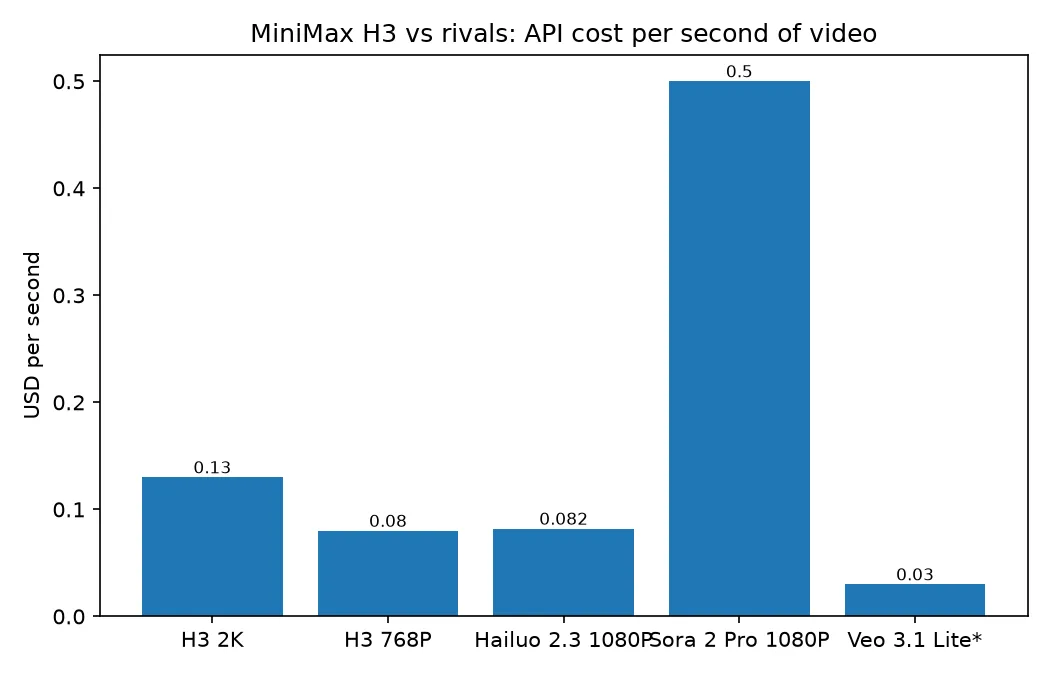
Against its own predecessor, the 2K tier costs more per second than Hailuo 2.3 at 1080P (about $0.082/s) while the 768P tier now undercuts it by a rounding error, and neither comparison is like-for-like: Hailuo 2.3 had no native audio and no omni-reference. Against the wider field, H3's per-second rate is where the value argument lives.
"At 2K, H3's per-second price is less than a third of mainstream models, and at 768p, it's less than half the price of mainstream models' 720p." — r/LocalLLaMA discussion
The numbers bear that out. H3 2K at $0.13/s is about a quarter of the ~$0.50/s that third-party aggregators report for Sora 2 Pro at 1080P. The one cheaper rival, Veo 3.1 Lite at roughly $0.03/s, omits audio entirely, so it is a different product; in the 2K-with-audio band H3 is the cheapest credible option.
H3 vs Veo 3.1, Kling 3.0, Seedance 2.0, Sora 2 Pro, and Hailuo 2.3
H3 does not lead on raw fidelity, and MiniMax does not pretend it does. Its pitch is the combination of 2K, native audio, generous reference control, and price: a control-and-audio play rather than a resolution play, given that several rivals already offer native 4K.
| Model | Resolution | Max clip | Audio | Reference control | API $/sec |
|---|---|---|---|---|---|
| MiniMax H3 | native 2K | 15s | native, same-pass | 9 img + 3 vid + 3 aud | $0.13 (2K) |
| Veo 3.1 | up to 4K | ~8s | 48kHz dialogue | limited | from $0.03 (Lite, no audio) |
| Kling 3.0 | native 4K | ~10s | yes | limited | varies |
| Seedance 2.0 | up to 1080P | 10s | yes | limited | varies |
| Sora 2 Pro | 1080P | up to ~25s | yes | limited | ~$0.50 (aggregator) |
| Hailuo 2.3 | 1080P | ~10s | not native | none | ~$0.082 |
Kling 3.0 and Seedance 2.0 have no published per-second API rate comparable to MiniMax's, so those cells read "varies"; the Sora figure is a third-party aggregator price, not an official OpenAI rate.
The spec sheet undersells where H3 landed. On Artificial Analysis's blind-preference arenas, checked August 4, 2026, H3 ranks first in Video Editing (Elo 1,130 over 8,223 votes), second in Text-to-Video with audio (1,234 over 6,077 votes, behind only Gemini Omni Flash), and third in Image-to-Video (1,187), where its confidence interval overlaps the top two. It is the highest-placed open-weights model on all three. In the same text-to-video ranking, Kling 3.0 1080p sits eighth at 1,109 and Veo 3.1 eleventh at 1,093: both above H3 on resolution, both below it on what viewers picked.
The practical split falls out of those rows. If you need native 4K, Kling 3.0 or Veo 3.1 are the alternatives. If audio is the priority, Seedance 2.0 is an audio-focused option. H3 is the lowest listed per-second option here for 2K footage with synced sound and multi-reference control. The field is also thinning: Sora's web and app shut down on April 26, 2026, with the API scheduled to end on September 24.
Is H3 open-weights?
Yes, with a caveat that decides whether self-hosting is worth it. The weights are public at MiniMaxAI/MiniMax-H3, ungated, under MiniMax's own H3 Community License rather than Apache or MIT, so read the license terms before commercial use. H3-Base ships as two BF16 checkpoints: FL2VA for text and first/last-frame work, Ref2VA for omni-reference work. The generator is a 33B dense single-stream transformer, and the text encoder is the full Qwen3-VL-32B.
Two modules are held back, and they are the ones the headline specs depend on. H3-Regenerate-2K, which produces 2K by regenerating H3's own 768p output in-context, is "not yet open-sourced" per the model card. H3-Context-IR, the hosted layer that parses multimodal instructions before generation, is excluded because it spans several hosted services, and MiniMax calls it "critical to the quality of the final output." Sparse-attention inference is also absent from the first release; local inference runs full attention.
The official reference deployment is four GPUs via SGLang, with vLLM, diffusers, and an official ComfyUI tutorial plus T2V and R2V workflow templates also supported. It is a genuine open release, and it is not the same product as the 2K API.
How to access MiniMax H3
H3 is reachable through MiniMax's own API (the video-generation-v2 endpoint) and the MiniMax Hub. There is no public waitlist gating it.
It is also on AIReiter as of August 2026, covering the same generation types the official API exposes: text-to-video, first/last frame, and reference-to-video. Self-hosting is the third route, at 768p and no per-second billing.
Where H3 still falls short
MiniMax H3's arena wins measure viewer preference between short clips, not whether the model survives a production edit, and the demo reels in circulation are vendor-supplied rather than independent tests. That gap is why each claim about H3's output quality here is attributed to a source rather than presented as measured.
Reported limitations from early-access coverage — character drift across cuts, unreliable dialogue, exact text and branding artifacts, limited fine-grained control, and early-access volatility — are typical of a model at this stage, and the reason one striking generation is not enough to choose a model. Keep failed clips as evidence alongside the good ones.
"I had early access to MiniMax's new H3 omni video model, and it is a positive surprise! I would rate it up there with VEO, Kling..." — creator-preview tester
FAQ
Is MiniMax H3 the same as M3?
No. H3 is a video generation model; M3 is a ~428-billion-parameter language and coding model. They launched at the same event and share a parent company, which is why search results mix them up.
Is MiniMax H3 open source?
The H3-Base weights are public on HuggingFace under MiniMax's own community license, not a standard open-source license. The 2K regeneration module and the Context-IR preprocessing layer are not released, so a local install generates at 768p.
How much does MiniMax H3 cost?
$0.13 per generated second at 2K and $0.08 at 768P through the official API, plus $0.05/s if you regenerate a 768P clip to 2K and token charges for the Context-IR step. Audio input is free and the first five reference images are free.
Can I use MiniMax H3 on AIReiter?
Yes. MiniMax H3 is on AIReiter as of August 2026, covering text-to-video, first/last frame, and reference-to-video.
Is H3 better than Veo or Kling?
Not on raw resolution — Kling and Veo offer native 4K. See the comparison table above: H3 trades 4K for same-pass audio and richer reference control at a lower per-second price.
When can I download H3 weights?
Now. H3-Base went up on HuggingFace on July 28, 2026. No date has been given for H3-Regenerate-2K, which is what a local install needs for 2K output.
The open question has moved: H3 is self-hostable today, but only the 768p half of it, and MiniMax has not said when the 2K module follows. Whether that gap is worth $0.13 a second depends on how much of your work ships at 2K.