 AIREITER
LTX-2.5 generates 10-second 720p video in 6.8 seconds via ComfyUI on 2× NVIDIA GB200, a sharp speed improvement over LTX-2.3. But its API costs more per second than the older model at every resolution. The speed jump is real; the price inversion is the catch.
What LTX-2.5 Changes
LTX-2.5, released August 11, 2026 by Lightricks, ships two model variants through its hosted API: Fast and Pro. The headline feature is Diffusion Fidelity Rendering - an adaptive compute pipeline that allocates rendering steps based on scene complexity rather than running a fixed step count for every frame. LTX claims this delivers faster generation without uniform quality loss, and early ComfyUI testers corroborate significant speed gains.
The 2.5 family also adds native multi-shot generation (continuity across cuts within a single output), stronger prompt adherence, and finer detail in textures, faces, and typography. These are vendor claims from the official model documentation; no independent benchmark scores have been published.
| Spec | LTX-2.5 Fast | LTX-2.5 Pro |
|---|---|---|
| Max resolution | 4K (3840×2160) | 1080p (1920×1080) |
| Frame rate | 24 fps, 48 fps | 24 fps |
| Text-to-video | Yes | Yes |
| Image-to-video | Yes | Yes |
| Audio-to-video | Yes | No |
| Retake / Extend / Reframe | No | No |
| Max single generation | ~20 seconds (24/25 fps) | ~10 seconds |
Despite its name, Pro is the more restricted variant: it caps at 1080p, drops audio-to-video, and lacks editing operations (retake, extend, reframe). Those endpoints remain exclusive to ltx-2-3-pro.
API Pricing by Resolution and Tier
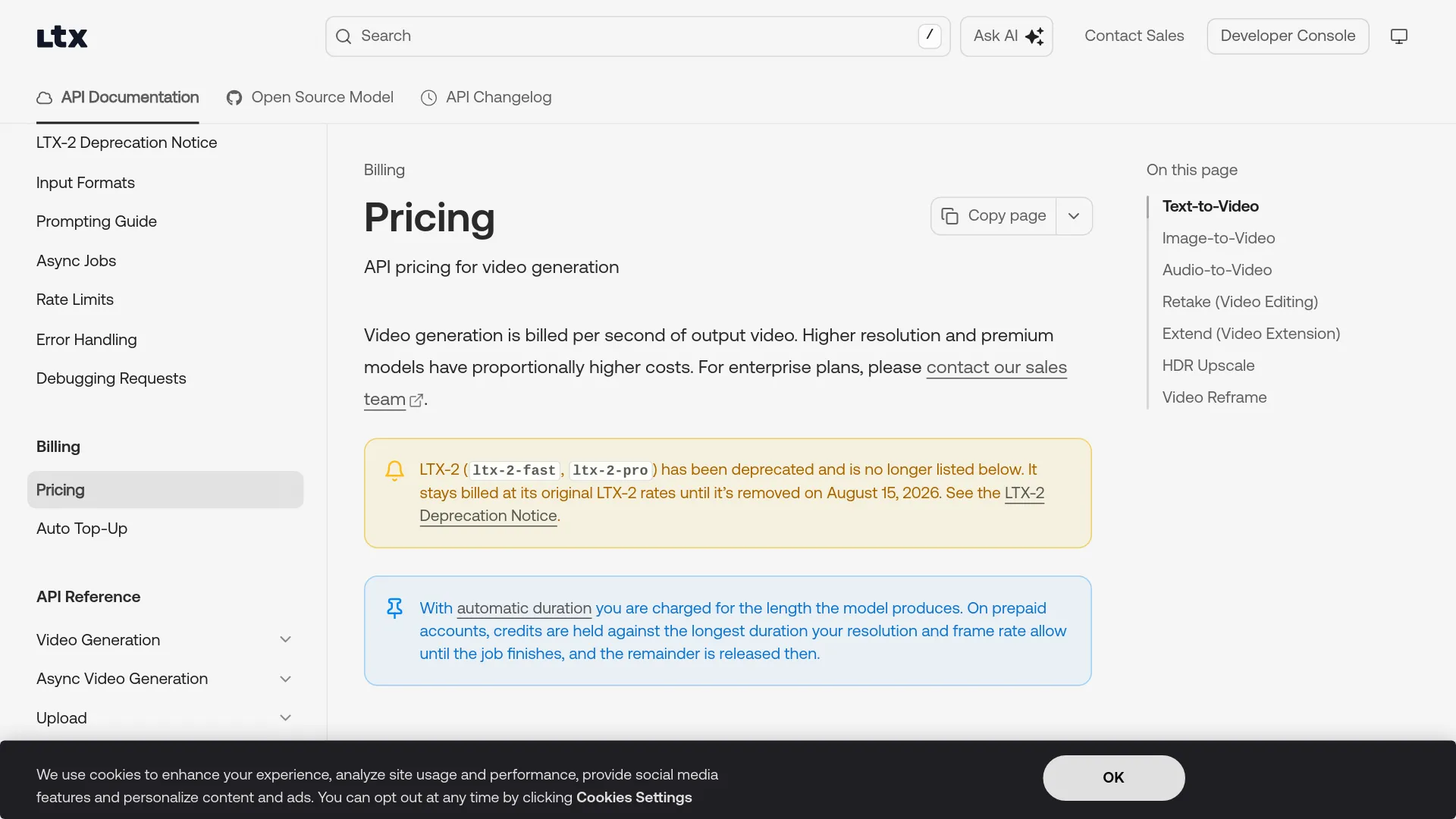
All LTX video generation is billed per second of output video, not per compute-minute. The official pricing page lists four model IDs across the 2.5 and 2.3 families. LTX-2.5 introduces higher per-second rates than its predecessor at every shared resolution.
LTX-2.5 Fast
| Resolution | Per second | Per 10-second clip |
|---|---|---|
| 720p (1280×720) | $0.09 | $0.90 |
| 1080p (1920×1080) | $0.13 | $1.30 |
| 1440p (2560×1440) | $0.19 | $1.90 |
| 4K (3840×2160) | $0.30 | $3.00 |
LTX-2.5 Pro
| Resolution | Per second | Per 10-second clip |
|---|---|---|
| 720p (1280×720) | $0.12 | $1.20 |
| 1080p (1920×1080) | $0.17 | $1.70 |
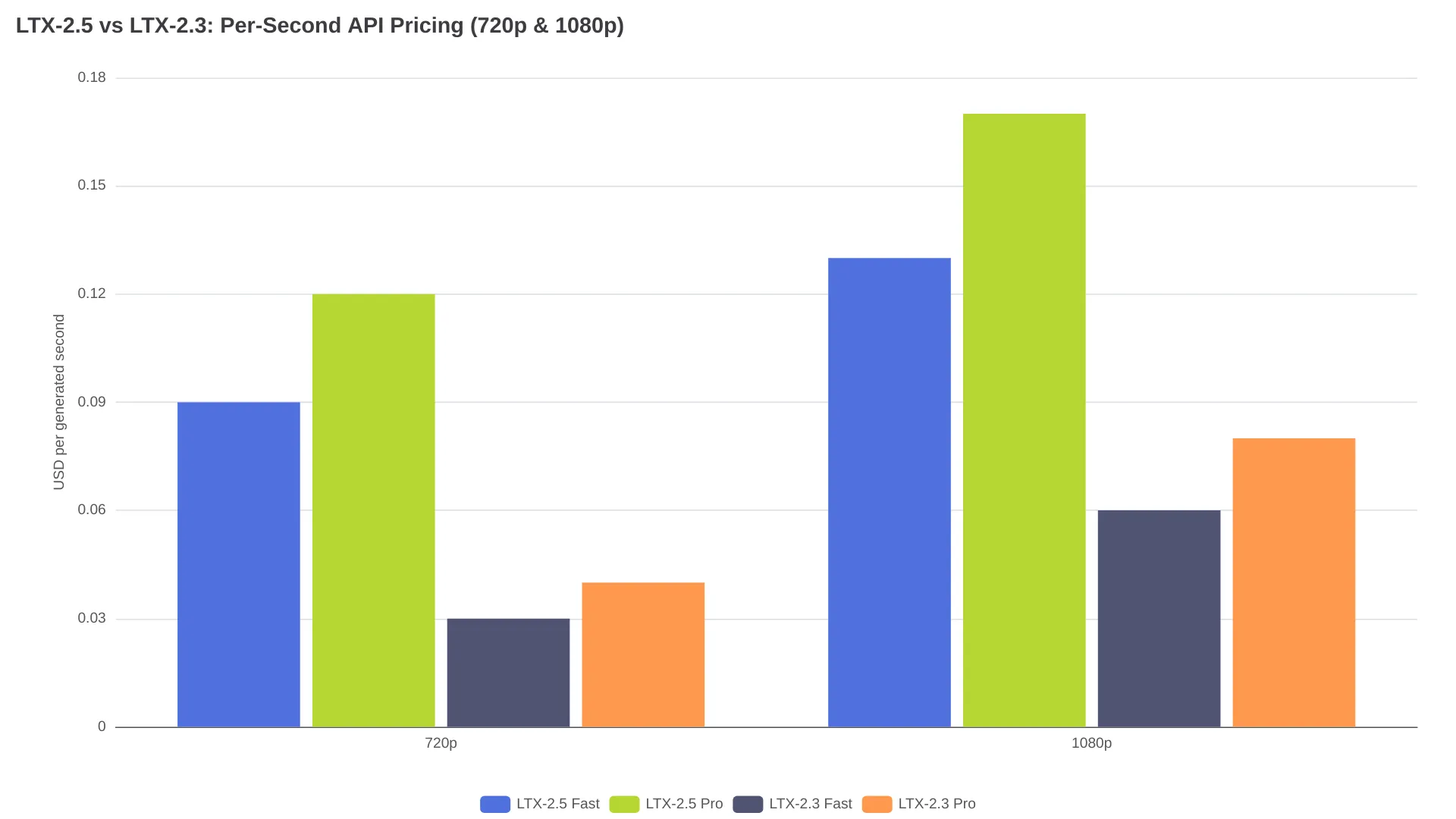
For comparison, here is how all four active models compare at the two resolutions where every variant is available:
LTX-2.5 vs LTX-2.3: When the Older Model Wins
The counterintuitive finding: LTX-2.3 is cheaper than LTX-2.5 at every resolution and tier. At 720p, LTX-2.3 Fast costs $0.03/s - one-third the price of LTX-2.5 Fast at $0.09/s. The gap narrows at 4K ($0.24 vs $0.30) but never closes.
| Resolution | LTX-2.3 Fast | LTX-2.5 Fast | LTX-2.3 Pro | LTX-2.5 Pro |
|---|---|---|---|---|
| 720p | $0.03 | $0.09 | $0.04 | $0.12 |
| 1080p | $0.06 | $0.13 | $0.08 | $0.17 |
| 1440p | $0.12 | $0.19 | $0.16 | - |
| 4K | $0.24 | $0.30 | $0.32 | - |
Beyond price, the endpoint compatibility gap is the bigger story. LTX-2.3 Pro is the only model that supports retake (regenerating portions of existing video), extend (adding frames to the beginning or end, capped at 505 billed frames), and reframe (aspect-ratio changes with generated fill). If your workflow involves editing rather than pure generation, LTX-2.5 offers no upgrade path - you need 2.3 Pro.
| Endpoint | ltx-2-5-fast | ltx-2-5-pro | ltx-2-3-fast | ltx-2-3-pro |
|---|---|---|---|---|
| Text-to-video | ✅ | ✅ | ✅ | ✅ |
| Image-to-video | ✅ | ✅ | ✅ | ✅ |
| Audio-to-video | ✅ | ❌ | ❌ | ✅ |
| Retake | ❌ | ❌ | ❌ | ✅ |
| Extend | ❌ | ❌ | ❌ | ✅ |
| Reframe | ❌ | ❌ | ❌ | ✅ |
When LTX-2.5 is the right pick: pure generation where prompt adherence and texture detail matter, especially multi-shot clips. When LTX-2.3 wins: editing workflows (retake/extend/reframe), budget-sensitive batch generation, and 4K Pro output (2.5 Pro stops at 1080p while 2.3 Pro reaches 4K).
How to Access LTX-2.5: API, ComfyUI, and Open Weights
Three access paths exist:
- Hosted API - Call
ltx-2-5-fastorltx-2-5-provia the model field in synchronous (v1/) or asynchronous (v2/) endpoints; see the official API reference for request format. Text-to-video and image-to-video support both sync and async. Audio-to-video on 2.5 Fast is async-only throughv2/audio-to-video. In LTX's launch materials, the managed API produced a 10-second image-to-video clip in 23.7 seconds at 1080p output.
- ComfyUI - LTX-2.5 has native ComfyUI integration with dedicated nodes for text-to-video, image-to-video, and Diffusion Fidelity Rendering. On 2× NVIDIA GB200 chips, a 10-second 720p clip generated in 6.8 seconds (LTX launch benchmark via IT之家). The hosted API took 23.7 seconds for a comparable task at 1080p output, but since resolutions differ, these are not directly comparable.
- Open weights - Model weights are available on HuggingFace (Lightricks/LTX-2) for self-hosting. Licensing is generous: organizations with annual recurring revenue under $10 million can use the model for free, including commercial use. Larger organizations need to negotiate a commercial license.
What Early Users Report
Two early Reddit threads capture the split reaction between speed enthusiasm and quality caution.
One ComfyUI tester reported a dramatic speed improvement:
"It was 400% faster." - comparing LTX-2.5 to LTX-2.3 for text-to-video generation (u/xdcfret1, r/comfyui)
The same user found output sharper and audio better-aligned than previous versions, but flagged persistent physics issues - in their demo video, a rider appeared to move backward after the first six seconds. They called it a "solid update" with "still much more to do."
A more critical post in r/StableDiffusion took a side-by-side approach:
"I can barely see the difference between 2.3 and 2.5." - u/PuppetHere, r/StableDiffusion
However, commenters in that thread pushed back, identifying better lip sync, cleaner audio (one said LTX-2.3 sounded like "an extremely low-bitrate MP3"), and more natural facial movement in the 2.5 clips. Some commenters suggested the improvements are most visible in talking-head and close-up scenarios, while complex physical interactions remain unreliable based on the demo videos shared.
A practical concern: LoRA and workflow compatibility is uncertain. Some LTX-2.3 LoRAs and IC-LoRAs partially work with 2.5, but results vary (r/StableDiffusion discussion). One user in the same thread reported zero usable results across 15 generations. ComfyUI users hit missing-node errors (GemmaAPITextEncode, LTXFloatToInt) that require fully updating ComfyUI.
LTX-2.5 vs Competing Video APIs on Cost
LTX's launch materials include a competitive pricing table ranking video models by per-second cost at 720p. LTX-2.5 Fast sits second-cheapest overall and is the only open-weights model in its price bracket.
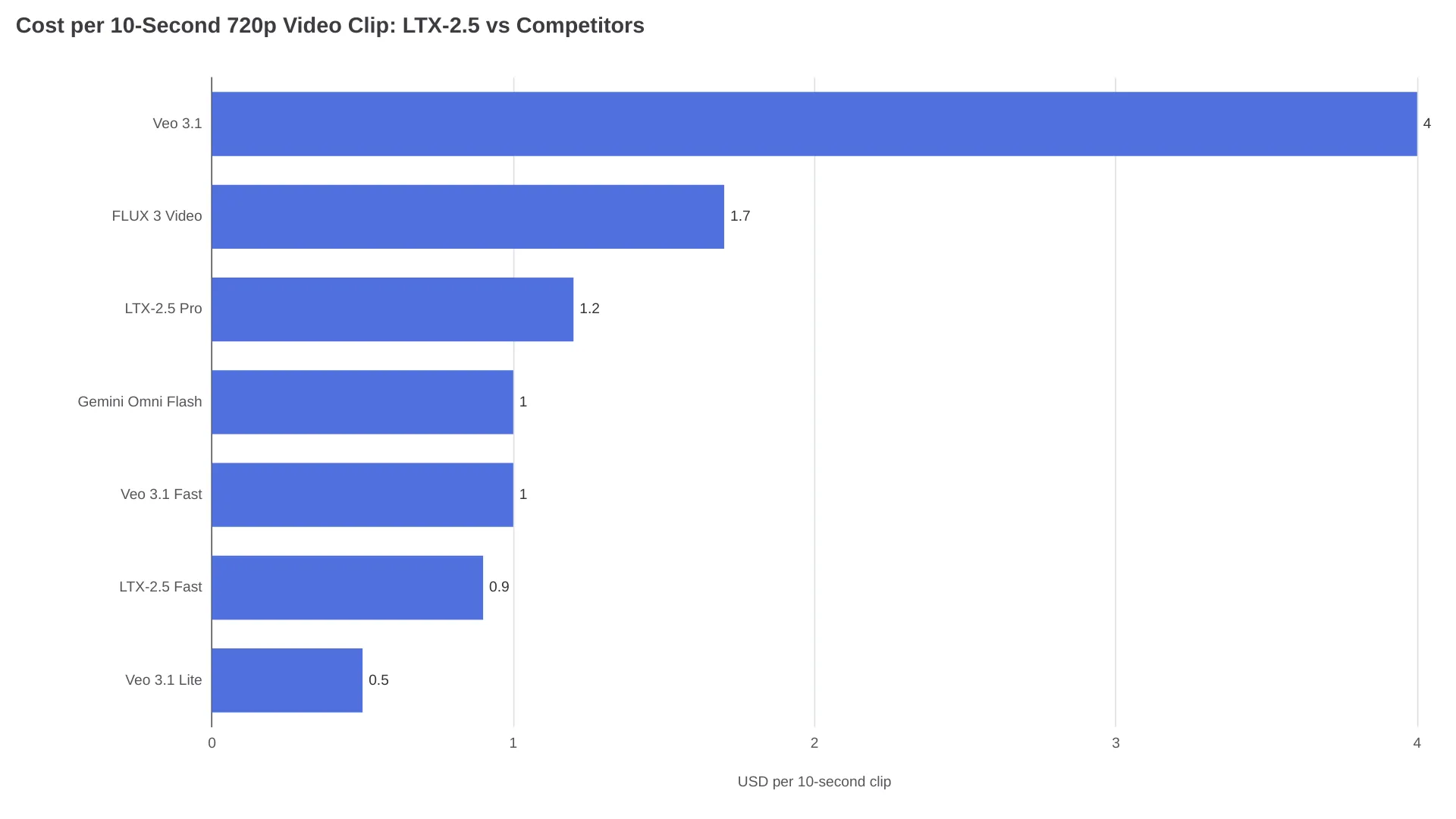
| Model | Per second (720p) | Per 10s clip | Key differentiator |
|---|---|---|---|
| Veo 3.1 Lite (Google) | $0.05 | $0.50 | Lowest price; no 4K, no clip extension |
| LTX-2.5 Fast (Lightricks) | $0.09 | $0.90 | Only open-weights option; scales to 4K at $0.30/s |
| Veo 3.1 Fast (Google) | $0.10 | $1.00 | Cheapest 4K closed-source path ($0.30/s) |
| Gemini Omni Flash (Google) | $0.10 | $1.00 | Top-ranked quality on Artificial Analysis; 720p only, 10s max |
| LTX-2.5 Pro (Lightricks) | $0.12 | $1.20 | Premium textures/typography; 1080p max |
| FLUX 3 Video (Black Forest Labs) | $0.17 | $1.70 | 20-second clips with audio; draft tier at $0.06/s |
| Veo 3.1 (Google) | $0.40 | $4.00 | Premium tier; 8× the Lite price |
Choose LTX-2.5 Fast when open weights or 4K matter; choose Veo 3.1 Lite when lowest 720p hosted cost matters.
For broader comparisons, see our LTX-2.3 vs MiniMax H3 analysis and the 2026 free AI video generator roundup.
FAQ
Is LTX-2.5 available through the hosted API?
Yes - both ltx-2-5-fast and ltx-2-5-pro are live with sync (v1/) and async (v2/) endpoints. See the access paths above for endpoint details.
Can I reuse LTX-2.3 LoRAs and workflows with LTX-2.5?
Partially. Some 2.3 LoRAs and IC-LoRAs produce results with 2.5, but quality varies and some workflows require updated ComfyUI nodes. See the user feedback section above.
Is LTX-2.5 free for commercial use?
Organizations with annual recurring revenue under $10 million can use the open-weights model commercially at no cost. Larger organizations must negotiate a commercial license with Lightricks.
What GPU do I need to self-host LTX-2.5?
LTX's benchmark used 2× NVIDIA GB200 for 6.8-second 720p generation. For 4K output or longer clips, substantially more VRAM is needed. The LTX-2 family includes FP8 and FP4 quantized variants on HuggingFace that reduce requirements, but no official minimum VRAM specification has been published for 2.5 specifically.