 AIREITER
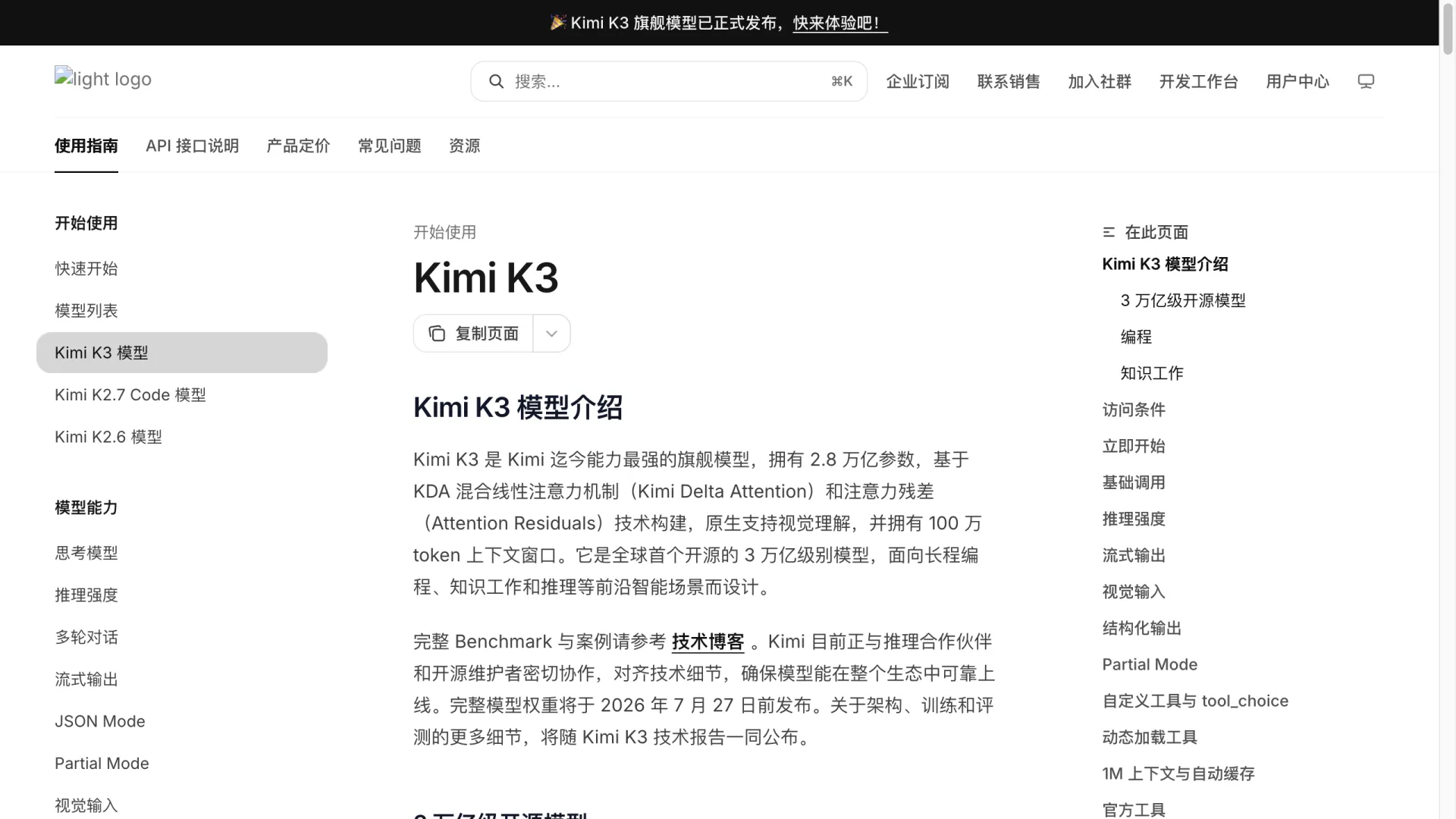
K3 is the better fit for very large, repeated prompts when cache hits are available. Claude Opus 5 fits agents that need built-in thinking controls. This article compares documented limits and integration behavior; it does not claim a quality winner without a same-prompt benchmark.
The short answer: choose by workload
Kimi K3 fits teams that need a one-million-token context window and cache-sensitive input pricing. Claude Opus 5 fits teams that prioritize default thinking and effort controls over maximum context size.
| Decision point | Kimi K3 | Claude Opus 5 | Better pick |
|---|---|---|---|
| Context window | 1,048,576 tokens | 200,000 tokens | K3 for very large inputs |
| Standard input price | ¥2/M cached; ¥20/M uncached | $5/M | K3 at the illustrative FX below |
| Standard output price | ¥100/M | $25/M | K3 at the illustrative FX below |
| Tool use | Tool calling and tool-choice controls are documented | Tool use is supported; disabling thinking has documented edge cases | Depends on tool schema and thinking setting |
| Access route | Kimi API | Claude API and listed cloud routes | Check your required provider |
Price and context change the economics
Kimi K3's official pricing page, checked August 7, 2026, lists ¥2 per million input tokens when the cache hits, ¥20 when it does not, and ¥100 per million output tokens. The same page lists a 1,048,576-token context window. That combination favors repeated long prompts, provided your application actually gets cache hits.
Claude Opus 5's official model documentation, checked August 7, 2026, lists a standard API price of $5 per million input tokens and $25 per million output tokens, plus a 200k context window.
As native-currency token arithmetic, a 180k-input / 8k-output request is ¥1.16 for K3 with a cache hit, ¥4.40 without one, and $1.10 for Opus 5 at standard rates. The request fits Opus 5's context window; actual billing depends on your contracted FX, cache eligibility, and billed output.
Tool calling and thinking are the integration fault line
Kimi's K3 API documentation explicitly covers tool calling, tool choice, dynamic tool loading, JSON mode, and structured output. These controls matter for schema-constrained and tool-routed applications.
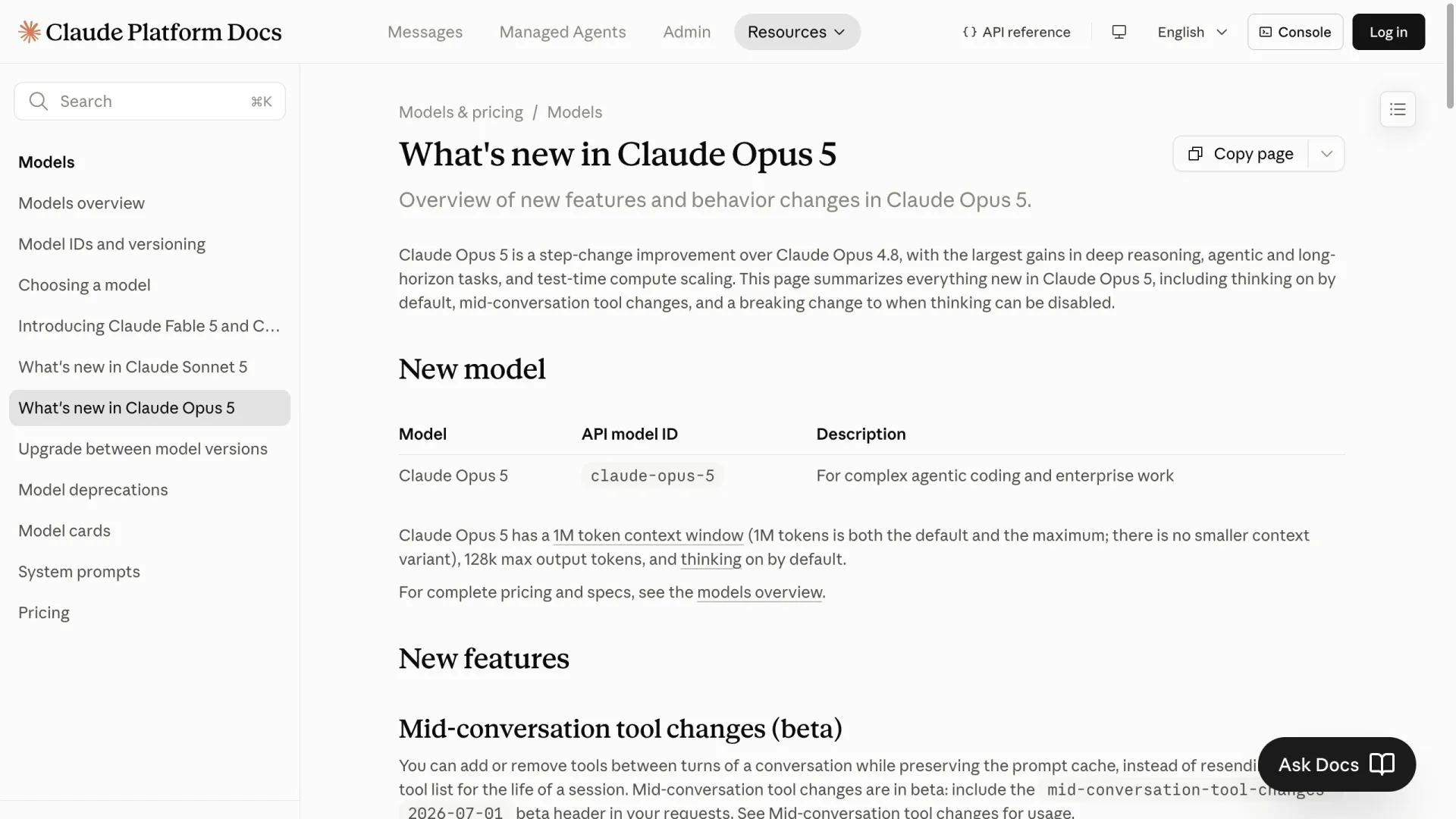
Claude Opus 5 has thinking enabled by default, with the model deciding how much to think on each turn and the effort parameter controlling depth. Anthropic documents a breaking constraint: disabling thinking at high effort is not accepted, and with thinking disabled the model can occasionally write a tool call into visible text instead of emitting a tool_use block.
Keep thinking enabled for Opus 5 when tool calls must remain structurally reliable; use K3 when explicit tool controls and schema-oriented output are the main requirement.
Which model wins for common workloads?
Long documents and knowledge work
K3 wins when the source set exceeds Opus 5's documented 200k context limit.
When the corpus fits inside 200k, Opus 5's thinking-by-default behavior is the more relevant differentiator than raw context size.
Coding and long-horizon agents
Choose Opus 5 for a new agent when its documented default thinking and effort controls matter more than fitting the full repository into one prompt.
Choose K3 for a large, cacheable agent context, but test its tool protocol on production-like tasks.
Cost-sensitive API workloads
Price-test K3 for cacheable, input-heavy workloads and log cache status because its cached and uncached input prices differ sharply.
Measure billed output for Opus 5 with representative workloads because thinking is enabled by default.
Run representative prompts through both APIs and record cache-hit rate, tool-call validity, latency, and billed output before committing.