 AIREITER
Hy4 preview’s token price is only part of the buying decision. Tencent has published a CNY rate card and OpenRouter has a live endpoint, but the right route depends on cache use, tool support, and whether your team can operate an eight-way distributed model.
Hy4 preview API pricing at a glance
Tencent Cloud TokenHub lists Hy4 preview at CNY 6 per million input tokens, CNY 18 per million output tokens, and CNY 0.30 per million cached-input tokens. OpenRouter lists the same meters at $0.834, $2.501, and $0.042 on its hosted model page.
| Route | Input / 1M tokens | Output / 1M tokens | Cached input / 1M tokens | Model ID |
|---|---|---|---|---|
| Tencent Cloud TokenHub | CNY 6 | CNY 18 | CNY 0.30 | Verify in TokenHub |
| OpenRouter | $0.834 | $2.501 | $0.042 | tencent/hy4-preview |
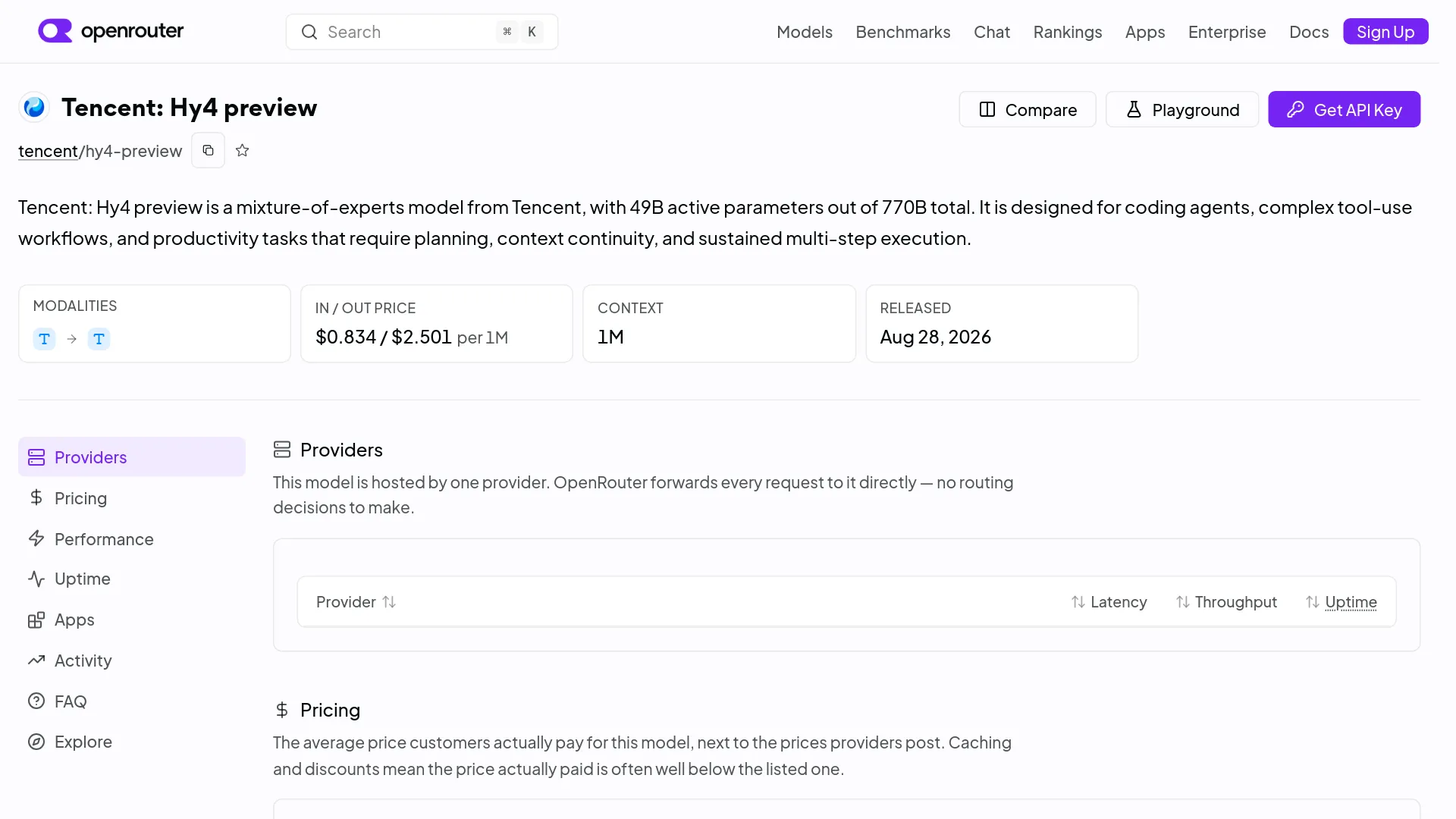
The official Tencent Cloud TokenHub price page, updated August 28, 2026, is the strongest source for the CNY card. The OpenRouter model page is the source for the hosted model ID, exact context limit, completion cap, and endpoint features.
Dividing each OpenRouter figure by its Tencent counterpart gives roughly $0.139 per CNY across the three meters. That is an implied alignment between the published provider cards, not a market exchange-rate quote; taxes, currency fees, account terms, and routing can still change the invoice.
A realistic Hy4 cost calculation
A request with 100,000 input tokens and 10,000 output tokens costs CNY 0.78 at Tencent’s published rate:
- Input:
0.1 × CNY 6 = CNY 0.60. - Output:
0.01 × CNY 18 = CNY 0.18. - Total: CNY 0.78.
If the 100,000 input tokens qualify for a cache hit, the same request costs about CNY 0.21: 0.1 × CNY 0.30 + 0.01 × CNY 18.
At OpenRouter’s displayed prices, the equivalent totals are $0.10841 without caching and $0.02921 with the input cached. These figures assume exactly the token counts shown and exclude provider-level charges or account adjustments.
Why output tokens change the bill quickly
Output costs three times as much as fresh input on both displayed cards. Long agent traces, code patches, and generated reports can therefore dominate the bill even when a stable system prompt or repository prefix is cached.
Log fresh input, cache-read input, and output separately. A cache hit lowers the prompt portion of the bill; it does not lower the cost of the generated response.
What you get for the API price
Hy4 preview is a Mixture-of-Experts model with a 770B total-parameter backbone, 49B active parameters per token, and a 1M-token context window. Tencent positions it for long-horizon software work, planning, and productivity tasks, but the available quality evidence is vendor-reported rather than an independent API benchmark.
| API or model fact | Verified detail |
|---|---|
| OpenRouter model ID | tencent/hy4-preview |
| Context | 1M tokens on Tencent’s card; 1,048,576 on OpenRouter |
| Maximum completion | 64,000 tokens on OpenRouter |
| License | Apache License 2.0 on Tencent’s model card |
| Published checkpoints | Hy4 preview and Hy4 preview-FP8 |
| Official local runtimes | vLLM and SGLang |
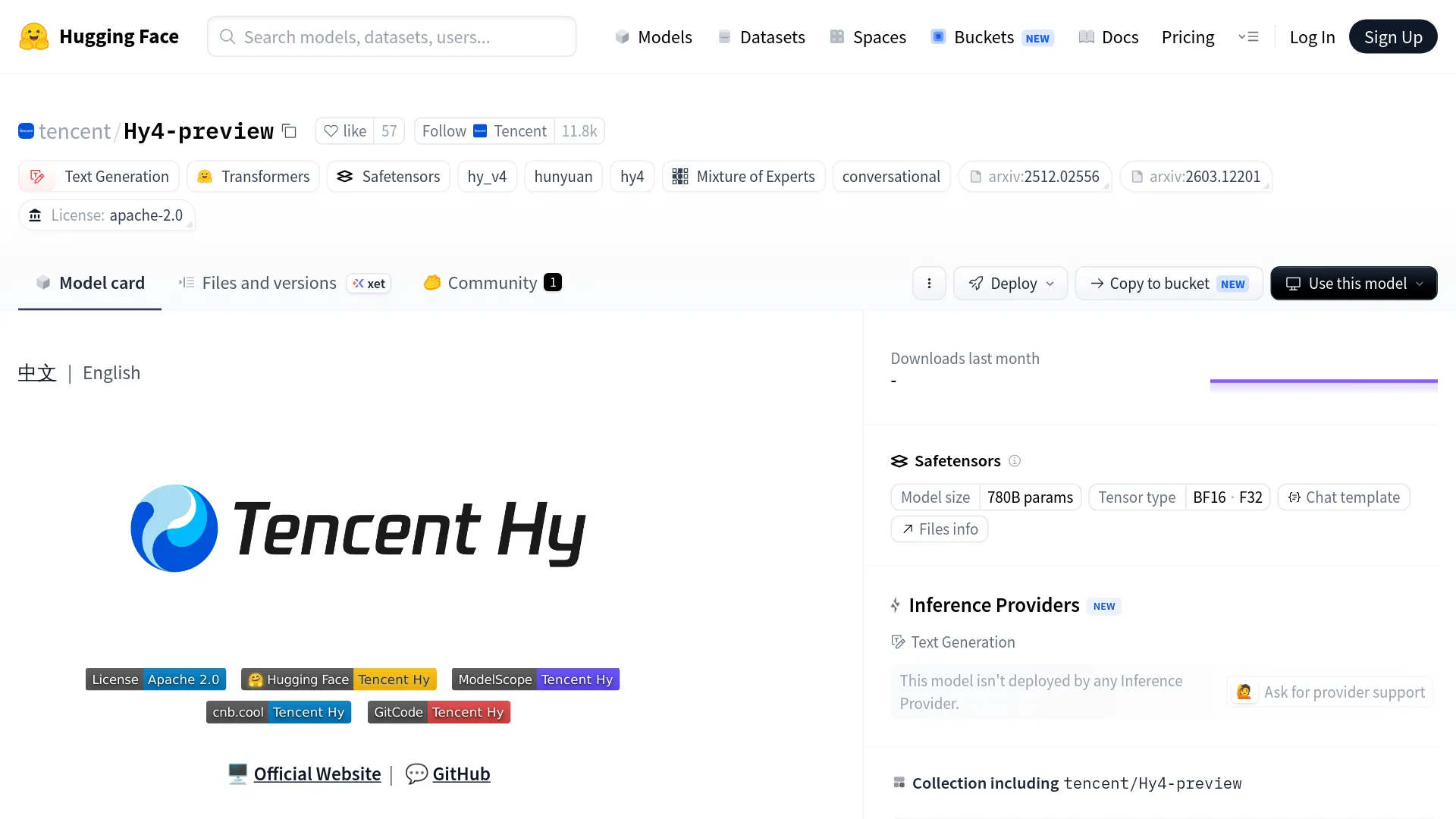
The official Tencent model card publishes the weights, license, and deployment documentation. It recommends the FP8 checkpoint in its serving examples, but does not quantify FP8’s memory, throughput, or quality difference from the non-FP8 checkpoint.
The agent caveat: OpenRouter does not expose tools or enforced JSON
The OpenRouter listing says this endpoint does not accept tools and does not support response_format for enforced structured output. That is a route limitation, not proof that every local Hy4 deployment lacks parser support.
Tencent’s vLLM and SGLang examples include Hy4 tool-call and reasoning parsers. If your application depends on native function calling or schema-enforced JSON, confirm the selected provider before integration and prepare an external orchestration or validation layer when necessary.
Hosted API or local deployment?
For evaluation and most early production experiments, hosted access avoids the storage, GPU, and runtime work required by the published local recipe. Local serving is reasonable only when your team already has distributed-GPU operations or a strong data-control requirement.
| Decision factor | Hosted API | Local Hy4 deployment |
|---|---|---|
| Setup | Provider account and API key | Download weights and build the runtime |
| Scale | Provider-managed | Official examples use 8-way tensor parallelism |
| Storage | No local weights | Hugging Face repository listed at about 1.56 TB |
| API behavior | Depends on the provider | vLLM/SGLang configuration is under your control |
| Main risk | Preview limits and route changes | Hardware, runtime compatibility, and operating cost |
When local Hy4 makes sense
Self-host Hy4 only if you already operate suitable multi-GPU infrastructure, need to keep prompts inside your environment, can maintain vLLM or SGLang, and accept preview-model behavior. Tencent documents vLLM with Python 3.12 and SGLang with transformers>=5.6.0, but those commands are examples rather than guaranteed minimum requirements.
One early community thread also shows why the hardware question should come before the benchmark question:
“I don't know who ... runs 780b models...” — u/_-_David in the r/LocalLLaMA Hy4 preview discussion.
This is a user reaction, not a capacity measurement. It is nevertheless a useful filter: a model with 1M context is not automatically a practical local model.
Hy3 remains the cheaper baseline
Standard Hy3 is the lower-cost option in Tencent’s current TokenHub table: CNY 1 input, CNY 4 output, and CNY 0.25 cached input per million tokens. Hy4’s fresh input rate is six times higher and its output rate is 4.5 times higher, so switching should be justified by a real need for the larger context or better performance on difficult tasks.
| Selection question | Choose Hy4 preview when… | Choose standard Hy3 when… |
|---|---|---|
| Context | Your workload needs the 1M-token class | Your prompts fit a smaller current limit |
| Budget | Added capability justifies CNY 6/18 pricing | Lower token cost matters most |
| Stability | You can test a preview route | You want the simpler established baseline |
The same official TokenHub page marks Hy3 preview for August 31, 2026 removal, so it is not a sensible target for a new integration.
Before you put Hy4 preview in production
- Record the provider, model ID, currency, region, and rate-card timestamp.
- Send a short request and verify the returned model and provider.
- Repeat a request with a stable prefix to test cache accounting.
- Test the context length your application actually needs instead of assuming full-window quality.
- Test a long completion separately because output is the expensive meter.
- Send tool-call and structured-output requests if your application needs them; OpenRouter currently lists both as unsupported.
- Log fresh input, cache reads, output, errors, and retries.
- Keep a fallback and regression prompts while the route builds uptime and usage history.
OpenRouter currently reports insufficient uptime and application-usage data for Hy4 preview. That does not establish poor reliability, but it does mean there is little public service history to use for capacity planning.
Hy4 preview API pricing FAQ
What is Hy4 preview’s API price?
Tencent Cloud TokenHub lists CNY 6 input, CNY 18 output, and CNY 0.30 cached input per million tokens. OpenRouter lists $0.834, $2.501, and $0.042 for those meters on its hosted page.
What is the Hy4 preview model ID on OpenRouter?
Use tencent/hy4-preview. Confirm the returned provider and model in your account because hosted routing settings can change.
Does Hy4 preview support a 1M-token context window?
Yes. Tencent’s model card states 1M tokens, while OpenRouter specifies 1,048,576 tokens and a 64,000-token maximum completion for its route.
Is Hy4 preview open source?
Tencent publishes the Hy4 preview checkpoints under the Apache License 2.0 on its official model card. “Open-weight” is the more precise description for the downloadable checkpoints.
Does the OpenRouter endpoint support tool calling?
The captured OpenRouter listing says no. It does not accept tools and does not support enforced structured output through response_format; local serving and other providers may expose different behavior.
The decision in one line
Use a hosted Hy4 preview route for controlled evaluation and long-context experiments; self-host it only when distributed-GPU capacity, data-control needs, and preview risk all fit your workload.