 AIREITER
If you landed here after hitting a paywall in Grok Imagine, the short version is this: the best free-to-cheap replacements right now are Nano Banana 2 (most realistic, handles text), GPT Image 2 (cheapest, strong portraits), and Seedream 5 Lite (stylized art). For video, Seedance 2.0 and Kling 3.0 come closest to what Grok Imagine used to do. None of them will nag you the way Grok's free tier does now, and a couple cost about a penny per image if you run them through an API. Below is what each one is actually good at, what "free" really means in 2026, and a side-by-side test I ran myself in July 2026.
Why people are ditching Grok Imagine
For a few weeks Grok Imagine was the fun, unfiltered toy everyone shared. That window closed. Threads across r/grok — "Grok Imagine Not Free Anymore," "Is Grok no longer free," "Grok Imagine doesn't support a free tier?" — all tell the same story: what used to be open access is now a trickle of a few videos a day, gated behind an X Premium subscription. One user summed it up: "They gave free access, people got used to it, and now the limits kicked in."
Two things send people looking for alternatives. First, cost — nobody wants to pay for X Premium just to make images. Second, restrictions: a lot of the appeal was that Grok didn't lecture you about content, and users specifically ask for tools with "fewer restrictions" for creative image-to-video work. So the real search isn't just "free" — it's "free, decent quality, and not annoying to use."
The alternatives at a glance
Here's the quick comparison before the detail. Free tiers are what you can realistically expect, not the marketing headline; paid prices are pay-as-you-go rates (the ones below are what I was actually billed on AIReiter in July 2026).
Tool | Best for | Free tier | Pay-as-you-go | Video? |
|---|---|---|---|---|
Nano Banana 2 | Realism + readable text | Light, not aggressively throttled | ~$0.03/image | No |
GPT Image 2 | Cheapest, portraits, signage | ChatGPT DALL·E ~10/day | ~$0.01/image | No |
Seedream 5 Lite | Stylized / illustration | Daily quota | ~$0.032/image | No |
Z-Image | Fast draft iteration | Daily quota | Low | No |
Qwen-Image | Multilingual text | Genuinely free | Low | No |
Flux 2 | Unlimited, self-hosted | Unlimited (local) | Free (own GPU) | No |
Seedance 2.0 | Video with native audio | Limited trial | Per clip | Yes |
Kling 3.0 | Cinematic camera control | Limited free credits | Per clip | Yes |
Hailuo 2.3 | Most generous free video | Generous free tier | Per clip | Yes |
(Midjourney is the obvious omission — it has no free tier and no public API, so it doesn't fit a "free alternative" list, though its quality is excellent if you'll pay $10+/month.)
The free-tier truth: what "free" actually means in 2026
Almost every "free" AI image generator has an asterisk. Providers advertise generous limits and then quietly throttle them, or attach provenance watermarks. Here's how the common free tiers actually behave, based on my own testing plus consistent community reports (tested July 2026 — these numbers drift, so treat them as ballpark):
Tool | Advertised free limit | What you actually get | Catch |
|---|---|---|---|
Google Gemini | ~100 images/day | ~20–30/day in practice | Embedded SynthID provenance watermark |
ChatGPT (DALL·E) | 2–3 images/day | ~10/day in practice | No watermark, slower |
Ideogram | "daily free prompts" | ~10–20 slow prompts (~40–80 images) | Free downloads capped at ~85% quality |
Leonardo AI | 150 tokens/day | ~10–30 images/day | Queue during peak |
Qwen-Image | Free generation | Genuinely free, 119+ languages | Slower renders |
Flux 2 (open source) | Unlimited (local) | Truly unlimited, offline | Needs a 12GB+ VRAM GPU |
The takeaway: "free" usually means "enough to experiment, not enough to work." If you generate more than a handful of images a day, you'll hit a wall — which is exactly the situation Grok users are trying to escape. (SynthID, note, is an embedded/detectable provenance signal rather than a big visible logo — but it does mark the image as AI-made.)
Best free and low-cost image alternatives to Grok Imagine
Nano Banana 2
The cleanest all-round replacement. It's fast, renders up to 4K, and — unusually — gets readable text right, which most generators still fumble (see the test below for proof). Its free access isn't throttled as aggressively as Gemini's, and it holds character consistency well across a series. If you want one tool for photorealistic scenes, start here.
GPT Image 2
The value pick — cheapest serious model in my test at about a cent an image. Text rendering is precise enough for signs, labels and UI mockups, and portraits come out warm and believable. The trade-off is you're mostly working in square format.
Seedream 5 Lite
Best when you want a look rather than a photo. It leans into illustration and crafted, stylized aesthetics, so it's great for posters, editorial art and social graphics — and weaker if you need documentary realism. Text stays crisp, as the test below shows.
Z-Image
Built for fast, low-cost draft iteration. A "daily quota" style of access makes it ideal for concept testing where you're generating dozens of rough options and only polishing the winners elsewhere.
Qwen-Image
The multilingual pick, and genuinely free. It renders text inside images reliably, including Chinese, Japanese and Arabic prompts, and supports 119+ languages. Renders are slower, but color and sharpness are excellent for final selects.
Flux 2
The one for people who want zero limits and zero subscriptions. It's open source (MIT), runs locally if you have a 12GB+ VRAM GPU (or a rented cloud GPU if you don't), and excels at architecture and structural geometry. No cloud rate limits, no moderation layer — the closest thing to Grok's old "just let me create" feel, if you're willing to run it yourself.
Head-to-head: I ran the same prompt through three of them
To see how these actually differ, in July 2026 I gave Nano Banana 2, Seedream 5 Lite and GPT Image 2 an identical prompt — a rainy neon ramen stall at night with a chef and a sign reading "GROK RAMEN 24H" — designed to stress text, realism and lighting at once. Each is the first result at default settings, no cherry-picking, run through AIReiter's API.
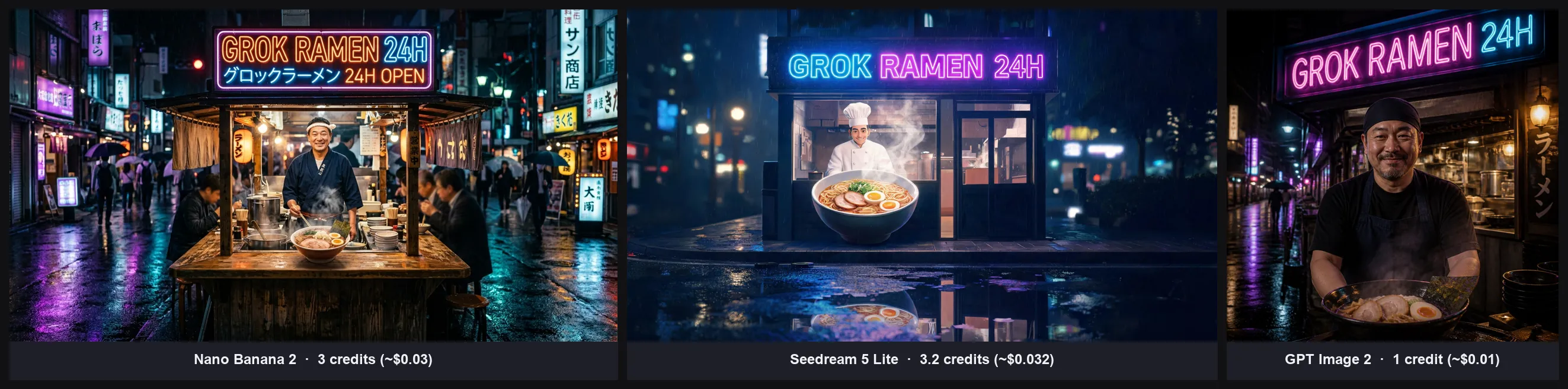
Method: identical prompt, default settings, first generation each (no re-rolls), run July 2026 via AIReiter's image API. Costs are the exact credits billed on that run.
The honest results:
Nano Banana 2 won on realism and scene richness — a full 16:9 street, background diners, wet reflections, and it even added a correct Japanese neon line I didn't ask for. Cost on AIReiter: 3 credits (~$0.03).
GPT Image 2 produced the most convincing portrait and the warmest cinematic light, but boxed it into a square frame with a tighter scene. Cost: 1 credit (~$0.01) — the cheapest.
Seedream 5 Lite rendered the crispest text but went full stylized-3D, with a cartoonish chef and a floating bowl — lovely, but not photoreal. Cost: 3.2 credits (~$0.032).
The surprise: all three nailed the sign text, which was never Grok Imagine's strength. So the "free alternatives can't do text" worry is outdated.
Best free alternatives for video
Grok Imagine was mostly about quick image-to-video, so this is where its core appeal lived — and where its refugees are landing. Here's how the four best replacements compare:
Tool | Best for | Native audio | Image-to-video | Clip length | Free tier |
|---|---|---|---|---|---|
Seedance 2.0 | Overall closest to Grok | Yes | Yes | Short clips | Limited trial, then per clip |
Kling 3.0 | Deliberate camera moves | No | Yes | Short–medium | Limited free credits |
Hailuo 2.3 | Casual / social, free use | No | Yes | Short clips | Most generous free tier |
Veo 3.1 | Longer, stable shots | Yes | Yes | Beyond 4–6s | Small free allotment, priciest |
In practice: Seedance 2.0 is the standout — audio and motion are linked at the prompt stage instead of bolted on afterward, so lip-sync and sound effects come out coherent. Kling 3.0 gives you real cinematic camera control (dolly, pan, arc, crane) but has a steeper learning curve. Hailuo 2.3 is the one to start with if you just want free clips for TikTok/Reels. Veo 3.1 handles longer shots with the least motion drift and subject decay, but it's the most expensive of the four.
What about "unrestricted" alternatives?
This comes up constantly, so let's be straight about it. Most hosted platforms — Gemini, ChatGPT, and yes, the paid Grok — run content moderation, and that isn't going away. Tools marketed as "unfiltered" often just have looser defaults, not zero rules. The genuinely permissive path is self-hosting an open model like Flux 2 or Wan, where there's no vendor moderation layer because you're running it on your own hardware. That means a 12GB+ VRAM GPU (or a rented cloud GPU), a bit of setup with a tool like ComfyUI, and your own responsibility for staying within the law and platform policies wherever you publish — "no vendor moderation" is not the same as "anything goes." It's more work, but it's the honest answer to "which one won't scold me," not a magic hosted service.
The cheapest way to actually run all of them
Here's the practical problem with chasing free tiers: the good models are scattered across a dozen sites, each with its own small, ever-changing free limit and its own login. The moment you need volume — or you just want Nano Banana 2, GPT Image 2 and Seedance in one place — the free-tier shuffle stops being worth it.
Running them through a single pay-as-you-go API is usually cheaper and less of a hassle. On AIReiter, for instance, these same models bill by usage with no monthly fee — the ~$0.03 (Nano Banana 2) and ~$0.01 (GPT Image 2) figures above are the exact per-image credits I was charged there. At a cent or three per image, $5 of credit is a few hundred generations — more than most free tiers give you in a month, without the throttling or the watermarks. Just remember those are one platform's rates, not the models' universal prices; check current pricing before you rely on them.
If you're comparing specific models before you commit, these go deeper: Nano Banana 2 vs Seedream 5, the Z-Image vs Nano Banana Pro pricing breakdown, and our Grok Imagine 1.5 review if you want to see what you're actually replacing.
FAQ
Is there a free alternative to Grok Imagine?
Yes. Nano Banana 2, GPT Image 2, Qwen-Image and Flux 2 all have free image access; Qwen and self-hosted Flux 2 are the most genuinely free. For video, Hailuo 2.3 has the most generous free tier. Most cap daily usage.
What's the best free AI image generator like Grok?
It depends on the job: Nano Banana 2 for photoreal scenes with text, GPT Image 2 for the cheapest paid usage and portraits, Seedream 5 Lite for stylized art, and self-hosted Flux 2 if you want no limits at all.
Are there unrestricted alternatives to Grok Imagine?
Not among hosted tools — they all moderate content. The only genuinely permissive route is running an open model like Flux 2 or Wan on your own (or a rented) GPU, where there's no vendor moderation layer — but you're then responsible for legal and platform compliance yourself.
What's the best free Grok alternative for video?
Seedance 2.0 comes closest to Grok Imagine's image-to-video and adds native audio. Hailuo 2.3 has the friendliest free tier, and Kling 3.0 offers the most camera control.
Why isn't Midjourney on the list?
Because it has no free tier and no public API — you can't try it for free or automate it. If you'll pay $10+/month for a web tool, its quality is excellent, but it doesn't fit a free-alternative list.