 AIREITER
Choose GLM-5.3-Flash for native visual work; choose DeepSeek V4 Flash for cache-heavy text and code, because workload and billing path matter more than a single benchmark.
The comparison starts with the model IDs
This is a comparison of GLM-5.3-Flash (glm-5.3-flash) and DeepSeek’s production API model deepseek-v4-flash, identified on the official pricing page as DeepSeek-V4-Flash-0731. DeepSeek V4 Pro and the separate deepseek-v4-flash-vision-exp endpoint are not substitutes for the main Flash model here. For the Ox Alpha identity, hardware limits and preview caveats, see the AIReiter GLM-5.3-Flash review.
The short answer by workload
| If your priority is… | Choose | Why |
|---|---|---|
| Screenshot-to-code, UI inspection, video or file input | GLM-5.3-Flash | Native image, video and file input in one model |
| Text-only bulk processing with high cache-hit rates | DeepSeek V4 Flash | Lower official cached-input pricing, especially off-peak |
| Fresh-input and output-heavy traffic during GLM’s promotion | GLM-5.3-Flash | Promotional input and output rates are below DeepSeek’s official cache-miss and output rates |
| Terminal-heavy coding with a conservative production choice | DeepSeek V4 Flash | Versioned public-beta route and official Flash evaluation results |
| Visual browser or computer-use agents | GLM-5.3-Flash | Visual feedback stays inside the coding or tool-use loop |
| A 1M-token text context | Neither by default | Both advertise 1M-class context; test retrieval at your actual prompt size |
| One model for mixed text, code and images | GLM-5.3-Flash | It avoids a separate vision endpoint for the main multimodal path |
What the official specifications actually say
The Z.AI model documentation and Z.AI pricing page describe GLM’s model and billing. DeepSeek’s Models & Pricing documentation and change log provide the corresponding Flash version and feature details.
| Specification | GLM-5.3-Flash | DeepSeek V4 Flash |
|---|---|---|
| API model ID | glm-5.3-flash | deepseek-v4-flash |
| Published version | GLM-5.3-Flash | DeepSeek-V4-Flash-0731 |
| Context window | 1M tokens | 1M tokens |
| Maximum output listed by official docs | 128K tokens | 384K tokens |
| Main input types | Text, images, video and files | Text and code; vision is a separate experimental model |
| Output | Text | Text |
| Reasoning control | Thinking enabled; reasoning_effort supported | Thinking and non-thinking modes; low, high and max effort |
| Tools and structured output | Function calling, streaming, context caching and JSON output | Tool calls, JSON output, Responses API and Anthropic API compatibility |
| Weights | Open weights published by the provider | Open weights published by the provider |
GLM’s 320B total parameters and 18B active parameters describe a sparse expert architecture, not an 18B local checkpoint; DeepSeek’s official Flash pricing page does not publish a comparable parameter count.
GLM accepts visual inputs in the main model path; DeepSeek offers deepseek-v4-flash-vision-exp separately, which changes routing and testing assumptions.
Coding and agents split into two different tests
Terminal agents test repository and tool execution; visual agents additionally interpret rendered interfaces and GUI states.
Terminal and repository work
Z.ai’s launch table and DeepSeek’s official July 31 update report these results:
| Benchmark | GLM-5.3-Flash | DeepSeek V4 Flash | Evidence status |
|---|---|---|---|
| Terminal Bench 2.1 | 84.3 | 82.7 | Separate provider-reported evaluations |
| DeepSWE | 63.4 | 54.4 | Separate provider-reported evaluations |
| Toolathlon Verified | 78.4 | 70.3 | Separate provider-reported evaluations |
| AutomationBench | 48.8 | 25.1 | Separate provider-reported evaluations |
| Agents’ Last Exam | 26.3 | 25.2 | Separate provider-reported evaluations |
GLM leads these provider-reported benchmarks, but differing harnesses mean the results should shortlist models, not determine the choice.
Independent evidence makes the choice less one-sided. Composio’s August 27 test of 30 multi-step agent tasks reported 21/30 completed by GLM-5.3-Flash and 20/30 by DeepSeek V4 Flash. DeepSeek was fastest on 19 of 30 tasks, while reported cost per successful task was about $0.028 for DeepSeek versus about $0.06 for GLM. These figures come from Composio’s test, not either provider.
For terminal-heavy agents, start with DeepSeek V4 Flash when speed, reproducibility and a defensible initial route are the constraints. Include GLM when first-pass repair quality or broader tool behavior is worth measuring against that lower cost.
Tools, browser states and visual feedback
GLM has the stronger product fit when an agent must inspect what its code produced. Z.ai describes a loop in which the model reads screenshots or rendered interfaces, changes the implementation, and checks the result again. That applies to screenshot-to-code, frontend debugging, browser use, documents and some 3D workflows.
DeepSeek can handle text-and-code agent work through deepseek-v4-flash; visual input requires the separate deepseek-v4-flash-vision-exp route. If an existing pipeline already has vision routing, that separation may be acceptable. If the agent moves between source code, a browser screenshot and video without changing endpoints, GLM is the cleaner fit. The site’s DeepSeek V4 Flash Vision Exp API guide covers that alternative.
What real users report after the benchmark
Community evidence points to a trade-off rather than a universal leader. A two-day user report described GLM as capable on smaller contexts but less composed as the prompt grew, while crediting its image support:
“When it grows bigger, it starts to act anxious and sloppy.” — @XBToshi, reporting two days of heavy GLM-5.3-Flash use in a published comparison
That is anecdotal evidence, not a failure rate. It does identify a failure mode that benchmark tables do not show: a large context limit does not guarantee stable multi-turn agent behavior.
A small Ollama experiment also favored DeepSeek on provider-specific quota units, but the author did not equate those units with API-dollar cost.
Latency and serving evidence change the answer
No same-harness p50 latency or throughput comparison is published for these exact models; do not transfer results from Pro, Vision-Exp or other routes. Composio found DeepSeek fastest on 19/30 agent tasks, a useful but non-throughput signal. Measure time to first useful tool call for interactive assistants and wall-clock time to an accepted result for batch jobs.
Price per token is not cost per completed task
The official rate cards produce a more nuanced result than “DeepSeek is cheaper.” Z.AI lists a 50% GLM-5.3-Flash promotion through September 9, 2026 at 24:00 UTC+8. DeepSeek separately prices cache hits and cache misses, with peak and off-peak rates.
All figures below are U.S. dollars per 1 million tokens.
| Billing item | GLM-5.3-Flash promotion | GLM-5.3-Flash list | DeepSeek V4 Flash off-peak | DeepSeek V4 Flash peak |
|---|---|---|---|---|
| Fresh/cache-miss input | $0.075 | $0.15 | $0.22 | $0.44 |
| Cached input | $0.015 | $0.03 | $0.007 | $0.014 |
| Output | $0.25 | $0.50 | $0.66 | $1.32 |
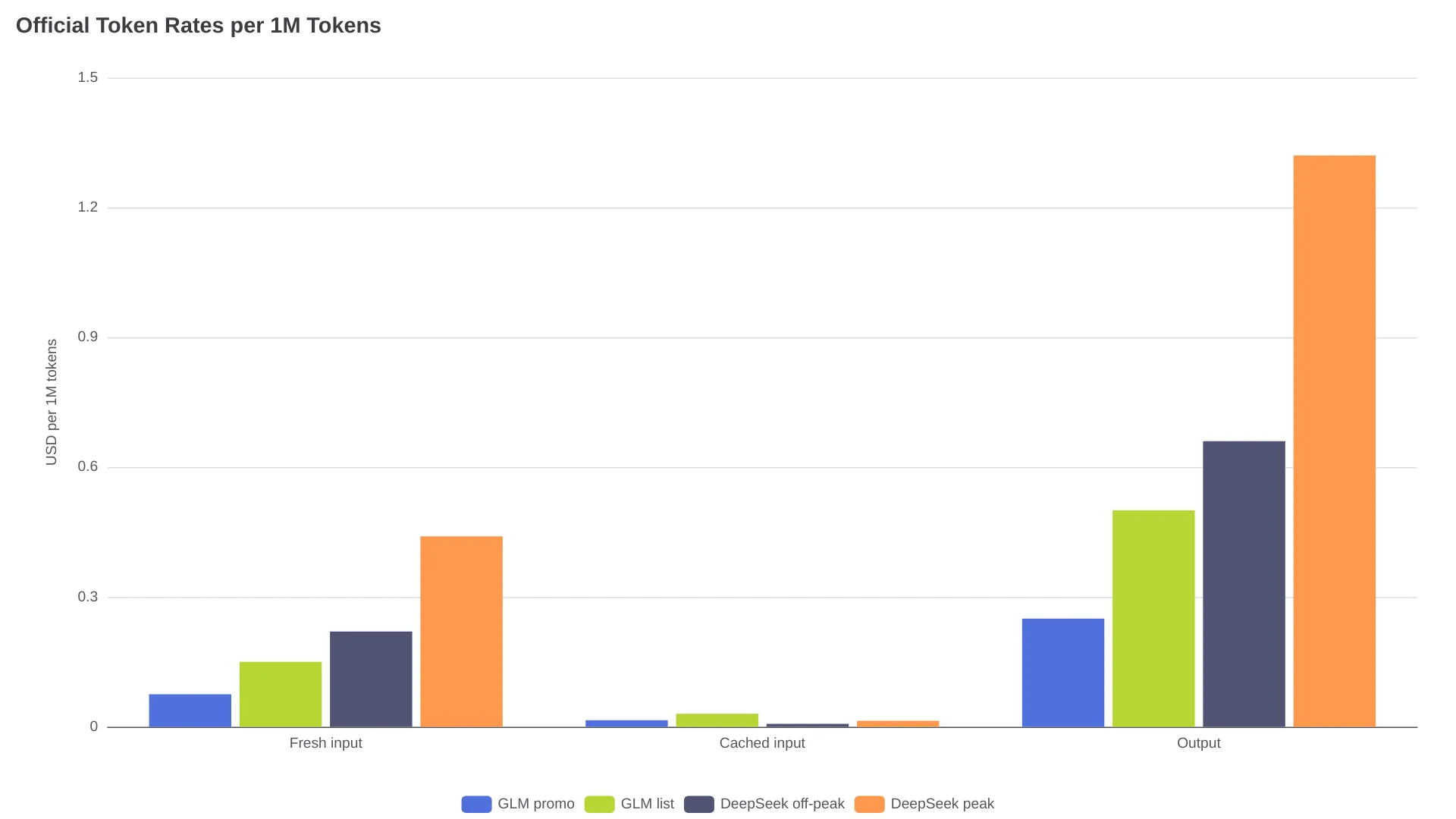
DeepSeek’s peak windows are 01:00–04:00 UTC and 06:00–10:00 UTC, Monday through Friday; all other times are off-peak. Its official table also lists 2,500 concurrency for V4 Flash. GLM’s pricing page lists limited-time-free cached-input storage but does not give a universal concurrency number there.
- DeepSeek wins cached-input price at every corresponding period.
- GLM’s promotion wins fresh-input and output price against DeepSeek’s official cache-miss and output rates.
- After the promotion, GLM’s list fresh-input and output rates remain below DeepSeek’s listed off-peak rates.
- DeepSeek’s strongest price case is cache-heavy, input-dominant traffic with short output, especially when scheduled off-peak.
A 10M-input / 2M-output example
Assume 10 million fresh input tokens and 2 million output tokens, with no tool fees or retries:
| Model and billing path | Calculation | Total |
|---|---|---|
| GLM promotion | 10 × $0.075 + 2 × $0.25 | $1.25 |
| GLM list | 10 × $0.15 + 2 × $0.50 | $2.50 |
| DeepSeek off-peak, cache miss | 10 × $0.22 + 2 × $0.66 | $3.52 |
| DeepSeek peak, cache miss | 10 × $0.44 + 2 × $1.32 | $7.04 |
If all 10 million input tokens are cache hits, DeepSeek’s off-peak total becomes $1.39 (10 × $0.007 + 2 × $0.66), while GLM’s promotional total becomes $0.65 (10 × $0.015 + 2 × $0.25). DeepSeek’s cache advantage becomes more important when the input-to-output ratio is much higher and output is short.
When DeepSeek’s lower bill is decisive
Choose DeepSeek V4 Flash when most requests reuse a long stable system or repository prefix, produce short answers, and can run outside peak hours. Classification, extraction, summarization and routine text-only automation fit this pattern better than screenshot-driven agents.
When GLM’s extra capability can be cheaper overall
GLM can lower pipeline cost when an image, document or video would otherwise require a separate vision request. Its promotional output rate also matters for agents that generate long code patches. Validate that hypothesis with billed tokens, repair loops and accepted-task rates rather than assuming a universal cost-per-task win.
Long context is a capacity claim, not a quality guarantee
Both official documentation sets list a 1M-token context window, so context size alone is a tie. DeepSeek lists a 384K maximum output; Z.AI’s model documentation lists 128K maximum output for GLM-5.3-Flash. That difference matters only for applications that permit unusually long generations.
Z.ai reports 3.01× lower attention computation and 4.44× lower KV-cache size than GLM-5.3, while noting that GLM’s KV cache remains slightly above DeepSeek V4 Flash’s. These vendor claims do not establish a latency or retrieval-quality advantage over DeepSeek.
Test retrieval, tool completion and accepted-task rate at 50K, 200K and your actual maximum prompt size, using the acceptance rule in the gate below.
Choose a default, or route both
| Workload | First model to test | Fallback or escalation |
|---|---|---|
| Text-only classification and extraction | DeepSeek V4 Flash | GLM if formatting or quality fails |
| High-cache repository chat | DeepSeek V4 Flash | GLM for difficult repair turns |
| Terminal coding agent | DeepSeek V4 Flash | GLM where first-pass completion matters |
| Screenshot-to-code | GLM-5.3-Flash | DeepSeek for text-only follow-up work |
| Browser or computer-use agent | GLM-5.3-Flash | DeepSeek for non-visual planning steps |
| Video, image or file-grounded analysis | GLM-5.3-Flash | DeepSeek Vision Exp if a separate route is acceptable |
| Long text with short output | DeepSeek V4 Flash | GLM if retrieval degrades |
| Long code generation during the promotion | GLM-5.3-Flash | DeepSeek when cache-hit economics dominate |
Before switching a production workload, run a small same-harness gate:
- Freeze the exact IDs:
glm-5.3-flashanddeepseek-v4-flash; do not let a router silently substitute Pro or Vision-Exp. - Use 20–50 real tasks covering successful jobs and recent failures. Include at least five tool-use tasks if the product is agentic.
- Record pass rate, repair loops, tool-call omissions, time to first useful action, total input/output tokens and cache-hit ratio.
- Compare cost per accepted task, then keep the other model as a fallback until timeout and failure rates are stable.
Z.AI’s quick start and DeepSeek’s first API call guide document OpenAI-compatible access; their reasoning controls, vision routes and billing semantics are not identical.
Questions buyers still ask
Is GLM-5.3-Flash the same model as Ox Alpha?
Z.ai officially identified GLM-5.3-Flash as the model it had tested anonymously as Ox Alpha. Preview routing, quotas and endpoint behavior should not be treated as the public model’s permanent specifications.
Use the routing table, then validate the default with pinned IDs, real failure cases and the same harness. The GLM-5.3-Flash review covers identity and deployment evidence; the DeepSeek V4 Flash Vision Exp API guide covers the separate visual route.