 AIREITER
If you are searching for GLM-5-3-Flash alternatives, you probably do not need another explanation of the Ox Alpha reveal. You need to replace a cheap but sometimes slow agent route, avoid a 320B local checkpoint, or keep multimodal work without rebuilding your API client. The right substitute depends on which problem you are solving.
The short answer: choose by the failure you are trying to fix
DeepSeek V4 Flash is the flexible text route when cache-hit pricing, optional non-thinking mode, and high concurrency matter. It has a 1M-token context, a 2,500-request concurrency limit, and official off-peak pricing of $0.22 per million uncached input tokens and $0.66 per million output tokens.
Qwen3.8-Flash is the hosted route to test when image and video input, API compatibility, and built-in tools matter. Its listed rate is $0.15 per million input tokens and $0.47 per million output tokens.
GLM-5.3 is the same-family escalation path when you want to stay with Z.ai but need its flagship text model. GPT-5.6 Terra and Claude Opus 4.8 are premium routes for work where another successful task is worth paying several times more. Kimi K3 supplies a 1M-context capability route, not a cheap replacement.
The decision is not “which model wins?” It is whether you are optimizing token cost, visual input, long-horizon coding, local control, or accepted-task rate.
The Ox Alpha endpoint is gone; start with the migration state
Z.ai’s official announcement identified the anonymous Ox Alpha preview as GLM-5.3-Flash on August 26, 2026. The public release added a named checkpoint, published pricing, an MIT-licensed Hugging Face model, and documented API access. The old preview environment should not be treated as a permanent model contract: preview routing, quotas, latency, and policy behavior can differ from the released API.
If a configuration still calls stealth/ox-alpha, the public OpenRouter identifier is z-ai/glm-5.3-flash; direct Z.ai requests use the general base URL https://api.z.ai/api/paas/v4. Z.ai documents a separate Coding Plan endpoint, https://api.z.ai/api/coding/paas/v4, so do not assume a subscription route and the general API have identical billing or limits.
The existing GLM-5.3-Flash review on AIReiter covers the baseline, including the difference between 18B active parameters and the roughly 320B total checkpoint. This article answers the next question: what should replace it when its cost, speed, hardware, or reliability no longer fits?
“For me it has changed nothing. Both models are way too big for my 32 GB RAM system.” — u/dampflokfreund, r/LocalLLaMA
Alternatives compared by price, context, and deployment path
The prices below are provider-listed snapshots checked on August 28, 2026. They are not one uniform promotion: DeepSeek changes rates between peak and off-peak hours, while Z.ai’s Flash price includes a temporary discount through September 9, 2026 at 24:00 UTC+8.
| Model | Input / 1M tokens | Output / 1M tokens | Context | Input modalities | Best replacement reason |
|---|---|---|---|---|---|
| DeepSeek V4 Flash | $0.22 off-peak; $0.44 peak | $0.66 off-peak; $1.32 peak | 1M | Text | Cache-aware text routing and non-thinking mode |
| Qwen3.8-Flash | $0.15 | $0.47 | 1M | Text, image, video | Hosted multimodal and API compatibility |
| GLM-5.3 | $1.40 | $4.40 | 1M | Text | Same provider, higher-capability family route |
| GPT-5.6 Terra | $2.00 | $12.00 | 1.05M | Text | Higher-confidence difficult agent work |
| Claude Opus 4.8 | $5.00 | $25.00 | 1M | Text | Hard coding and long-context review |
| Kimi K3 | $3.00 | $15.00 | 1M | Text | Long-context capability work |
Z.ai currently lists GLM-5.3-Flash at $0.075 input, $0.015 cached input, and $0.25 output per million tokens during its 50% promotion. List prices are $0.15, $0.03 cached, and $0.50. The comparison graphic uses the list price rather than the temporary promotional rate. (Z.ai pricing)
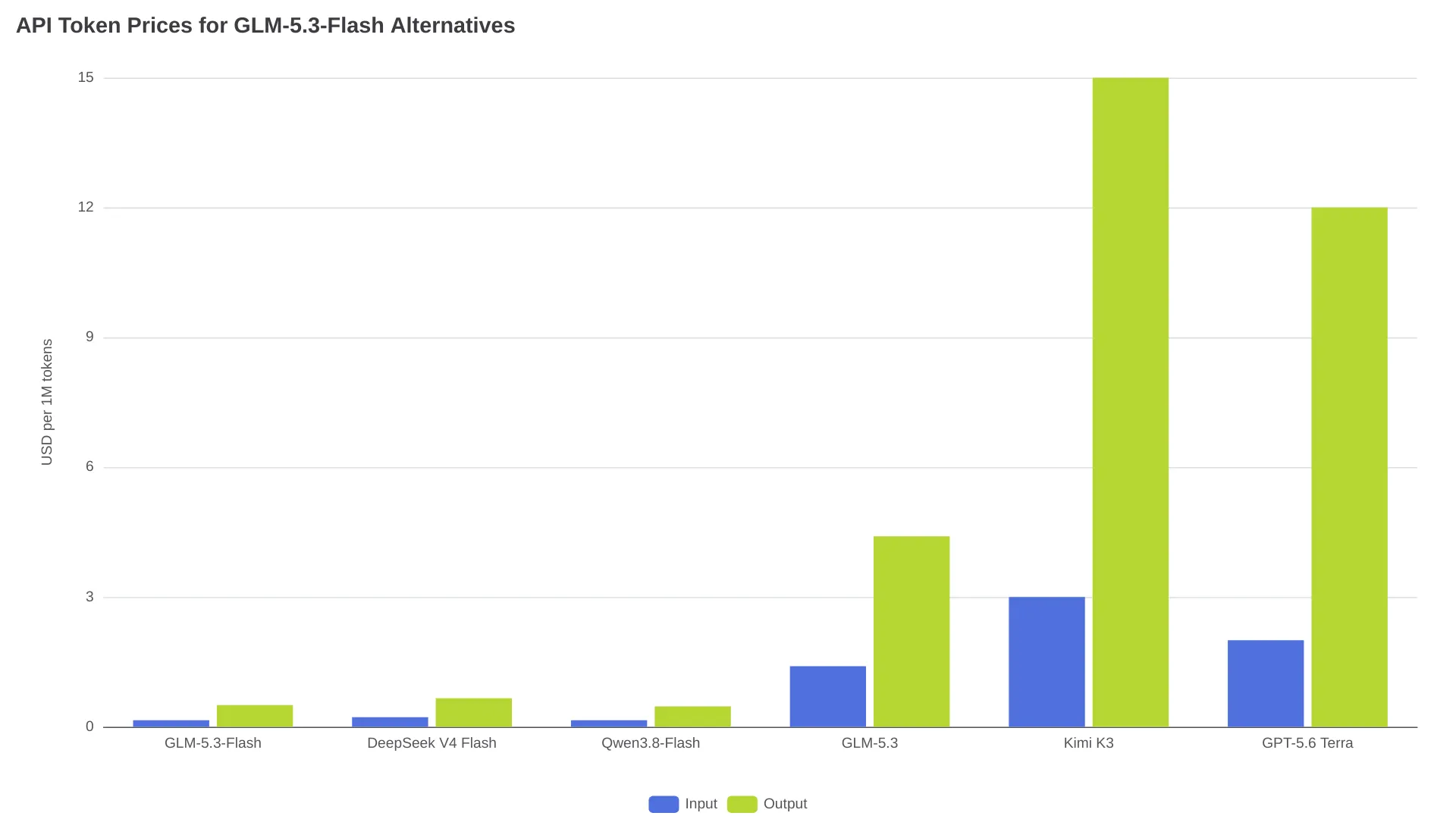
Price basis: GLM-5.3-Flash list price, DeepSeek V4 Flash official off-peak price, and current provider-listed rates for the other rows. DeepSeek peak pricing is twice its off-peak rate.
The six realistic replacement paths
DeepSeek V4 Flash: the cache-aware text and coding route
DeepSeek V4 Flash is the first model to test when GLM-5.3-Flash is too expensive for routine text traffic. DeepSeek lists a 1M-token context, 384K maximum output, JSON output, tool calls, the Responses API, and Anthropic-compatible access. Its official concurrency limit is 2,500 requests.
The billing difference matters. DeepSeek separates cache hits from cache misses and doubles rates during weekday peak windows, 01:00–04:00 and 06:00–10:00 UTC. It also supports thinking and non-thinking modes, while the GLM-5.3-Flash model card documents low, high, and max reasoning effort rather than a simple no-thinking route.
Choose DeepSeek V4 Flash for repeated-context workloads, retrieval-heavy chat, and text-only coding where cache hits or controllable reasoning matter. Qwen3.8-Flash has lower listed fresh-token rates, so DeepSeek is not automatically the cheapest choice for every text request. It is not a visual drop-in replacement: image input belongs to DeepSeek’s separate deepseek-v4-flash-vision-exp route, and image-derived tokens are billed as input.
Qwen3.8-Flash: the closest hosted multimodal substitute
Qwen3.8-Flash is the closest hosted alternative to test if your agent sends screenshots, charts, or videos and you want to keep one API-shaped integration. QwenCloud lists image, text, and video input; a 1M-token context; 991K maximum input; and 131K maximum output. It supports OpenAI- and Anthropic-compatible APIs, tools, structured output, caching, batches, web search, and fine-tuning.
The operational trade-off is its cache structure. QwenCloud lists implicit cache reads at $0.016 per million tokens, explicit cache creation at $0.20, and output at $0.47. Its published limits are 2M tokens per minute and 15,000 requests per minute, but the page does not define whether those limits apply per account, key, organization, or deployment.
Pick Qwen3.8-Flash when visual input is essential or fresh-token price matters. The official model page provides no named benchmark table, latency result, or long-session reliability study, so validate it on your own agent traces instead of assuming feature parity means behavioral parity.
GLM-5.3: the same-family escalation when Flash is not enough
GLM-5.3 is not the budget alternative. It is the sensible escalation when the problem is insufficient depth on text-only work rather than price or multimodality. Z.ai’s rate card lists $1.40 per million input tokens, $0.26 cached input, and $4.40 per million output tokens, roughly an order of magnitude above Flash’s list price.
Z.ai presents GLM-5.3 as its flagship coding model, while GLM-5.3-Flash is the lower-cost natively multimodal model. Use GLM-5.3 selectively for difficult text-first tasks; moving to it may remove the visual workflow that made Flash useful.
GPT-5.6 Terra: for higher-confidence agent execution
GPT-5.6 Terra is a premium route for teams that value difficult-task completion over low token rates. OpenAI lists $2 per million input tokens, $0.20 cached input, and $12 per million output tokens, with a roughly 1.05M-token context window. In Z.ai’s published benchmark table, GPT-5.6 Terra scores 87.4 on Terminal-Bench 2.1 and 69.6 on DeepSWE v1.1, above GLM-5.3-Flash’s 84.3 and 63.4 under those cited setups.
Those figures justify testing Terra when a failed coding task costs more than a higher API bill; they do not prove universal production superiority. Use it as an escalation tier for high-value repository changes or complex autonomous work.
Claude Opus 4.8: for difficult coding and long-context review
Claude Opus 4.8 costs $5 per million input tokens and $25 per million output tokens under Anthropic’s standard global pricing. Anthropic also lists cache reads at $0.50 per million tokens and batch rates at half of standard input and output pricing.
In Z.ai’s comparison table, Opus 4.8 leads GLM-5.3-Flash on Terminal-Bench 2.1, Agents’ Last Exam, HLE with Tools, and NL2Repo, while Flash leads on several tool-heavy and automation rows. That split makes Opus more useful as a measured escalation model than as a universal default.
Kimi K3: for 1M-context capability work, not cheap inference
Kimi K3 belongs here because it addresses a different switching reason: you may want a 1M-context route for long software-engineering or research workflows. Kimi lists $0.30 per million cached input tokens, $3 input, and $15 output.
At those rates, pick Kimi K3 only when its context and capability profile justify the premium. It is not the answer to “how do I reduce my token bill?”
Pick the alternative by workload, not by leaderboard rank
| Your workload or constraint | First model to test | Why |
|---|---|---|
| Bulk text classification or extraction | Qwen3.8-Flash | Lower listed fresh input and output rates than DeepSeek V4 Flash off-peak |
| Long text with repeated prefixes | DeepSeek V4 Flash | Cache-hit pricing and optional non-thinking mode |
| Long text with mostly fresh input | Qwen3.8-Flash | Lower listed fresh-token rates |
| Screenshots, charts, or video in an API workflow | Qwen3.8-Flash | Native image/video input and familiar API protocols |
| Same Z.ai ecosystem, but harder text reasoning | GLM-5.3 | Keeps the provider while moving up the family tier |
| Coding where failure is expensive | GPT-5.6 Terra | Premium escalation with stronger cited coding scores |
| Careful code review or repository planning | Claude Opus 4.8 | Premium reasoning plus cache and batch options |
| Long-horizon work where context matters more than price | Kimi K3 | 1M-context capability positioning |
| Ordinary laptop or 32GB workstation | Hosted API first | GLM-5.3-Flash is a roughly 320B-total-parameter checkpoint, not an 18B local model |
The local-deployment constraint is substantial. The official GLM-5.3-Flash checkpoint is described as roughly 320B total parameters; AIReiter’s deployment review records an FP8 footprint around 306 GiB and a default vLLM deployment around 386GB of VRAM. Quantization lowers the bar, but does not make this a normal laptop download.
A safer migration pattern for agents
Keep the provider adapter separate from task routing, then evaluate the replacement on the work that matters.
- Keep one request interface. Preserve the OpenAI-compatible message, tool, and structured-output layer where the provider supports it. Treat reasoning controls, vision payloads, tool calls, structured outputs, and context limits as capability flags, not universal fields.
- Test accepted tasks, not just generated text. Record whether the code builds, the tool call is valid, the visual check passes, and the task finishes without a retry. A cheap first response that needs two repository-sized retries may not be cheaper.
- Route by failure mode. Send repeated-context text to DeepSeek V4 Flash, multimodal requests to Qwen3.8-Flash, and high-risk coding tasks to GPT-5.6 Terra, Claude Opus 4.8, or GLM-5.3 according to your acceptance results.
- Keep a fallback. The AIReiter review records a seven-day community test with 30 successful builds from 49 attempts and 14 timeout failures. That is not a universal provider failure rate, but it is enough reason not to run a single-route production agent.
- Budget against normal prices. Z.ai’s Flash promotion ends September 9, 2026. DeepSeek rates change by peak window. Qwen’s cache creation and cache reads use different prices. A migration that only works under a temporary rate is not a stable cost model.
A practical first test is ten routine or text-heavy requests plus ten coding, tool-use, or visual tasks. Compare accepted-task rate, total completion time, retries, and total token spend. For many teams, that means testing DeepSeek V4 Flash for repeated-context text and Qwen3.8-Flash for multimodal work, while retaining GLM-5.3-Flash as a fallback until the new paths prove reliable.
FAQ
What is the best free alternative to Ox Alpha?
No permanent, provider-neutral free replacement is established by the official sources checked here. Providers may offer changing quotas or promotions, but a production decision should use published paid rates and treat free access as a bonus.
Which alternative supports images and video?
Qwen3.8-Flash officially lists image, text, and video input. DeepSeek’s standard V4 Flash route is different from its deepseek-v4-flash-vision-exp route, so test the exact endpoint before migrating a visual agent.
Which alternative can I run locally?
Open-weight routes include the GLM-5.3-Flash checkpoint and Qwen3.8-Flash-Next. GLM-5.3-Flash is roughly 320B total parameters, while Qwen’s open-weight Flash-Next documentation describes a native 262K context that can be extended to 1M with YaRN. Neither should be assumed to fit a 32GB machine.
How do I avoid surprises after changing providers?
Run 20 representative tasks across two routes and compare accepted-task rate, total completion time, retries, and total token spend. Keep the existing GLM-5.3-Flash route as a fallback until the replacement proves reliable on your own tools and repositories.