 AIREITER
Gemini 3.8 Flash costs $0.75 per million input tokens and $3.75 per million output tokens through December 31, 2026, but higher reasoning can make completed tasks more expensive. Test it for multimodal and specialized agents rather than migrating every Gemini 3.7 Flash request.
The launch-day answer: what Gemini 3.8 Flash actually is
Gemini 3.8 Flash launched on September 2, 2026, according to Google’s launch announcement, with the stable API model ID gemini-3.8-flash. Google positions it for software engineering, autonomous agents, and multi-step enterprise workflows. The Google AI for Developers model page lists it as stable, while the Google DeepMind model card says it is based on Gemini 3.7 Flash.
What changed from Gemini 3.7 Flash
Google says Gemini 3.8 Flash takes more reasoning steps and calls tools iteratively on difficult tasks, while warning that higher effort can use more tokens. Artificial Analysis reports a high-reasoning Intelligence Index score of 59 versus 56 for Gemini 3.7 Flash, but a high-reasoning cost per task of $0.58 versus $0.40. (Google launch announcement; Artificial Analysis comparison)
Choose by workload before you choose a model
Gemini 3.8 Flash is strongest where a request benefits from a large context, multiple tools, or multimodal evidence. Short, repetitive work may not benefit from its extra loops.
Use Gemini 3.8 Flash for multimodal and specialized agent work
BenchmarkList reports 61.4% on Finance Agent v2, 54.9% on HLE-Verified, 87.8% on LVBench, 86.2% on CharXiv-R, and 86.2% on LABBench2. Its records distinguish launch-post, self-reported, and independently sourced results, so these numbers are signals rather than one uniform independent test. (BenchmarkList model record)
| Workload | Evidence to weigh | Decision |
|---|---|---|
| Finance and structured analysis | Finance Agent v2: 61.4% | Strong candidate for a controlled pilot |
| Long video or chart understanding | LVBench: 87.8%; CharXiv-R: 86.2% | Strong candidate when text-only models are a poor fit |
| Biology and scientific workflows | LABBench2: 86.2%; BioMysteryBench human-difficult: 56.5% | Test with expert review |
| Long documents and PDFs | 1,048,576-token input limit; PDF input supported | Useful for retrieval and synthesis, then validate recall |
Google’s model card still lists hallucinations, timeouts, and occasional slowness as limitations. (Gemini 3.8 Flash model card)
Keep Gemini 3.7 Flash for simple, efficiency-first traffic
A classification, extraction, tagging, or short-summary pipeline may not need extra reasoning. Artificial Analysis measured Gemini 3.8 Flash at $0.24 per task and 0.8 minutes at low reasoning, versus $0.58 and 2.5 minutes at high reasoning. Gemini 3.7 Flash’s high-reasoning figures were $0.40 per task and 2.2 minutes.
Use 3.8 where additional reasoning prevents a failed task; keep 3.7 where extra output only adds cost.
Do not call it a universal autonomous coding winner
BenchmarkList records 89.4% on Terminal-Bench 2.1 and 73.7% on DeepSWE 1.1, but only 19.1% on Terminal-Bench 4.0. It also lists 59.0% on OSWorld 2.0, a long-horizon computer-use evaluation. (BenchmarkList coding and agentic results)
For a terminal or desktop agent that must recover hidden state, verify changes, and continue after tool failures, compare Gemini 3.8 Flash with your current model on the same workflow before switching.
The cost decision is per task, not per million tokens
Gemini 3.8 Flash API pricing through 2026
Google’s official launch post gives the following direct API rates. The introductory price ends on December 31, 2026, and the standard rate begins January 1, 2027. (Google launch announcement)
| Period | Input price | Output price | Practical reading |
|---|---|---|---|
| Through Dec. 31, 2026 | $0.75 / 1M tokens | $3.75 / 1M tokens | Introductory rate |
| From Jan. 1, 2027 | $1.50 / 1M tokens | $7.50 / 1M tokens | Both rates double |
Output costs five times as much as input at the introductory rate. Google’s documentation also lists Batch API, Flex inference, and Priority inference, but the cited model page does not show their numerical prices.
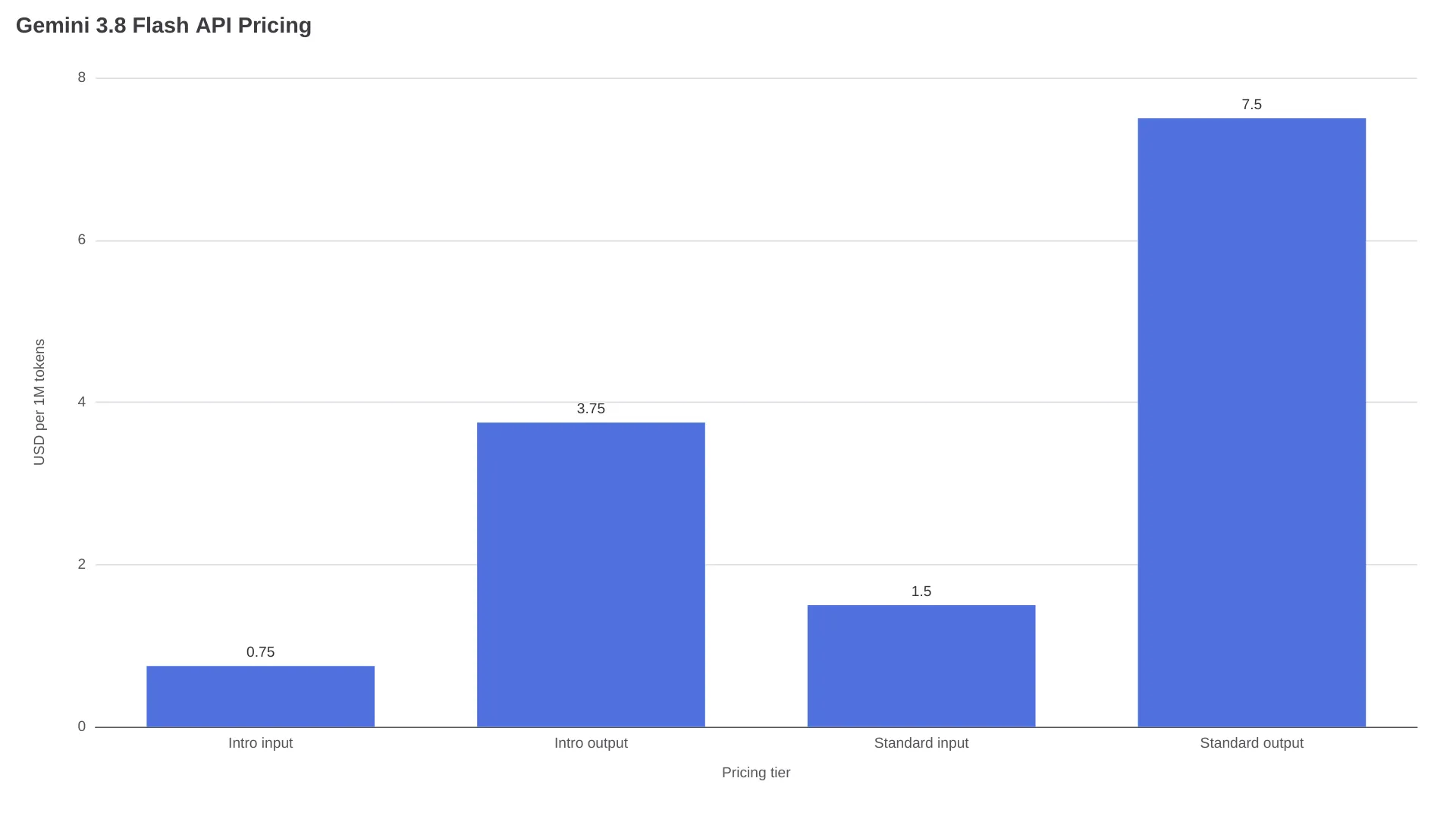
A task using 2 million input tokens and 500,000 output tokens costs $3.38 at the introductory rate: (2 × $0.75) + (0.5 × $3.75). The same mix costs $6.75 from January 1, 2027: (2 × $1.50) + (0.5 × $7.50).
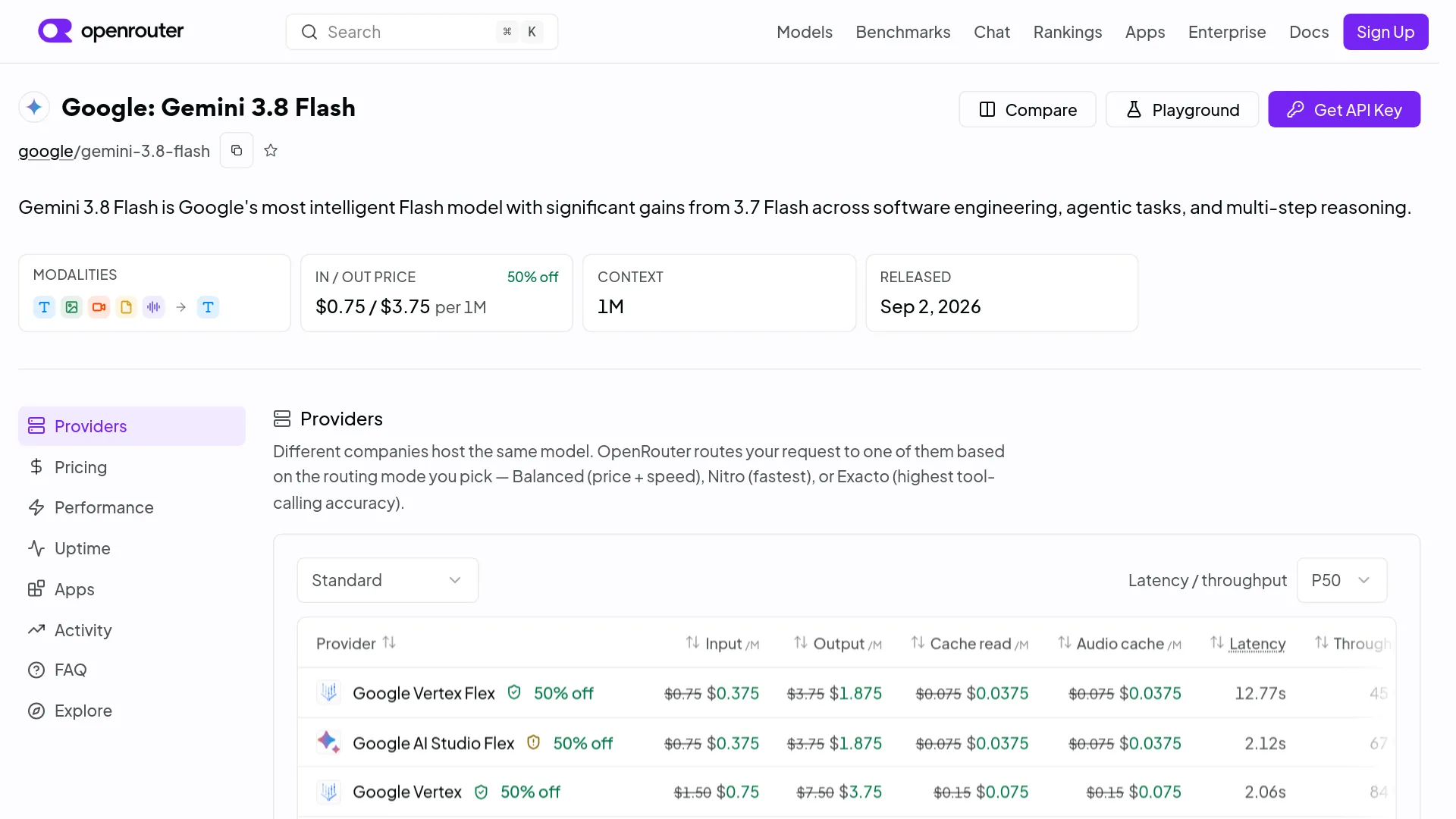
The OpenRouter Gemini 3.8 Flash page separately lists Google Vertex and Google AI Studio routes, cache prices, latency, throughput, and a displayed discount. Check the provider and billing path before comparing a router price with Google’s direct rate card.
Why a cheaper token can produce a larger bill
Artificial Analysis reports the following Gemini 3.8 Flash reasoning-level measurements:
| Reasoning level | Intelligence Index | Cost per task | Time per task |
|---|---|---|---|
| Low | 52 | $0.24 | 0.8 minutes |
| Medium | 57 | $0.41 | Not listed |
| High | 59 | $0.58 | 2.5 minutes |
Artificial Analysis does not list a medium-reasoning time in the cited analysis. The same analysis says Gemini 3.8 Flash generated 120 million output tokens during its Intelligence Index evaluation, compared with a 71-million-token median for comparable models. That is an evaluation-wide measurement, not a prediction for every API request. It does show why token price alone is a weak production budget. (Artificial Analysis model profile)
For an internal comparison, calculate total input, cached-input, reasoning, and output tokens per completed task, then divide API spend by successful tasks rather than requests sent. Include tool calls, retries, and human corrections.
API limits and capabilities
What the stable API supports
The official model page lists a maximum input limit of 1,048,576 tokens and a maximum output limit of 65,536 tokens. Gemini 3.8 Flash accepts text, images, video, audio, and PDF input, and returns text. It supports caching, code execution, file search, function calling, Google Maps grounding, search grounding, structured outputs, URL context, and computer use in Preview. (official model documentation)
Thinking levels are low, medium, and high; minimal is unsupported and returns an error. The model does not provide native image or audio generation, and the developer documentation does not list Live API support.
Where you can use it—and why Cyber is different
Google lists Gemini 3.8 Flash in the Gemini API, Google AI Studio, Android Studio, Stitch, Google Antigravity, Gemini Enterprise, the Gemini app, AI Mode in Google Search, and Gemini in Google Sheets. (Google launch announcement)
Gemini 3.8 Flash Cyber is a separate cybersecurity variant. Google says Fairwind access is prioritized for trusted defenders, including government authorities, critical-infrastructure operators, and software maintainers. The launch post reports more than 70% success on an internal vulnerability-discovery benchmark across 20 programming languages and 47.2% pass@1 on CWE-Bench patching; those figures describe Cyber, not the general model. Google’s announcement describes access through Fairwind, so do not assume the general Flash API route provides Cyber access. (Google Cyber announcement)
Early product rollout can differ by account and surface. One Reddit user reported:
“3.8 Flash is showing up for me in the Gemini web app now too, so it looks like it’s officially live. I’m in Australia on a Pro subscription, but it hasn’t appeared in AntiGravity or the iOS app yet.” — u/DMAC80, r/GeminiAI
For an application, verify the configured API model ID, gemini-3.8-flash, and any response metadata available to your integration; a model’s self-description is not endpoint verification.
What the evidence does not prove yet
| Documented limitation | Practical implication |
|---|---|
| Artificial Analysis reports 13.39 seconds to the first answer token at high reasoning, despite about 304.6 output tokens per second afterward. (Artificial Analysis model profile) | Expect an initial reasoning wait followed by fast generation. |
| The DeepMind model card gives a March 2026 knowledge cutoff, with some domains limited to January 2025. (Gemini 3.8 Flash model card) | Use search grounding or verified retrieval for current information. |
| Computer use is Preview-only, the developer docs do not list a self-hosting option, and output is text rather than image, audio, or video. (Google developer documentation) | Keep a separate deployment or model fallback for those requirements. |
A low-risk rollout plan for production traffic
- Select 30–50 real tasks that represent your production mix, including long-context cases and known failures.
- Run Gemini 3.8 Flash at low, medium, and high thinking levels against your current model.
- Log total tokens, cache hits, tool turns, retries, time to first token, completion time, human corrections, and accepted-task rate.
- Calculate cost per successful task and separate interactive traffic from batch traffic.
- Canary a small share of production requests before changing the default route.
- Keep Gemini 3.7 Flash for simple jobs if extra reasoning does not improve accepted-task cost.
- Budget the January 1, 2027 rate of $1.50 input and $7.50 output per million tokens.
The best first test has a checkable outcome: a multi-file change with tests, a document workflow with a known answer, or a multimodal extraction job with reviewed labels.
Gemini 3.8 Flash API pricing FAQ
How much does Gemini 3.8 Flash cost?
Google’s introductory direct API rate is $0.75 per million input tokens and $3.75 per million output tokens through December 31, 2026. From January 1, 2027, the listed rates become $1.50 and $7.50.
Is Gemini 3.8 Flash better than Gemini 3.7 Flash?
It is stronger on several launch-day reasoning and agentic measurements, including Artificial Analysis’s 59 versus 56 Intelligence Index result at high reasoning. Gemini 3.7 Flash can still be cheaper to operate for simple traffic because 3.8 may use more output tokens.
Is Gemini 3.8 Flash good for coding agents?
It is a credible candidate, with reported scores of 89.4% on Terminal-Bench 2.1 and 73.7% on DeepSWE 1.1. Its 19.1% Terminal-Bench 4.0 result means long-horizon terminal and desktop workflows need their own evaluation.
Is Gemini 3.8 Flash free?
The API is paid at the listed token rates. Check the current AI Studio project terms separately from the direct API rate card.
What is Gemini 3.8 Flash Cyber and who can access it?
Gemini 3.8 Flash Cyber is tuned for vulnerability discovery and automated patching. Google says access is prioritized through the Fairwind Program for trusted defenders; it is not a general public model available through an ordinary Gemini 3.8 Flash API key.
Start with low or medium reasoning on a fixed task set, measure cost per accepted result, and raise the effort level only where the additional work prevents a measurable failure.