 AIREITER
Google shipped Gemini 3.7 Flash three weeks after 3.6 Flash with a substantial capability jump: DeepSWE v1.1 went from 48.6% to 65.3%. Both models share the same $0.75/$3.75 per-million-token introductory pricing through December 2026, so the upgrade costs nothing per token. It pays off unevenly depending on your workload.
Benchmark Results: 3.7 Flash vs 3.6 Flash Head to Head
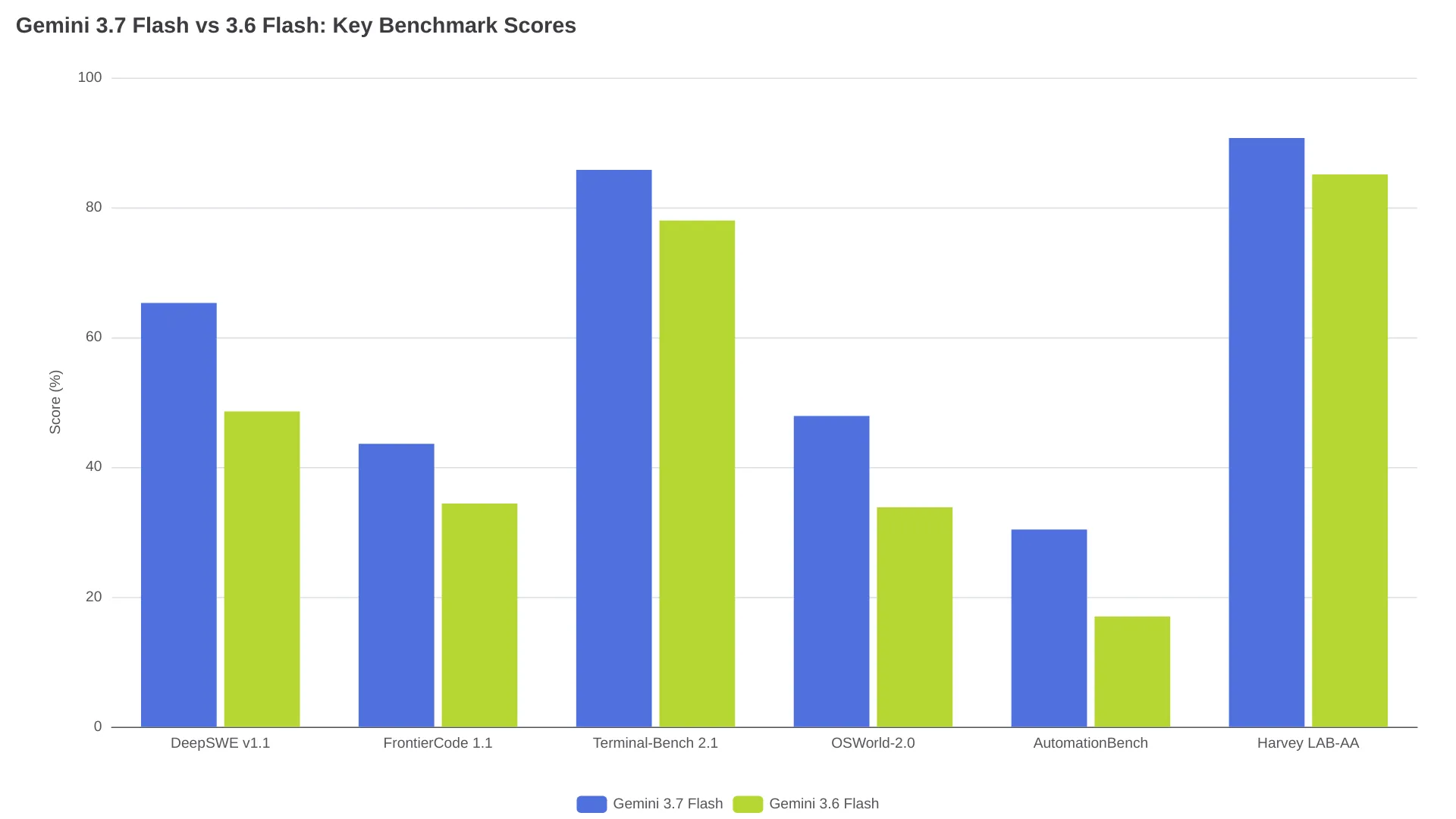
The headline numbers from Google DeepMind's official model page show across-the-board gains for 3.7 Flash, with the largest deltas in coding-agent and enterprise-automation benchmarks. The table below covers all 18 metrics Google publishes for both models, with Claude Sonnet 5 and GPT-5.6 Terra included for context.
| Benchmark | Gemini 3.7 Flash | Gemini 3.6 Flash | Delta |
|---|---|---|---|
| Artificial Analysis Intelligence Index (composite) | 56 | 52 | +4 |
| FrontierCode 1.1 (production code quality) | 43.6% | 34.4% | +9.2 |
| DeepSWE v1.1 (long-horizon software engineering) | 65.3% | 48.6% | +16.7 |
| Code Arena (web development Elo) | 1588 | 1538 | +50 |
| Terminal-Bench 2.1 (agentic terminal coding) | 85.8% | 78.0% | +7.8 |
| Terminal-Bench 3.0 (general agent capabilities) | 14.9% | 5.4% | +9.5 |
| AutomationBench (enterprise workflow automation) | 30.4% | 17.0% | +13.4 |
| GDPVal-AA v2 (knowledge work Elo) | 1525 | 1422 | +103 |
| Harvey LAB-AA (complex legal workflows) | 90.7% | 85.1% | +5.6 |
| GDP.pdf (expert PDF comprehension) | 34.0% | 22.0% | +12.0 |
| CharXiv, no tools (chart reasoning) | 84.5% | 85.2% | −0.7 |
| CharXiv, with tools | 88.7% | 89.4% | −0.7 |
| LVBench (long video understanding) | 85.4% | 84.2% | +1.2 |
| GDM-MRCR v2, 128k (long-context retrieval) | 97.0% | 91.8% | +5.2 |
| OSWorld-2.0 (agentic computer use) | 47.9% | 33.8% | +14.1 |
| Agent's Last Exam (desktop agent tasks) | 26.3% | 24.2% | +2.1 |
| HLE-Verified (multidisciplinary expert reasoning) | 53.6% | 51.2% | +2.4 |
| LABBench2 (biology research tasks) | 82.1% | 76.1% | +6.0 |
All figures are vendor-reported by Google DeepMind from the 3.7 Flash model page. Independent reproduction has not yet been published for most of these benchmarks, so treat the deltas as directional rather than guaranteed for your workload.
Coding and Agent Tasks: Where 3.7 Flash Leaps Forward
The coding and agentic benchmarks show the largest gaps between the two models. DeepSWE v1.1, which measures long-horizon software engineering on real repository tasks, jumped 16.7 percentage points, from 48.6% to 65.3%. That score now exceeds Claude Sonnet 5 (53.8%) and sits between it and GPT-5.6 Terra (69.6%) on the same metric (all comparison scores from the DeepMind benchmark table).
Beyond DeepSWE, the agent-oriented benchmarks show similar jumps:
- Terminal-Bench 3.0 (multi-tool agent capabilities): 5.4% → 14.9%, nearly tripling
- AutomationBench (enterprise workflow automation): 17.0% → 30.4%
- FrontierCode 1.1 (production code quality): +9.2 points
- OSWorld-2.0 (agentic computer use): 33.8% → 47.9%
Early user sentiment on Reddit captures the gap between benchmark wins and daily developer experience:
Effective for implementation, but may be weaker for planning, code review, and difficult problem decomposition.
— User discussion on r/google_antigravity
Google's own customer evidence, published on the DeepMind model page, reinforces this. Browser Use reported that "the Gemini 3.7 Flash agent was 35% cheaper than 3.6 Flash, with a +8% observed prompt-cache hit rate and fewer tool errors." Harvey measured a 2.6-point all-pass lift on Legal Agent Bench. Nunu.ai found on-par performance with GPT-5.6-Terra "at around half the cost." All three attribute savings to fewer agent-loop steps, not per-token discounts.
Knowledge Work and Multimodal: Smaller but Real Gains
Outside of coding, the gains narrow. The Artificial Analysis Intelligence Index rose from 52 to 56, placing 3.7 Flash between Claude Sonnet 5 (55) and GPT-5.6 Terra (57) per the DeepMind comparison table. The strongest non-coding improvement is document comprehension: GDP.pdf jumped from 22.0% to 34.0%, a 12-point gain for pipelines ingesting complex documents, financial reports, or legal filings. GDM-MRCR v2, measuring long-context retrieval at 128K tokens, improved from 91.8% to 97.0%.
Harvey LAB-AA, which evaluates complex legal workflows, rose from 85.1% to 90.7%. Long-video understanding (LVBench) and biology research tasks (LABBench2) both improved by about 6 points. These matter for specialized workloads but are unlikely to drive an upgrade decision on their own.
Pricing Reality: Same Introductory Rate for Both Models
| Model | Input ($/1M tokens) | Output ($/1M tokens) | Standard rate (from Jan 1, 2027) |
|---|---|---|---|
| Gemini 3.7 Flash | $0.75\* | $3.75\* | $1.50 / $7.50 |
| Gemini 3.6 Flash | $0.75\* | $3.75\* | $1.50 / $7.50 |
| Claude Sonnet 5 | $2.00 | $10.00 | — |
| GPT-5.6 Terra | $2.00 | $12.00 | — |
\*Introductory price expires December 31, 2026. All pricing from the DeepMind model page.
Google applied the $0.75/$3.75 promotional rate to both Flash models when 3.7 launched on August 13, 2026. Before that, 3.6 Flash charged $1.50/$7.50 as its standard rate. Starting January 1, 2027, both revert to $1.50/$7.50 unless Google extends the promotion. At identical per-token prices, the cost difference comes from task efficiency: Browser Use's reported 35% agent-cost reduction was measured on the same workloads, attributed to fewer tool calls and higher cache hit rates rather than different pricing.
For a detailed breakdown of 3.7 Flash API costs including caching, Batch API, and grounding charges, see our Gemini 3.7 Flash API pricing guide.
Where 3.6 Flash Still Wins
3.6 Flash holds a narrow edge in chart reasoning. On CharXiv without tools, 3.6 scores 85.2% versus 3.7's 84.5%. With tools enabled, the gap is identical: 89.4% vs 88.7%. These sub-1-point margins are narrow enough that either model could perform comparably on individual chart tasks. Validate on your own chart workload before choosing a default.
No other benchmark in Google's comparison table shows 3.6 ahead of 3.7. The intelligence index gap (52 vs 56) is the closest contested area outside of chart reasoning, but even there 3.7 leads.
Migration: What Changes Beyond the Model String
The mechanical migration is a model ID change: swap gemini-3.6-flash for gemini-3.7-flash. According to the DeepMind model page, both models share the same context window (1M input, 64K output), the same input modalities (text, image, video, audio, PDF), and the same tool-use capabilities (function calling, search grounding, computer use). The model page lists 3.7 Flash's status as general availability.
One caveat: the 3.5-to-3.6 transition introduced silent API behavior changes that caught developers off guard. As documented by independent testing, temperature, top_p, and top_k were silently ignored, thinking_budget became a string-enum thinking_level, and response prefilling was removed. Google has not yet published whether 3.7 Flash introduces similar changes. Until that documentation exists, run your evaluation suite against both model strings before migrating production traffic. Keep 3.6 available as a fallback.
Should You Switch to 3.7 Flash?
The decision breaks down by workload type:
- Switch now if you run coding agents. DeepSWE v1.1 gained 16.7 points and Terminal-Bench 3.0 nearly tripled. At the same per-token price, there is no financial reason to stay on 3.6 for coding-agent workloads.
- Switch now if you process complex documents. GDP.pdf comprehension jumped 12 points (22.0% → 34.0%). Long-context retrieval at 128K tokens is near-perfect at 97.0%.
- Test first if chart reasoning is your primary task. CharXiv scores favor 3.6 by less than 1 point. Run a side-by-side evaluation before committing.
- Stay on 3.6 if your pipeline is validated and stable. The DeepMind model page does not list a retirement date for 3.6 Flash. If your workflow passes regression tests and you have no immediate need for the coding gains, the cost of debugging behavioral shifts may exceed the benefit. Migrate one workflow at a time.
- Factor in the release cadence. Google shipped 3.7 three weeks after 3.6. Migrate the workflows where 3.7's gains are largest now, keep 3.6 pinned as a fallback, and treat each Flash release as an incremental upgrade to evaluate rather than a platform shift.
You can compare both models side by side through the Gemini 3.7 Flash and Gemini 3.6 Flash chat interfaces.
Is Gemini 3.7 Flash a new architecture or a post-training update?
Google has not publicly characterized 3.7 Flash as either a new architecture or a post-training patch. The Artificial Analysis Intelligence Index moved from 52 to 56, whereas independent testing confirmed that 3.5 and 3.6 Flash both scored 50 on the same index. Whether 3.7's improvement reflects architectural changes or improved training data is not documented.
Does Gemini 3.7 Flash cost more than 3.6 Flash?
No. Both models share the same $0.75 per million input tokens and $3.75 per million output tokens through December 31, 2026. After that, both move to $1.50/$7.50. Savings from upgrading come from fewer tool calls and reasoning steps per task, not lower per-token pricing.
Where is Gemini 3.7 Flash available?
According to the DeepMind model page, 3.7 Flash is available through Gemini API, Google AI Studio, Google Antigravity, Vertex AI, Gemini Enterprise, and the Gemini App, with general availability status.
Should I wait for the next Flash version instead of migrating now?
3.7 Flash is a GA model with published benchmarks and customer adoption. If your workload benefits from the coding and agent gains, migrate those workflows now and re-evaluate when the next version ships. Waiting introduces opportunity cost from the gains you could already be using.