 AIREITER
A team can swap claude-fable-5 for claude-fable-5-1 and get a successful first response, then discover that its tool router or mutable conversation history no longer works. Fable 5.1 is the stronger default for long-running, cache-heavy work, but it is not a risk-free drop-in: list prices and limits stay the same while three API behaviors change.
The short answer: upgrade for cached agents, not every request
Claude Fable 5.1 is the current successor to Claude Fable 5, and Anthropic’s documentation recommends moving to it for improved performance. The practical upgrade is clearest when an agent repeatedly reads a large prompt prefix: cache reads fall from $1 to $0.25 per million tokens, while standard input and output rates remain $10 and $50 per million tokens. (Anthropic’s Fable 5.1 overview)
| If your workload… | Start with… | Why |
|---|---|---|
| Reuses a long system prompt, codebase, or document context | Fable 5.1 | Cache reads are 75% cheaper, and Anthropic reports stronger agentic results. |
Uses forced tool calls such as tool_choice: {"type":"any"} | Test Fable 5.1 before switching | Fable 5.1 rejects forced tool selection with a 400 error. |
| Edits or rebuilds earlier conversation turns | Keep Fable 5 until the history layer is fixed | Fable 5.1 binds thinking blocks to the preceding prompt, tools, and history. |
| Needs the lowest standard token price | Neither Fable model | Both cost $10 per million input tokens and $50 per million output tokens. |
| Runs ordinary, non-cached prompts with a stable Fable 5 integration | Run an evaluation first | The list-price saving may be small, and benchmark gains vary by task. |
What changed from Fable 5 to Fable 5.1
Claude Fable 5.1 keeps the main capacity profile of Claude Fable 5: a 1-million-token context window, 128,000-token maximum output, and always-on adaptive thinking. The documented differences are lifecycle status, a June 2026 knowledge cutoff instead of January 2026, cheaper cache reads, and new API behavior around tools and thinking blocks. (Fable 5 legacy overview; Fable 5.1 model overview)
| Specification | Claude Fable 5 | Claude Fable 5.1 |
|---|---|---|
| API model ID | claude-fable-5 | claude-fable-5-1 |
| Lifecycle | Active, legacy | Active, latest Fable model |
| Release date | June 9, 2026 | September 1, 2026 |
| Context window | 1M tokens | 1M tokens |
| Maximum output | 128K tokens | 128K tokens |
| Thinking | Adaptive, always on | Adaptive, always on |
| Default effort | High | High |
| Reliable knowledge cutoff | January 2026 | June 2026 |
| Input / output price | $10 / $50 per MTok | $10 / $50 per MTok |
| Cache-read price | $1 / MTok | $0.25 / MTok |
Fable 5.1 is available through the Claude API, Amazon Bedrock, Google Cloud, Microsoft Foundry, and Claude Platform on AWS. Anthropic lists Fable 5 as available on the same platform families, with retirement no sooner than June 9, 2027; Fable 5.1 is not scheduled for retirement before September 1, 2027. (Fable 5.1 availability and lifecycle; Fable 5 availability and lifecycle)
The price difference is in cache reads, not list rates
Fable 5.1 is not cheaper on a normal fresh input or output token. Fable 5.1 charges the same $10 per million input tokens and $50 per million output tokens as Fable 5, but a cache read costs $0.25 per million tokens instead of $1. (Anthropic pricing documentation)
| Usage category | Fable 5 | Fable 5.1 | Change |
|---|---|---|---|
| Fresh input | $10 / MTok | $10 / MTok | None |
| Output | $50 / MTok | $50 / MTok | None |
| 5-minute cache write | $12.50 / MTok | $12.50 / MTok | None |
| 1-hour cache write | $20 / MTok | $20 / MTok | None |
| Cache read | $1 / MTok | $0.25 / MTok | 75% lower |
| Batch input / output | 50% discount | 50% discount | Same stated discount |
For a simple illustration, assume an agent reads a cached 1-million-token project context ten times and then generates 200,000 output tokens. The cache-read portion costs $10 on Fable 5 and $2.50 on Fable 5.1; the output costs $10 on either model. Under those narrow assumptions, the token bill falls from $20 to $12.50, or 37.5%.
Actual savings depend on cache hits, writes, output length, retries, tool calls, and fallback routing. Anthropic estimates about 25% lower cost for typical workloads and up to about 45% lower cost for highly agentic workloads. (Anthropic’s Fable product page)
Subscription usage is separate from API economics. Anthropic’s help center says Fable 5 and Fable 5.1 follow the same current plan mechanics: Max and premium Team or legacy Enterprise seats can use Fable models for up to 50% of the weekly usage limit, while Pro and standard seats use pay-as-you-go usage credits. The earlier Fable 5 promotion ended July 19, 2026, and Fable 5.1 was not part of it. (Anthropic plan guidance)
Benchmarks show a real but uneven upgrade
Anthropic’s published comparison gives Fable 5.1 a clear lead on several agentic and computer-use measurements, but the size of the lead ranges from modest to very large. These are vendor-reported results from safeguarded, version-specific evaluations, so use them directionally and validate on your own prompts. (Anthropic’s benchmark table)
| Benchmark | Fable 5.1 | Fable 5 | Difference |
|---|---|---|---|
| Terminal-Bench-Science 0.1 | 52.6% | 24.7% | +27.9 points |
| Terminal-Bench 4.0 | 55.8% | 42.0% | +13.8 points |
| GDPval-AA v2 | 1,853 Elo | 1,723 Elo | +130 Elo |
| OSWorld 2.0, partial | 77.9% | 72.9% | +5.0 points |
| OSWorld 2.0, strict | 41.7% | 36.1% | +5.6 points |
| Humanity’s Last Exam, no tools | 60.9% | 57.8% | +3.1 points |
| Humanity’s Last Exam, with tools | 65.0% | 63.8% | +1.2 points |
| AutomationBench | 31.4% | 17.1% | +14.3 points |
| CursorBench 3.2.0 | 73.4% | 70.5% | +2.9 points |
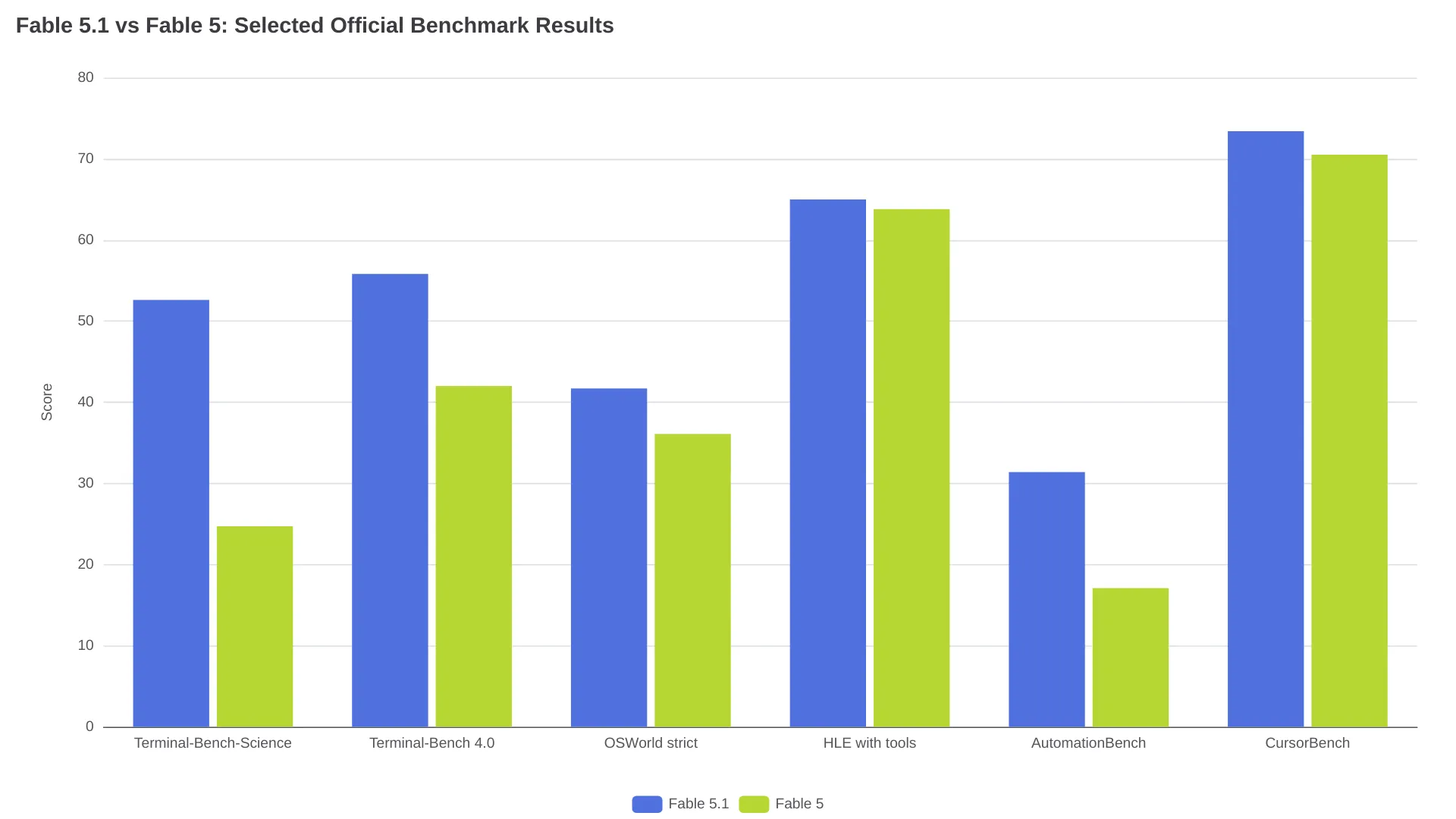
The largest published gap is Terminal-Bench-Science 0.1, where Fable 5.1 more than doubles Fable 5’s reported score. AutomationBench and Terminal-Bench 4.0 also show sizeable increases. The smaller gains on Humanity’s Last Exam and CursorBench support a narrower conclusion: Fable 5.1 is not uniformly better by the same margin on every type of work.
Anthropic’s table lists the 55.8% Terminal-Bench 4.0 result for public Fable 5.1 and reports Mythos 5.1 separately at 60.9%. Mythos 5.1 is not a generally available replacement for Fable 5.1. (Anthropic’s product page)
API migration: three Fable 5 behaviors to test first
Anthropic describes the Fable 5.1 migration as mostly drop-in, but three changes can produce production failures or silently alter agent behavior. Test these before changing the model ID in every environment. (Fable 5.1 migration guide)
1. Forced tool choice returns a 400
Fable 5.1 accepts tool_choice: {"type":"auto"} and tool_choice: {"type":"none"}. It rejects {"type":"any"} and named-tool forcing with a 400 invalid_request_error, including in the Messages API, Message Batches API, and token-counting endpoint.
If the application needs valid JSON, use structured outputs where available or keep tool choice at auto with a strict schema and an explicit instruction. If the application needs a particular tool on one turn, Anthropic documents an appended, turn-scoped system instruction as the replacement pattern.
2. Thinking blocks are bound to their producing model
Fable 5.1 can read preserved thinking blocks from Fable 5 and earlier compatible Claude models. Older models cannot read Fable 5.1 thinking blocks; if a fallback sends the conversation to an older model, the API drops the unreadable blocks and the fallback must plan again.
The dropped blocks are not billed as input, but the new planning pass can increase latency and first-turn cost after a model switch. For debugging, Anthropic documents the thinking-binding-controls-2026-08-01 beta header, which reports a model_binding_mismatch transformation.
3. Editing earlier history can invalidate the request
On newer API accounts, Fable 5.1 checks whether the system prompt, tools, or earlier message history changed before a preserved thinking block. Editing, reordering, deleting, or rebuilding that prefix can return a 400 invalid-signature error instead of producing a response.
The safe default is append-only history. Use server-side compaction or context editing rather than splicing a summary into the middle of a transcript, and keep cross-turn files stable by using a Files API file_id or identical bytes. A client that already preserves the exact prefix may need only a model-ID change; a client that reconstructs messages on each turn needs an adapter first.
Additive changes worth using
Fable 5.1 also adds controls that can improve a long-running agent without a full rewrite:
- Per-message effort: change
low,medium,high,xhigh, ormaxfrom a later turn without invalidating the cached prefix. - Turn-scoped system messages: add a one-turn instruction without injecting and deleting text from the earlier system prompt.
- Progress updates: request readable updates between tool calls with the documented display settings.
- Lower cache-read pricing: keep the repeated prefix, but re-measure cache hit rates after migration.
The effort name is not a portable unit of work. Start with the documented default of high, then compare quality, latency, and total tokens at medium and higher settings on the actual task set.
Access, quotas, and fallback can change the practical result
Fable 5.1 is broadly available on paid Claude plans and through Anthropic’s API and listed cloud platforms, but plan access does not mean unlimited included usage. Pro users and standard Team seats may need usage credits from the first request, while Max and premium seats share a Fable-specific portion of their weekly pool. Claude Code requires version 2.1.250 or later for Fable 5.1; Fable 5 requires version 2.1.170 or later. (Anthropic’s plan and access guide)
Automatic switching can also make a Fable comparison look different in the app than in the API. Anthropic says sensitive cybersecurity and biology requests can be routed to Opus fallback models, and that automatic switching is active by default in Claude surfaces. In the API, developers must configure fallbacks; a refusal is returned as a successful HTTP response with a refusal stop reason unless fallback handling is added. (Anthropic fallback guidance)
Early user reports are anecdotal, but they identify two costs a pilot should measure:
“5.1 seems fine but it does seems slower.” — u/BeowulfShaeffer, r/ClaudeAI release discussion
“I’m already at 100% usage.” — u/noeyb, r/ClaudeAI release discussion
These comments do not establish a general performance rate, but they make wall-clock time and quota burn worth logging alongside answer quality.
A decision table for Fable 5 users
| Situation | Practical choice |
|---|---|
| New agent with repeated context reads | Fable 5.1, with cache-hit and latency logging from day one |
| Existing Fable 5 agent with append-only history and automatic tools | Pilot Fable 5.1 on a representative task slice |
| Existing agent that forces named tools | Fix tool selection first, then test Fable 5.1 |
| Existing client that rewrites old messages or system prompts | Keep Fable 5 as a fallback while the history layer is redesigned |
| Mostly fresh prompts with little cache reuse | Compare completed-task cost, not just token rates |
| Work likely to trigger cyber or biology safeguards | Model the fallback path and its Opus pricing before migrating |
| Need lower standard input/output rates | Compare another Anthropic model, because Fable 5.1 and Fable 5 have identical list rates |
A practical migration test can stay small: replay 20 to 50 representative tasks, pin the same tools and prompts, and record success rate, forced-tool errors, fallback count, cache-read tokens, total input/output tokens, latency, quota burn, and completed-task cost. Promote Fable 5.1 only if it clears the quality bar without creating an unacceptable compatibility or quota failure.
Questions buyers still ask
Why did Claude switch away from Fable 5.1?
A safeguard classifier can trigger an automatic fallback for some cybersecurity, biology, reasoning-extraction, or frontier-model-development requests. In Claude apps, the request may be rerun on an Opus model; in the API, fallback behavior must be configured by the developer. (Anthropic fallback guidance)
Fable 5.1 is the better target for a new long-horizon agent and for Fable 5 workloads with substantial cache reuse. Keep Fable 5 during a compatibility pilot when the integration forces tools, edits message history, or cannot tolerate fallback and quota uncertainty.