 AIREITER
Claude Opus 5 costs half of Claude Fable 5, and by Anthropic's own launch numbers it lands within 0.5% of Fable 5's peak CursorBench 3.2 score at max effort.
It also beats Fable 5's best OSWorld 2.0 result at roughly a third of the cost per task (both vendor-reported, no independent replication yet). Fable 5 still lists at double the price, on every line:
| Per million tokens | Claude Fable 5 | Claude Opus 5 | Ratio |
|---|---|---|---|
| Input | $10 | $5 | 2.0x |
| Output | $50 | $25 | 2.0x |
| Cache write, 5 min | $12.50 | $6.25 | 2.0x |
| Cache read | $1 | $0.50 | 2.0x |
| Batch API | $5 / $25 | $2.50 / $12.50 | 2.0x |
Verified against Anthropic's pricing page on July 25, 2026. So Claude Opus 5 vs Fable 5 is one question: what has to be true about your workload before the 2x comes back?
Short answer, with the arithmetic below: Fable 5 has to succeed about 60% more often than Opus 5, which makes Opus 5 the default and Fable 5 the exception.
The 2x is exactly 2.0x, and three places it collapses
Do not stack tokenizer inflation on top of the rate difference. The models overview says Fable 5's tokenizer, introduced with Opus 4.7, produces "roughly 30% more tokens" than models before Opus 4.7. Opus 5 is also a 4.7-and-later model, so both sides inflate identically and the gap stays 2.0x, not 2.6x.
Three price points break the ratio outright:
- Opus 5 fast mode costs $10 / $50, Fable 5's standard rate. At equal spend the trade is Fable 5's capability against Opus 5 at up to roughly 2.5x output tokens per second. Claude API only.
- Fable 5 on the Batch API costs $5 / $25, Opus 5's sticker price. Latency-tolerant work gets the frontier model at the default model's synchronous list rate. Batch against batch the 2x holds, so this is billing-mode arbitrage, not a discount.
- Fable 5 cache reads cost $1, against Opus 5's $0.50. Like for like the ratio stays 2x, but Fable 5 reading from cache costs a fifth of Opus 5 reading fresh input, so cache-heavy loops shrink the absolute gap.
Our four tasks: Fable 5 spent fewer tokens and cost more
We ran four mechanically scored tasks once per model on July 24, 2026: a two-defect kth_smallest bugfix, a strict-JSON schema task, a Frobenius-number question (packs of 7 and 12, answer 65), and a comment-free refactor with validation. Both models passed 4 of 4.
| Task | Opus 5 output | Fable 5 output | Channel |
|---|---|---|---|
| Two-defect bugfix | 36 tok / 4.52s | 69 tok / 5.61s | Claude Code |
| Strict JSON schema | 94 tok / 4.8s | 86 tok / 4.4s | Gateway |
| Frobenius number (65) | 407 tok / 6.8s | 358 tok / 7.3s | Gateway |
| Refactor, no comments | 429 tok / 6.93s | 251 tok / 8.09s | Claude Code |
| Total | 966 tok / 23.05s | 764 tok / 25.40s | |
| Output cost at list | $0.024 | $0.038 |
Fable 5 produced 21% fewer output tokens and still cost about 1.6x per pass, because its output rate is double. The cheaper model was the more verbose one, and Fable 5's token thrift recovered less than half of its own premium.
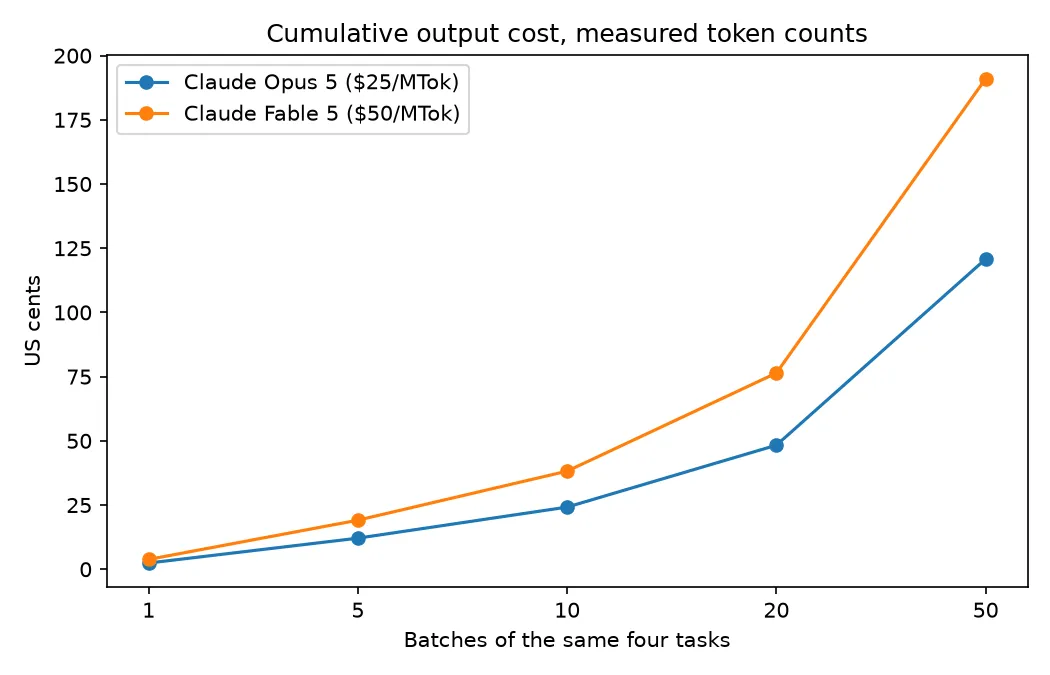
The docs rate Fable 5 "Slower" against Opus 5's "Moderate", and it was slower on three of four tasks here.
Three caveats on those numbers:
- One run per (model, task) pair at default effort, scored mechanically. A smoke test, not a benchmark.
- Output tokens only, at official rates: our gateway reported wildly varying prompt-token counts for the same prompt, so a real bill adds input and cache cost.
- Token counts track thinking configuration, not quality. Opus 5 runs thinking on by default at effort
high; Fable 5's always-on adaptive thinking scaled down on the two short tasks.
The totals also mix channels: Fable 5 returned an empty completion on both code tasks through our OpenAI-compatible gateway, three times in a row, so those rows come from Claude Code's first-party channel. That is a routing fault rather than a fact about Fable 5's coding, worth a health check if a relay sits in your stack.
The break-even calculation
Token price is the wrong unit. Expected spend per completed task decides this:
expected cost per success = cost per attempt / first-pass success rateThat formula already absorbs retries, since the expected number of attempts at success rate p is 1/p. Set the two models equal, cancel the shared terms, and Claude Opus 5 vs Fable 5 reduces to one inequality:
success_rate(Fable 5) / success_rate(Opus 5) >= cost_per_attempt(Fable 5) / cost_per_attempt(Opus 5)The right side is 2.0 if both models emit the same token count, and 1.58 with our measured output mix. Call the working threshold 1.6 on output cost alone: Fable 5 has to succeed about 60% more often than Opus 5 before the premium returns. Input-heavy or cache-heavy workloads push it back toward 2.0x.
| If Opus 5 solves it first try | Fable 5 must solve it |
|---|---|
| 30% of the time | 47% |
| 40% | 63% |
| 50% | 79% |
| 60% | 95% |
| 63% | 100% |
| 70% | unreachable |
The bottom two rows decide it. Once Opus 5 clears roughly a 63% first-pass rate, no capability gain makes Fable 5 cheaper per outcome, because Fable 5 cannot exceed 100%. On the general 2.0x ratio that ceiling falls to 50%.
So Fable 5's economic case lives inside the tasks Opus 5 fails, which is the same reason the best Claude model for coding at a fixed budget is rarely the one at the top of the lineup. The threshold rests on three assumptions, and breaking any one moves it toward Fable 5:
- Attempts are independent.
- Failures are cheap to detect.
- A failure costs no more than a retry.
One worry the arithmetic does not cover is whether the premium buys the model that gets superseded. The model deprecations page lists both as Active:
claude-fable-5retires "not sooner than June 9, 2027".claude-opus-5retires "not sooner than July 24, 2027".
Anthropic gives at least 60 days' notice, and those floors cover Anthropic-operated platforms only. So this is a cost-per-outcome decision, not a bet on a survivor.
Where the 2x pays for itself
Three cases justify the premium:
- Failures you cannot detect cheaply. A test suite makes
1/phonest; an eight-hour run that fails at hour six does not, because the bill includes wasted compute plus the engineer reconstructing it. Anthropic aims Fable 5 here: "built for the most demanding reasoning and long-horizon agentic work." - Deliverables worth more than the tokens. R&D World reports Stripe migrating a 50-million-line Ruby codebase in one day. At that ratio of outcome to spend, per-token pricing stops being a variable.
- Guaranteed capacity. Priority Tier covers Fable 5 and Opus 4.8 and excludes Opus 5, so a request naming Opus 5 fails validation there. This is the one axis where 2x buys something the cheaper model cannot sell, and it holds only for organisations that already have a commitment.
Where it does not, and two hard blocks
Zero data retention is a wall, not a price. Fable 5 and Mythos 5 carry 30-day retention as designated Covered Models and are unavailable under ZDR, so a ZDR organisation gets 400 invalid_request_error on every Fable 5 request, whatever the budget. Opus 5 has no such limit.
Security-adjacent coding buys a worse experience for the premium. The classifier that shipped with Fable 5's restoration, in Anthropic's wording, "comes at the cost of flagging benign requests more often during routine coding and debugging tasks." Blocked requests reroute to Opus 4.8, and a mid-stream refusal bills the streamed partial while delivering nothing. Two outside measurements size that tax:
- R&D World's Terminal-Bench breakdown: a safety refusal on 20.9% of trials, scoring 84.3 against identically weighted Mythos 5's 88.0.
- CodeRabbit's 105-example code-review run: 65 actionable issues against 66 for Opus 4.8, at lower precision.
Three more costs sit outside the rate:
- Availability history. Anthropic's redeployment statement records both models suspended from June 12 to July 1, 2026, about 18 days with zero access for all users, after US export controls "required us to restrict access to foreign nationals, whether inside or outside the United States."
- Integration work. The launch docs tell integrators calling Fable 5 to plan for new refusal handling, fallback retries on another Claude model, and new billing rules. The 1x model asks for none of it.
- Two features run the wrong way. Opus 5's reliable knowledge cutoff is May 2026 against Fable 5's January 2026, and mid-conversation tool changes (beta
mid-conversation-tool-changes-2026-07-01) are Opus 5 onward.
Where Mythos 5 and Project Glasswing sit
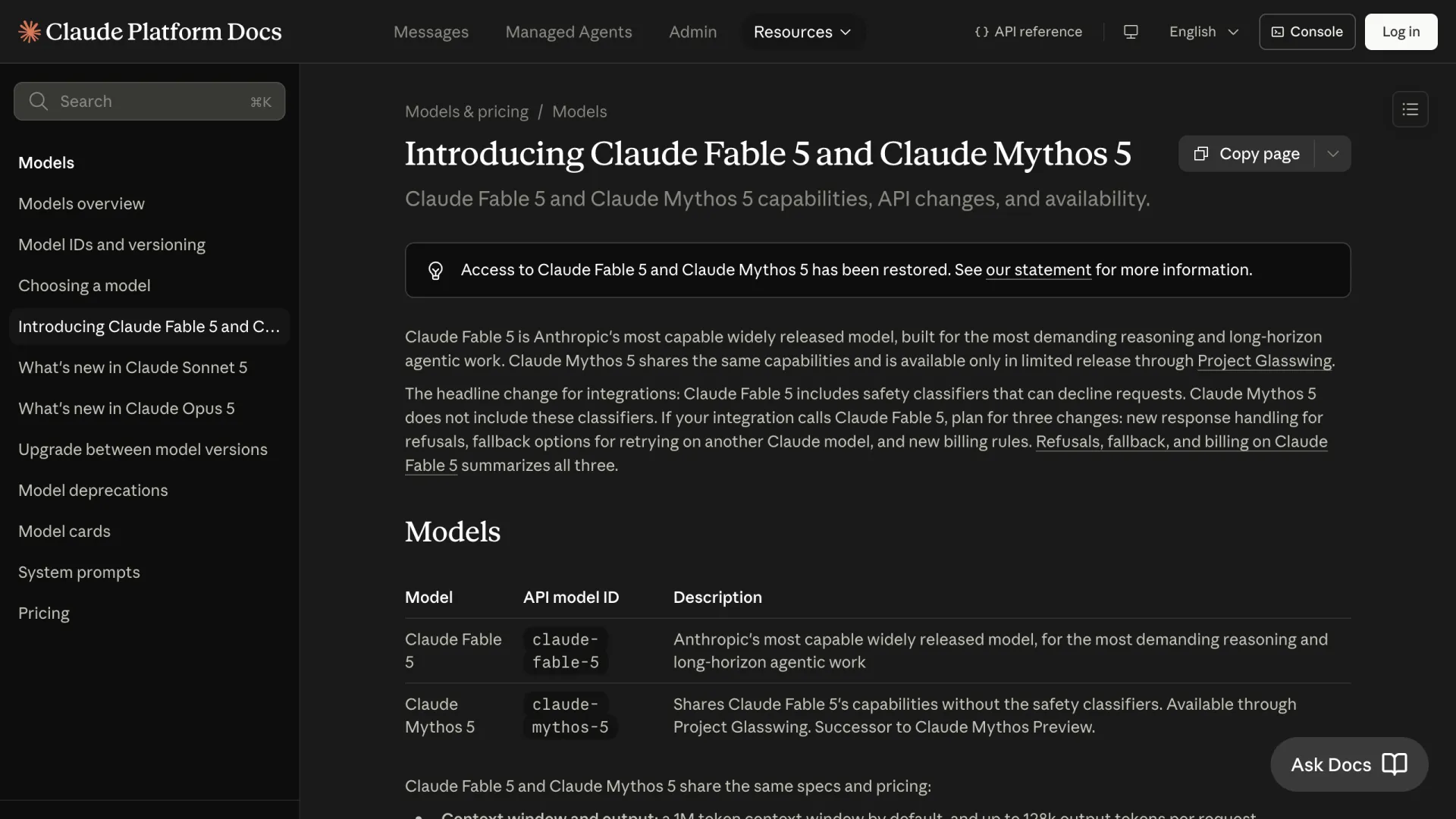
Anthropic still calls Fable 5 "Anthropic's most capable widely released model". Widely released is the qualifier that excludes Claude Mythos 5 (claude-mythos-5), which carries the same capabilities at the identical $10 / $50 price.
Mythos 5 ships only through Project Glasswing, a limited defensive-cybersecurity release with no self-serve signup. The split is classifiers and access, not capability: it is Fable 5 without the safety classifiers, not a stronger model.
That reorders the security case. Anthropic puts Opus 5 behind Mythos 5 on cybersecurity and biology, and "far behind" on exploit development (vendor-reported). The strongest Claude for security work is the one you cannot buy, and the one you can buy at 2x is the one whose classifier flags benign debugging. Mythos 5 measured against Opus 4.8 covers that lineage.
How to call each one
Model IDs and access
Opus 5 ships as claude-opus-5 and is Claude Max's new default. Fable 5 is claude-fable-5 on the same API, and either one is picked in Claude Code through /model. Opus 5 runs on:
- Claude API, claude.ai, Claude Code and Claude Cowork
- Amazon Bedrock, as
anthropic.claude-opus-5 - Google Cloud and Microsoft Foundry
Both run a 1M-token window with 128k max output, so context is not a tiebreaker. On consumer plans Fable 5's allowance moved to usage credits after July 7, and standard Enterprise seats carry "no included Fable 5 allowance", so an organisation without credits has no Fable 5 access at all.
The spend lever
Effort and thinking controls are where the money moves. Opus 5 exposes low through max, defaults to high, and accepts thinking disabled at high or below. Fable 5's adaptive thinking cannot be disabled at all, a floor under its output tokens rather than a dial.
If you route Claude through an Anthropic-compatible gateway, check which side of this matchup it carries.
AIReiter prices Opus 4.8 at $1.56 / $7.76 per MTok against the official $5 / $25, roughly 69% below. As of July 25 its Claude lineup stops at Fable 5, Sonnet 5, Opus 4.8 and Opus 4.7, with no Opus 5 entry yet.
The recommendation, and the one exception
Default to Opus 5 and treat Fable 5 as an escalation you justify per task class. Anthropic's own guidance agrees: "start with Claude Opus 5 for complex agentic coding and enterprise work. For workloads that need the highest available capability, use Claude Fable 5."
Two cases change the inputs rather than beating the threshold:
- Long autonomous runs, where a silent failure costs more than the retry and
pstops being measurable. - Anything asynchronous, where Fable 5 on Batch matches Opus 5's synchronous list price.
One exception overrides the arithmetic rather than satisfying it: Priority Tier. Fable 5 and Opus 4.8 sit inside it while Opus 5, Sonnet 5 and Mythos 5 are excluded, so a workload needing committed 99.5%-uptime throughput cannot buy the cheap side at any price.
Read that narrowly. Anthropic states those capacity commitments "are no longer available for purchase", and existing holders keep them only to their contract's end date. Without one already in hand, this exception is closed to you and the break-even arithmetic stands unchallenged.
FAQ
Is Opus 5 better than Fable 5?
Opus 5 reaches within 0.5% of Fable 5's peak CursorBench 3.2 score at max effort for half the cost per task (vendor-reported, not independently replicated), and its knowledge cutoff is newer, May 2026 against January 2026.
Fable 5 keeps the most-capable-widely-released title and a design aimed at long-horizon agentic runs. Its Priority Tier eligibility only helps organisations that already hold a commitment.
Why was Fable 5 removed from Claude, and is it back?
Anthropic suspended both models for all users from June 12 to July 1, 2026, after US export controls required restricting access to foreign nationals. The trigger was an externally reported way of prompting Fable 5 past its safeguards to find software vulnerabilities. Access is restored, with a retrained classifier that blocks it in over 99% of cases while flagging benign coding requests more often.
Is Claude Fable 5 free?
No. It runs $10 / $50 per million tokens on the API. Consumer plans included it for up to 50% of weekly usage limits through July 7, after which access moved to usage credits, with no allowance on standard Enterprise seats. The cheapest route at volume is the Batch API at $5 / $25.
Does Fable 5's tokenizer make the real gap 2.6x?
No. Both use the tokenizer introduced with Opus 4.7, so the roughly 30% inflation applies against Sonnet 4.6 and earlier, not between these two. Per token the gap is 2.0x, and in our sample Fable 5 emitted 21% fewer output tokens, putting the per-pass gap at about 1.6x.
What is the difference between Fable 5 and Mythos 5?
Identical specs and $10 / $50 pricing. Mythos 5 shares Fable 5's capabilities without the safety classifiers and ships only through Project Glasswing, with no self-serve signup. Both are Covered Models with 30-day retention, and both were suspended in the same June window.
Can I disable thinking on Fable 5 to cut the bill?
No. Fable 5's adaptive thinking is always on, so its output-token floor is structural. Opus 5 accepts thinking: {"type": "disabled"} at effort high or below and returns 400 at xhigh and max, which makes effort a cost dial only on the cheaper model.
The number to keep
One ratio settles Claude Opus 5 vs Fable 5 for most task classes, and it points at Opus 5. The same arithmetic runs across vendors, where Opus 5 against the GPT-5.6 family only changes the rates.
- Break even when
success_rate(Fable 5) / success_rate(Opus 5) >= 1.6on your workload. Below that line, Opus 5 plus a retry costs less per finished task.