 AIREITER
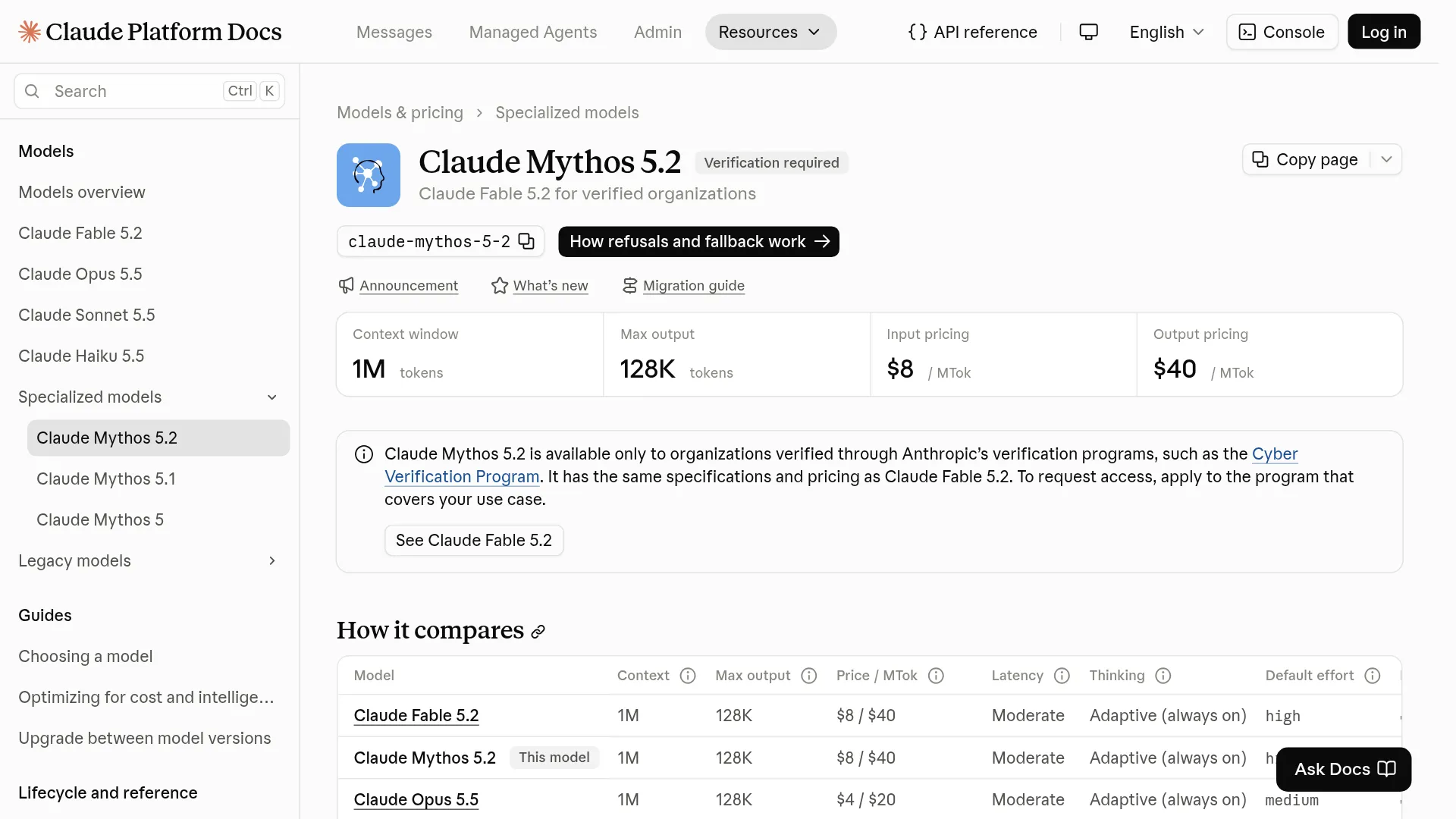
Claude Mythos 5.2 answers the security and biology prompts that Claude Fable 5.2 refuses. Per the launch announcement and platform docs, the two share weights, specs, and price. Only the safeguard layer and the access rules differ:
| Attribute | Claude Mythos 5.2 | Claude Fable 5.2 |
|---|---|---|
| Underlying weights | Same model | Same model |
| Model ID (Claude API / Google / Foundry) | claude-mythos-5-2 | claude-fable-5-2 |
| Bedrock ID | anthropic.claude-mythos-5-2 | anthropic.claude-fable-5-2 |
| Context / max output | 1M / 128K | 1M / 128K |
| I/O modalities | Text + images in, text out | Text + images in, text out |
| Thinking | Adaptive, always on, default high | Adaptive, always on, default high |
| Knowledge cutoff | June 2026 | June 2026 |
| Base price | $8 / $40 per MTok | $8 / $40 per MTok |
| Release / retirement | Nov 9, 2026 / no sooner than Nov 9, 2027 | Nov 9, 2026 generation |
| Access | Verification required | Generally available |
Who actually gets in
Three routes exist, all organization-shaped.
1. Cyber Verification Program. For defensive security teams, plus newer tiers for authorized offensive work such as penetration testing and red-teaming. This is the path for the OWASP audit, the binary scan, or the exploit-reproduction workflow that Fable refuses. Blocked Fable cyber prompts otherwise fall back to Opus 4.8.
2. Life Sciences Verification Program. For teams doing research biology: binder design, capsid modeling, and similar dual-use work. It launched in beta for teams, with expansion to individual Pro and Max plans described as a future step. Blocked Fable biology prompts otherwise fall back to Opus 5.
3. Claude Security on Enterprise. Enterprise customers get Mythos-backed repository scanning, finding tracking, and patch suggestions without a separate verification application, per the launch announcement. If your company already pays for Claude Enterprise, this is the fastest route to Mythos-backed results.
Calling claude-mythos-5-2 from a standard Claude API key without the grant attached to your workspace fails. The eesel hands-on review documents the two operational traps: Mythos is a Covered Model requiring 30-day data retention unless zero retention is approved, with a workspace-configuration error instead of completions when the setting is wrong, and Mythos 5.2 shares a rate limit with Mythos 5.1 and Mythos 5.
How to apply without losing a week
Anthropic publishes no full checklist, so treat this as the documented skeleton plus early-applicant experience, not an official SLA:
- Apply as an organization. Both programs target security professionals, research teams, and companies. Solo applicants routinely stall. One applicant's week is representative — defensive work on his own app refused, applications to two programs unanswered:
Cybersecurity doesn't seem to be a fair game! While trying to validate our session management against OWASP standards, I ran into restrictions with both Claude Code and Codex... I applied for both Daybreak and Cyber Verification Program yet I still wan't accepted.
— @danpdc, real user post, November 10, 2026
- Document the blocked workflow. State the team, the defensive or research mission, and exactly which Fable refusals block it. Fable over-blocks legitimate work — testers report refusals on their own game-structure analysis (@Motion_Viz) and on prompts with no visible cyber content (@DeryaTR_) — so attach the refusal evidence, not a generic "security research" paragraph.
- Budget 7 days plus 5 for clouds. The eesel review reports roughly seven business days for Anthropic's initial response and about five more before Bedrock, Google Cloud, or Foundry access propagates.
- Fix retention before the first call. Have your admin attach the grant to the correct workspace and confirm the 30-day retention setting (or an approved zero-retention exception) first.
- Treat fast mode as a second approval. Fast mode ($16 input / $80 output, up to 2.5x token speed) stays restricted to verification-program members per the launch announcement. Do not assume Mythos approval includes it on every cloud.
Keep Mythos 5.1 pinned until 5.2 is live on every platform you use. The eesel review notes edited thinking history failing on Bedrock and a Mythos 5.1 advisor no longer pairing with a Mythos 5.2 executor.
Blocked on Fable? What to run until Mythos is approved
| Your situation | Run this now | Why |
|---|---|---|
| Defensive scan or vuln triage Fable blocks | Opus 5.5 ($4 / $20), or Claude Security on Enterprise | Anthropic's broader internal evals put Opus 5.5 roughly on par with Mythos 5.2 for general vulnerability ID at half the token price |
| Hardest long coding or research, no cyber/bio content | Fable 5.2 ($8 / $40) | Same weights as Mythos; ~55% fewer blocks than Fable 5.1 and up to 30% faster output |
| Routine review, agents, support workloads | Sonnet 5.5 ($2 / $10) or Haiku 5.5 (from $0.10 / $0.50) | Same 1M context and 128K output ceiling, fast or fastest latency, no verification |
On the headline security benchmarks — all Anthropic-run, so read them as vendor evidence — Mythos 5.2 leads and the launch announcement plus the iThinkDiff breakdown agree on the numbers:
| Evaluation | Mythos 5.2 | Mythos 5.1 | Opus 5.5 (no safeguards) |
|---|---|---|---|
| CVE Rediscovery (1,829 CVEs, Oct 2026) | 89.6% | 78.3% | 81.3% |
| CyScenarioBench | 76.3% | 61.7% | 67.6% |
| Sandbox escape (planted creds, 1,800+ scenarios) | 3.1% | 21% | 3.3% |
Anthropic's caveat, carried by both secondary writeups: on its broader internal vulnerability-identification eval, Mythos 5.2 lands roughly on par with Opus 5.5. The edge is real on CVE rediscovery and scenario tests, not universal. External color comes from partner runs cited in the launch post: one tester found one in six confirmed bugs missed by every other frontier model, and Mozilla reported roughly doubled discovery counts versus Mythos 5.1 across Firefox campaigns.
The price math that decides if the paperwork is worth it
Mythos 5.2 costs 20% less than Mythos 5.1 ($10 / $50) and exactly 2x Opus 5.5:
| Usage | Price per million tokens |
|---|---|
| Standard input | $8 |
| Standard output | $40 |
| 5-minute cache write | $10 |
| 1-hour cache write | $16 |
| Cache read | $0.20 |
| Batch input / output | $4 / $20 (50% off) |
| Fast-mode input / output | $16 / $80 (verification orgs only) |
Output costs 5x input, so output discipline and cache-hit rates move the bill more than the model badge. Cache reads at 2.5% of input price and batch at half price are where scanning and agent workloads actually save. Mythos justifies its 2x over Opus only when it finds what Opus misses or unblocks biology work nothing else will run.
The trade-off to accept: Mythos 5.2 is Anthropic's highest scorer on the cited CVE Rediscovery (89.6%) and CyScenarioBench (76.3%) runs, but every point of that edge costs double the Opus token price plus an application, a retention concession, and a shared rate limit. If your work is not being refused, you are paying for locks you will never pick.