 AIREITER
If you only have ten seconds: on the public Artificial Analysis text-to-video leaderboard, Seedance 2.0 sits at #1 with an Elo of 1,219, while Wan 2.7 lands at #8 with 1,095 — and Seedance is also the cheaper of the two to run via API ($9.07/min vs $16.90/min). So for most people chasing finished, ready-to-post clips with synced audio, Seedance 2.0 is the stronger pick. Wan 2.7 earns its place a different way: it's part of Alibaba's open video line, which means local deployment and a level of control Seedance's closed API doesn't offer.
These two models aren't really competing for the same job — so the verdict depends on yours.
The 30-second verdict
Seedance 2.0 | Wan 2.7 | |
|---|---|---|
Maker | ByteDance Seed | Alibaba (Tongyi Lab) |
Leaderboard Elo (w/ audio) | 1,219 (#1) | 1,095 (#8) |
Native synced audio | Yes | No (video-focused) |
Access model | Closed API / Dreamina app | API now; open-weights family (2.7 weights unconfirmed) |
API price (Artificial Analysis) | $9.07 / min | $16.90 / min |
Best for | Finished cinematic clips with sound | Local control, customization, open workflows |
If your goal is the best out-of-the-box result, Seedance 2.0. If your goal is to own and tweak the pipeline, Wan 2.7.
Meet the contenders
Wan 2.7 is the newest entry in Alibaba Tongyi Lab's open video family — the line that shipped Wan 2.2 in July 2025 as one of the first open-source MoE video models, with weights on GitHub and ModelScope. One caveat that shapes everything below: Wan 2.2's weights are confirmed downloadable, but whether Wan 2.7 itself ships open weights hasn't been confirmed by Alibaba — for now it's only verifiable as an API model on the leaderboard (listed as an April 2026 release). Ignore the resolution and VRAM figures that single-product "wanXX" sites quote; none are official.
Seedance 2.0 comes from ByteDance Seed, the team behind the Dreamina (即梦) app — which is why the leaderboard lists it as "Dreamina Seedance 2.0 720p." Its defining feature, per ByteDance's official page, is "audio-video joint generation": one unified model takes text, image, audio, and video in and returns clips with natively synced sound, plus control over lighting, shadow, and camera. It's closed and hosted, and ByteDance publishes no official resolution or length ceiling (the leaderboard pegs it at 720p, March 2026).
Benchmark head-to-head
The most trustworthy comparison isn't a marketing claim from either company — it's the Artificial Analysis text-to-video leaderboard, an Elo arena where humans vote on blind pairs of generated clips (the "With Audio" board, in this case).
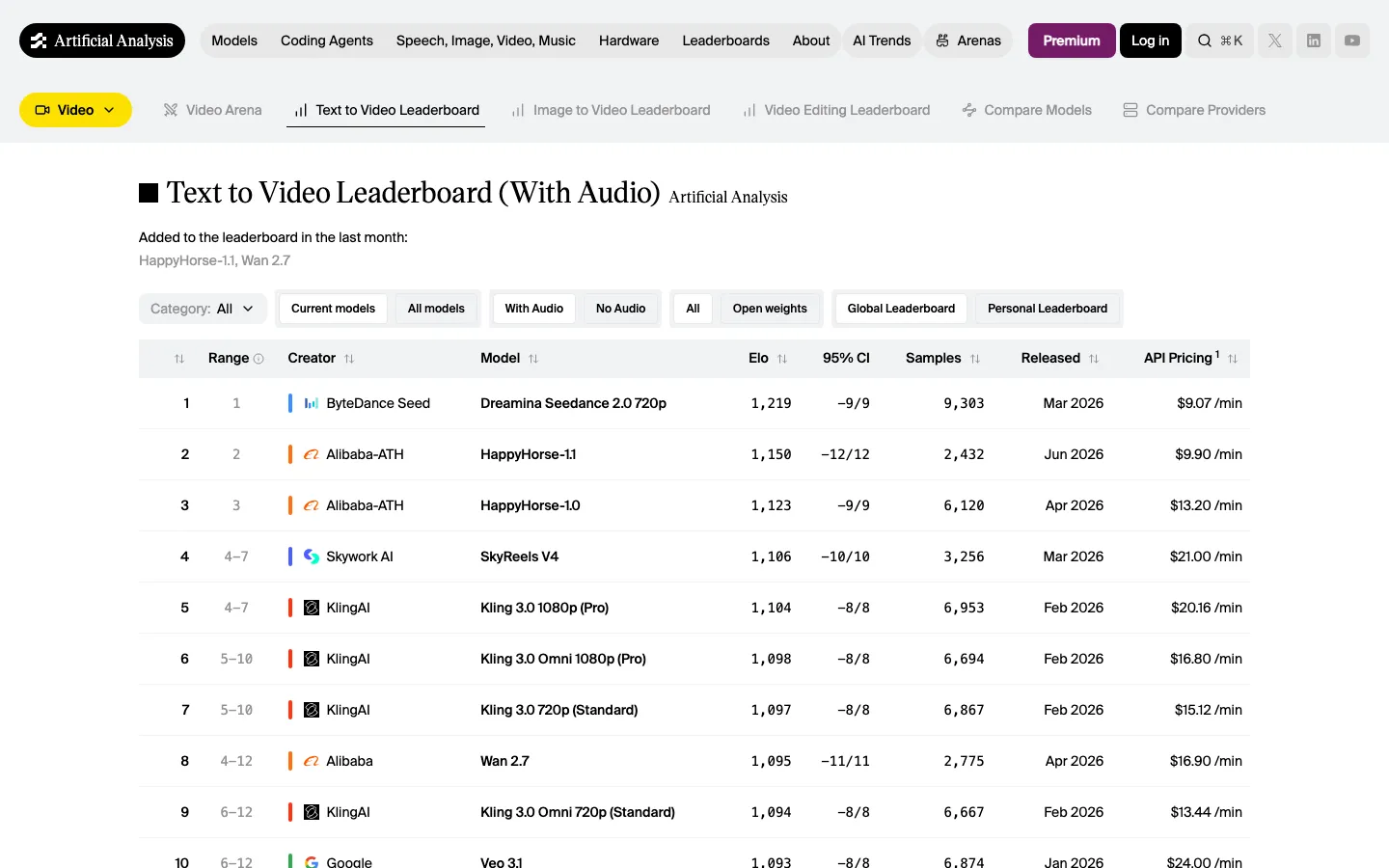
Here's how the two stack up, with the surrounding field for context:
Rank | Model | Maker | Elo | Released | API price |
|---|---|---|---|---|---|
1 | Seedance 2.0 720p | ByteDance Seed | 1,219 | Mar 2026 | $9.07/min |
5 | Kling 3.0 1080p (Pro) | KlingAI | 1,104 | Feb 2026 | $20.16/min |
8 | Wan 2.7 | Alibaba | 1,095 | Apr 2026 | $16.90/min |
10 | Veo 3.1 | 1,093 | Jan 2026 | $24.00/min |
Source: Artificial Analysis "Text to Video Leaderboard (With Audio)," Global board, captured 29 June 2026. Elo reflects blind human pairwise votes; "API price" is the per-minute rate Artificial Analysis lists for each model's provider, not a universal price — rates vary by vendor and change over time. Confirm current pricing before budgeting.
Two things stand out. First, the gap is large: 124 Elo points separate Seedance 2.0 from Wan 2.7 — not a rounding error but a clear, human-voted preference, and Seedance leads the entire field by an unusually wide margin. Second, Seedance 2.0 is cheaper per minute than Wan 2.7 on this listing, which flips the usual "you pay more for quality" assumption. Wan 2.7's sample count (2,775 votes) is also lower than Seedance's (9,303), so its rating carries a wider confidence interval — expect it to wobble a bit as more votes land. (If you're also weighing Kling, which sits between them at #5, our Kling 3.0 API pricing guide breaks down its tiers.)
Feature comparison
Benchmarks rank output quality, but they don't capture how you work with each model. That's where the two genuinely diverge:
Capability | Seedance 2.0 | Wan 2.7 |
|---|---|---|
Native synced audio | Yes — audio-video joint generation | No — video only |
Input types | Text, image, audio, video | Text, image (video line) |
Camera / lighting control | Emphasized in official docs | Available, varies by workflow |
Self-hosting | No (hosted API only) | Family supports it; 2.7 weights unconfirmed |
Fine-tuning / customization | Limited to API params | Possible if 2.7 weights ship (as with Wan 2.2) |
Per-minute API cost | $9.07 | $16.90 |
Best output environment | Hosted, turnkey | ComfyUI / local pipelines (if self-hosted) |
The single biggest functional difference is audio. Seedance 2.0 generates the sound with the video in one pass; Wan 2.7 gives you silent footage you'd pair with audio separately. If your deliverable is a talking, ambient, or musical clip, that's a real workflow saving — not just a quality score.
Which one should you choose?
It depends on what you're optimizing for:
Solo creator / social marketer → Seedance 2.0. You want the best finished clip with sound, fast, and you're not running thousands of generations a month. It tops the leaderboard, includes synced audio, costs less per minute, and is built to be called rather than configured. (On a tighter budget? The lighter Seedance 2 Mini covers a lot of the same ground.)
Agency / client work → Seedance 2.0. Same logic, higher stakes: the highest blind-vote quality plus native audio means fewer revision rounds and less post-production.
Developer / studio with a custom pipeline → Wan 2.7 (validate first). If you can self-host, fine-tune, and integrate into something like ComfyUI, you trade the last slice of quality for control and no per-minute metering at scale.
Privacy-sensitive or high-volume API user → lean Wan 2.7. Self-hosting keeps data in-house and turns per-minute API costs into fixed compute — but confirm Wan 2.7's weights are actually downloadable for your use first.
Plenty of teams will use both: Seedance for client deliverables, Wan for experimental or self-hosted work. That split is perfectly reasonable.
One caveat worth repeating: Wan 2.7 is new, and its public track record (and vote count) is still thin. If you're betting a production workflow on it, validate it against your own prompts before committing.
FAQ
Is Wan 2.7 better than Seedance 2.0?
On the public Artificial Analysis leaderboard, no — Seedance 2.0 leads by 124 Elo points and costs less per minute. But "better" depends on the job: Wan 2.7 wins for open, self-hosted, customizable workflows.
Does Seedance 2.0 generate audio?
Yes. Its defining feature is "audio-video joint generation" — it produces natively synchronized sound in the same pass, per ByteDance's official Seedance 2.0 page.
Is Wan 2.7 open source?
Wan's earlier model (Wan 2.2) is confirmed open-source. Wan 2.7 continues that open line, but exact license terms for 2.7 specifically haven't been confirmed by Alibaba — verify before relying on it.
How much do they cost?
On the Artificial Analysis listing, Seedance 2.0 is $9.07/min and Wan 2.7 is $16.90/min via API. Pricing varies by provider and can change, so confirm current rates before budgeting.
Which is faster to get a usable clip?
Seedance 2.0, for most users — it's a hosted, turnkey API that returns a finished clip with sound. Wan 2.7 can be faster at scale if you self-host, but requires setup.
Bottom line
On raw quality it isn't close — Seedance 2.0 owns the benchmark today. But two things will decide whether that lead holds: whether Alibaba ships Wan 2.7's open weights (which would hand self-hosters a quality jump the closed Seedance can't match on price), and how Wan 2.7's Elo settles as its vote count catches up to Seedance's. Until then, pick by workflow, not loyalty: hosted-and-finished leans Seedance, open-and-controllable leans Wan — and given how new Wan 2.7 is, run your own prompts through it before you commit.