 AIREITER
A polished demo can make a new interface model look ready to ship. Runway Solaris is not generally available: Runway announced it on August 31, 2026, opened an early-access request, and has not published public pricing, an API, or a general sign-up as of September 1, 2026.
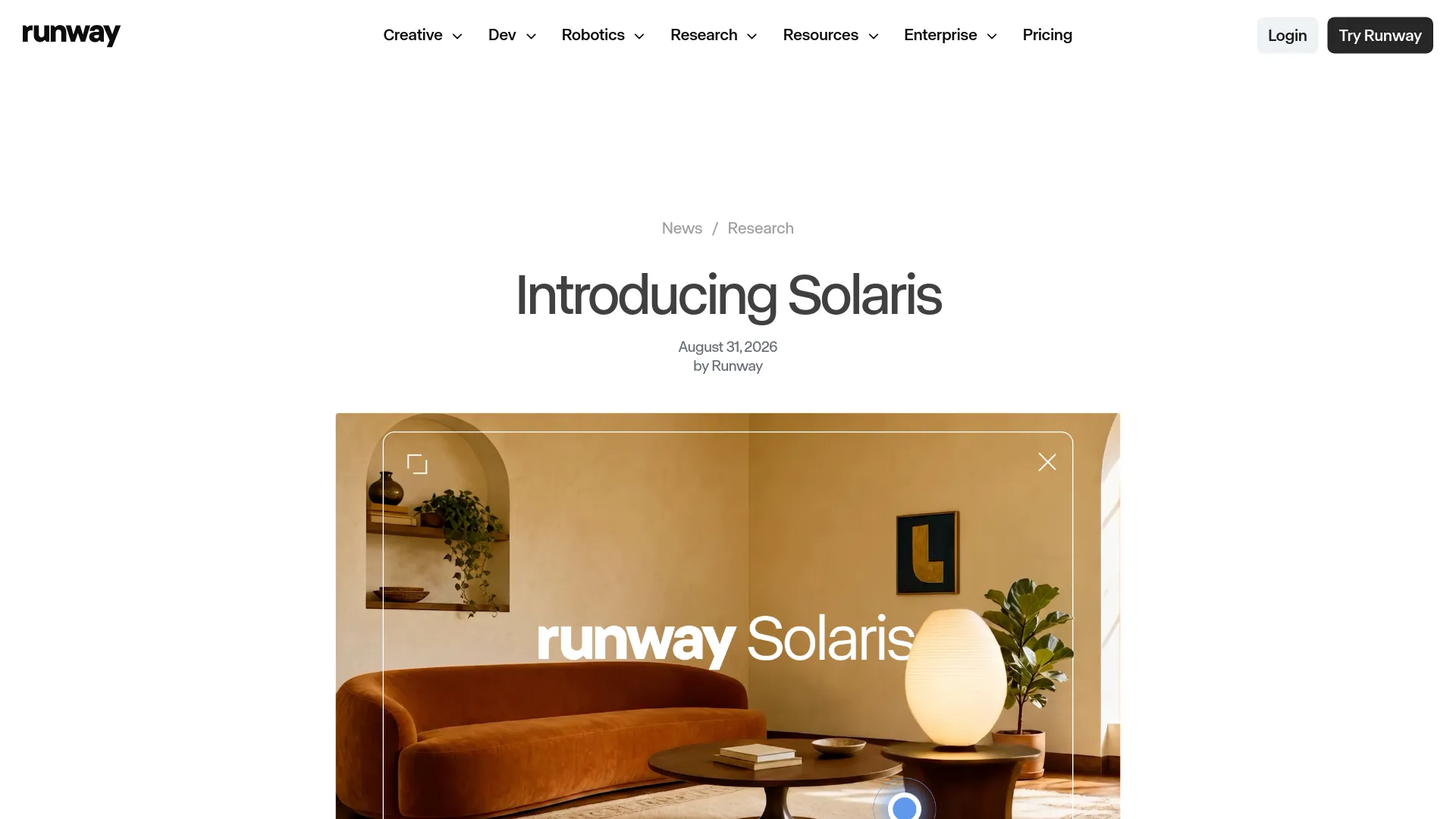
Runway Solaris availability: announced, but not generally available
Runway Solaris is an officially announced research model, not an unverified leak. Runway describes it as the first model in its new Interface World Models family and provides a form for limited testing.
That is different from a public product launch. Runway says it is working with key partners toward a public release, but the announcement does not give a launch date or say that every applicant will receive access.
| Availability question | What is confirmed | What is not confirmed |
|---|---|---|
| Has Runway announced Solaris? | Yes, on August 31, 2026 | — |
| Can anyone use it now? | Limited testing by request | Open public access |
| Is there a public launch date? | No date published | Timing and rollout regions |
| Is there an API or SDK? | No public Solaris API is documented | API, SDK, quotas, and authentication |
| Is there pricing? | No Solaris price announced | Subscription, usage, or enterprise rates |
| Is it a stable production product? | Runway calls it an early step and research system | Reliability, support, and service guarantees |
| Are hardware or deployment requirements published? | No public requirements are listed in the announcement | Browser, GPU, cloud, local-hosting, and device support |
The safest current description is “officially announced, early access by request.” Calling Solaris generally available, free, or included with a Runway subscription would go beyond the information Runway has published.
What Runway has actually opened
The confirmed access path is the Solaris announcement page, where Runway presents the research and asks interested people to submit an early-access form. The visible fields include full name, business email, company name, company size, and additional details.
The form is a request for consideration, not a documented self-serve trial. Runway publishes no eligibility rule, response time, supported country list, guaranteed invitation policy, or requirement that applicants hold a particular Runway plan. The general Runway pricing page therefore should not be treated as Solaris pricing.
A practical access checklist is:
- Use the official Runway research page rather than a third-party “Solaris access” offer.
- Describe the interface or agent-training problem you want to test.
- Treat any approval as research access unless Runway provides commercial terms separately.
- Do not budget for Solaris until Runway publishes price, quotas, and service conditions.
There is also no confirmed Solaris endpoint, model identifier, SDK, rate limit, image or frame billing rule, hosting option, or local deployment package in the public materials reviewed here.
What Solaris is—and what it is not
Runway Solaris is an Interface World Model: a system that generates the visual interface itself, frame by frame, as a person clicks, drags, types, or otherwise interacts with a scene. It is not simply a chatbot that writes React code, and it is not a prerecorded video with clickable hotspots.
Conventional software renders through an intermediate representation such as HTML, CSS, JavaScript, a component tree, or game-engine logic; Solaris instead treats the generated frame as the interface and jointly handles rendering and interaction without that conventional representation.
| System | What happens after an interaction? | Main strength | Main risk |
|---|---|---|---|
| Coded website or app | Deterministic code selects or renders the next state | Repeatability, integration, accessibility hooks | More work to design and implement unusual behavior |
| AI app builder | A language model writes or edits code, then the app renders | Functional software can be deployed and maintained | Visual fidelity and generated code quality vary |
| Video demo | A fixed sequence plays or responds through preset controls | Smooth visual presentation | Limited real interaction |
| Solaris concept | The model synthesizes the next interface frame from the current state and user input | Open-ended visual interaction | Text stability, state consistency, cost, and control |
“No code” should therefore be read as no conventional intermediate application layer for the displayed experience, not as “no software exists anywhere in the system.” Runway describes a language model that reasons about the user’s request and produces prompts or instructions that guide the rendering model.
How Solaris works, and what Runway’s evaluation proves
Solaris builds on Runway’s Gen-4.5 video model and follows the company’s broader GWM-1 general-world-model research. Runway adapted the model to treat clicks, drags, and other interactions as conditioning for the next frame rather than treating the prompt as a one-time instruction.
The official Solaris report says Runway made the system faster through autoregressive frame generation, denoising-step distillation, and training on the faster model’s own outputs. Runway targets interactive response and visual quality at 720p, but has not published a latency number.
The engineering trade-offs are direct:
- Speed: Runway says interactions stop feeling interactive at roughly half a second of delay, so a video model must produce sequential frames cheaply enough to keep up.
- Coherence: Text, layout, object identity, and scene state must remain stable over a whole session, not just within a short clip.
- Cost: Generating every frame is still more expensive than serving a page rendered once, even though Runway says its real-time system is much cheaper than a standard video diffusion model.
Runway compared Solaris with a coded interface produced by Claude Opus 5 from the same starting image and interaction request. The company ran a study with 250 participants across 30 interaction examples and nearly 7,500 pairwise judgments.
| User-study question | Solaris preference | Coded result preference | Rated equivalent |
|---|---|---|---|
| Which result followed the instruction better? | 61% | 24% | 13% |
| Which behaved more naturally in the scene? | 71% | 21% | 6% |
Those numbers support a narrow claim: on Runway’s selected visual-interaction examples, participants more often preferred Solaris’s response to the coded comparison. They do not establish public availability, production reliability, lower cost, accessibility compliance, or superiority for data-heavy business applications.
The report also evaluates screenshot-to-interface reconstruction across 30 interfaces using structural similarity and DINOv3 features. Runway says reconstruction quality declined as visual complexity increased. This supports Solaris’s visual-first argument, but remains a company-run evaluation rather than an independently reproduced benchmark.
Where Solaris could fit first
Solaris looks most relevant to visual experiences where natural manipulation matters more than deterministic business logic. Runway’s examples include virtual clothing stores, product scenes, interactive tutorials, simulations, and training environments for computer-use agents.
| Potential first use | Why the model fits | What must be proven first |
|---|---|---|
| Interactive prototypes | A designer could explore behavior without implementing every screen | Repeatable states and export or handoff options |
| Visual commerce and tutorials | Users can manipulate a scene or receive a context-specific visual step | Accurate product data, correct instructions, reliable text, and recovery from mistakes |
| Simulations and education | A scene can respond to direct manipulation | Safety, factual grounding, and predictable outcomes |
| Agent training | Agents can encounter layouts that were not memorized in advance | Measurable task success, stable state, and machine-readable controls |
Authentication, payments, inventory, legal disclosures, reporting, and accessibility depend on predictable semantics and connections to the rest of a software stack. Runway explicitly lists trust, long-session coherence, text, accessibility, and integration as unresolved challenges.
Real-user discussion reflects that boundary. In the launch thread on r/singularity, one user asked:
“has anyone used it yet? is it really as good as the demo suggests?” — u/Competitive_Tap2450, Reddit discussion
The question reflects that independent hands-on testing and failure-inclusive sessions were not yet publicly available in the discussion reviewed for this article.
What remains unconfirmed before a buying decision
Runway Solaris is not ready to evaluate like a normal API because the commercial and operational details are still missing. Before a team replaces a coded interface or commits engineering time, it needs answers in seven areas.
| Decision area | Confirmed today | Evidence still needed |
|---|---|---|
| Access | Early-access request exists | Approval rate, wait time, regions, and user limits |
| Cost | No Solaris price | Per-frame or per-session cost, quotas, and overage rules |
| Developer access | No public API or SDK confirmed | Authentication, webhooks, streaming, and versioning |
| Integrations | Integration is an acknowledged challenge | Databases, payments, APIs, identity, and tool calls |
| Reliability | Runway focuses on session coherence | Long-session drift, recovery, and reproducibility measurements |
| Text and data | Stable legible text remains difficult | OCR, numeric accuracy, forms, tables, and dense dashboards |
| Accessibility | Runway says accessibility APIs must be addressed | DOM-equivalent semantics, keyboard navigation, and screen-reader support |
| Deployment | No public hosting or hardware matrix | Browser, device, GPU, cloud-region, and local-runtime support |
The key distinction is between a visually convincing response and a dependable software state. A generated checkout screen that looks correct but cannot expose product totals, preserve an order, or provide an accessible control is a demonstration, not a commerce system.
Runway Solaris FAQ
Is Runway Solaris available to the public?
Not generally. Runway has announced Solaris, but the public page currently offers limited testing by early-access request rather than open access.
How do I request Runway Solaris early access?
Open Runway’s official Solaris announcement and submit the form. The page does not promise approval or publish a response timeline.
Does Runway Solaris have an API or price?
No public Solaris API, SDK, quota, or pricing schedule was included in the announcement reviewed here. Runway’s general subscription plans do not confirm Solaris access.
Does Solaris generate HTML, CSS, or JavaScript?
Runway presents Solaris as an interface generated directly, without an intermediate HTML/CSS implementation. The system still uses a language model, prompts, and a rendering model to determine how the experience evolves.
Is Solaris a video or a genuinely interactive model?
It is designed as an interactive model rather than a fixed video: Runway says clicks, drags, and typing condition the next generated frames. Broad public access is not open, so outside testing remains limited.
Can Solaris replace a normal website or app?
Not on the evidence available today. Solaris may fit visual prototypes, simulations, tutorials, and exploratory experiences, while transactional, accessible, and data-integrated software still needs capabilities Runway identifies as open problems.
Is Runway Solaris based on Gen-4.5?
Yes. Runway says Solaris builds on Gen-4.5 and extends the company’s GWM-1 world-model direction toward real-time interface generation.
Apply if you can test a research system, not if you need a production runtime
A design team or research group with a concrete visual-interaction experiment can request early access. A product team needing an API contract, predictable state, accessibility support, published operating costs, and a deployment path should keep its production interface on conventional software for now.
The unresolved trade-off is the important part of the Solaris announcement: open-ended generated interfaces may make visual interaction more adaptable, but they still need to become legible, testable, affordable, integrated, and dependable before they can replace ordinary software.