 AIREITER
Muse Spark 1.1 launched on July 9, 2026 as Meta Superintelligence Labs' strongest model yet for agentic work and coding. It runs on Meta's new Meta Model API at $1.25 per million input tokens and $4.25 per million output tokens, with $20 in free credits for each new account. The headline catches: the public preview is US-only, new users join a waitlist, and Meta is deliberately keeping it off third-party platforms like OpenRouter for now.
Unlike the original Muse Spark from April, which never left a private preview for select partners, 1.1 is the first version developers can actually build on. It is a reasoning model tuned for end-to-end agents, repository-level coding, and native multimodal perception, with a computer-use mode that drives a real desktop from a plain-language goal. For developers outside the US, or anyone who needs production access today, the Claude and GPT models it benchmarks against are already available globally, often below Muse Spark's own price.
What's new in Muse Spark 1.1
The original Muse Spark shipped in April 2026 from Meta Superintelligence Labs (MSL), the unit Meta assembled last year under Chief AI Officer Alexandr Wang to close the gap with OpenAI, Google, and Anthropic. It was MSL's first model since the Llama 4 family and the first product of a ground-up overhaul of Meta's AI efforts.
Muse Spark 1.1, released July 9, turns that research model into a developer product. Wang calls it a "step-change" over the original, and tracking accounts watching Meta's API listings reported roughly a 43-point gain across the evaluation suite. Internally the Muse Spark line carried the code name Avocado; Meta says a larger model code-named Watermelon is already training, with no release date. The launch also landed the same week as Muse Image (code name Mango), Meta's first image-generation model from MSL.
The upgrade concentrates on the three areas Meta says developers asked for most:
End-to-end agentic workflows, with better multi-turn memory and long-context coherence, so an agent holds the thread through long sessions.
Advanced coding, with stronger generation and debugging, repository-level edits across languages, and more reliable tool calling.
Native multimodal perception, so the model reasons over image, video, and document input in a single call.
Meta also lists a 1 million-token context window on its API page, which is what makes those long agentic sessions and large repository edits practical.
The capabilities that matter: agents, code, and computer use
Three patterns from Meta's Model Cookbook show where Muse Spark 1.1 is aimed.
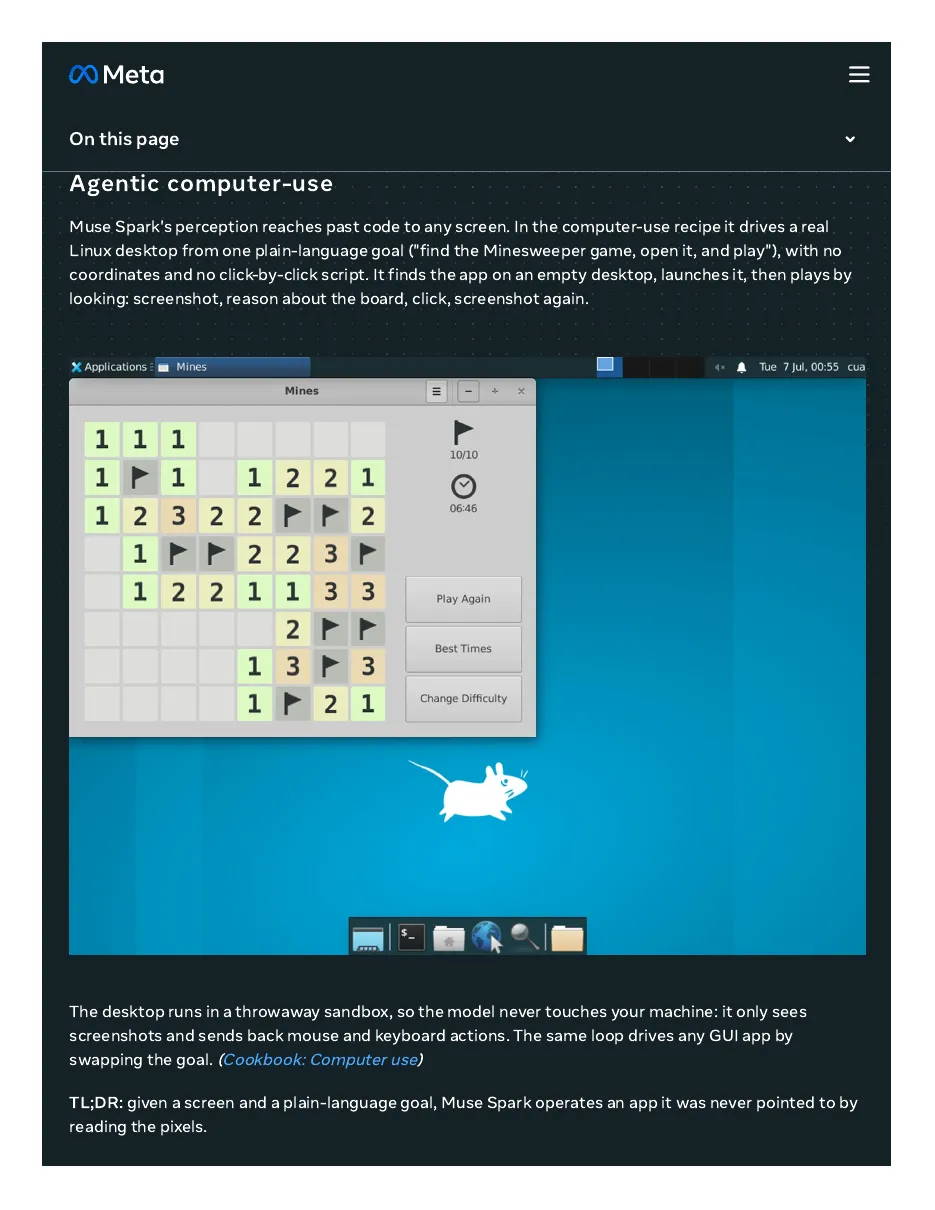
Computer use. Given one plain-language goal such as "find the Minesweeper game, open it, and play," the model drives a real Linux desktop running in a throwaway sandbox. It finds the app on an empty screen, launches it, then plays by looking: take a screenshot, reason about the board, click, screenshot again. It does not touch your machine; it only sees pixels and sends back mouse and keyboard actions. Swap the goal and the same loop drives any GUI application.
Multi-agent orchestration. A recipe stands up a four-profile product studio (product manager, backend, frontend, and technical writer, all running muse-spark) that turns a one-line idea into a working app plus launch copy. The coordination is the interesting part: specialists negotiate only through threaded comments on a shared Kanban board, work is sequenced by real task dependencies rather than polling, and the product manager is the sole arbiter but has no terminal, so it cannot implement anything itself. Each decision is an auditable comment.
Built-in web search. Add {"type": "web_search"} as a tool on any Responses API call and the model fetches live information, synthesizes an answer, and returns inline citations, with no retrieval stack to build.
One technical note that affects cost: Muse Spark is a reasoning model. It thinks before it answers, those thinking tokens show up as usage.completion_tokens_details.reasoning_tokens, and they are billed as output. You control depth with reasoning_effort (from minimal to xhigh), so matching effort to the task is the main lever on your bill.
Muse Spark 1.1 API pricing, explained
Muse Spark's headline pricing, confirmed by Meta and reported by both CNBC and Reuters:
Per million tokens | |
|---|---|
Input | $1.25 |
Output | $4.25 |
Free credits (new account) | $20 (one-time) |
After the $20 credits run out, billing is pay-as-you-go. Because it is a reasoning model, the model's internal thinking is billed at the output rate, so a heavy reasoning workload costs more than the per-token headline suggests. A request with 100,000 input tokens and 30,000 output tokens (reasoning included) runs about $0.25 at list price. Dial reasoning_effort down for simple tasks.
Where does that sit in the market? Per Reuters, Muse Spark 1.1 is priced above OpenAI's entry-level GPT-5 mini and Anthropic's low-cost Claude Haiku 4.5, but below Anthropic's higher-end Claude Sonnet 4.6. Wang called it "very aggressive and attractive" pricing meant to scale with heavy usage. For context, here is how it lines up against the Sonnet-class Claude model Meta is undercutting:
Model | Input / Output (per M tokens) |
|---|---|
Muse Spark 1.1 (Meta Model API) | $1.25 / $4.25 |
Claude Sonnet 4.6, official API | $3.00 / $15.00 |
Claude Sonnet 4.6 via AIReiter relay (~80% off) | $0.60 / $3.00 |
Sonnet-class Claude, which leads Artificial Analysis's independent intelligence index, is the model Muse Spark is chasing. Through an Anthropic-compatible relay like AIReiter it lands around $0.60 in and $3.00 out, below Muse Spark's own price, with no waitlist or US-only restriction. If raw cost per token on a frontier model is the goal, the models Muse Spark is measured against are already cheaper to reach.
How to get API access, and the catches
Muse Spark 1.1 is available through the Meta Model API, now in public preview. The setup is simple if you can get in:
Sign up at the Meta Model API developer portal; each account starts with $20 in free credits.
It is US-only for now. Some early partners already have access; new users add themselves to a waitlist and are let in over time.
It is not on third-party platforms. CNBC reports Meta is deliberately limiting API access to its own properties rather than listing it on marketplaces like OpenRouter, so you cannot reach it today through the aggregators many developers already use.
The API is drop-in compatible with two SDK families: the OpenAI SDK (Chat Completions and Responses formats) and the Anthropic SDK (Messages format). Point an existing client at https://api.meta.ai/v1, set the model to muse-spark-1.1, and keep your code. A minimal call looks like this, per Meta's Cookbook:
import os
from openai import OpenAI

client = OpenAI(
    base_url="https://api.meta.ai/v1",
    api_key=os.environ["MODEL_API_KEY"],
)

resp = client.responses.create(
    model="muse-spark-1.1",
    input="Explain a tool-call loop in one sentence.",
)
print(resp.output_text)
Beyond the API, Muse Spark 1.1 is live in Thinking mode in the Meta AI app and on the Meta AI website. Reuters reports Meta expects it to replace the Llama models powering chatbots across WhatsApp, Instagram, Facebook, and Meta's smart glasses.
Muse Spark 1.1 vs Claude and GPT: where it stands
On Meta's own reported benchmarks, Muse Spark 1.1 sits at or near the top of the agentic field: an OSWorld computer-use score of 80.8, MCP Atlas scaled tool use at 88.1, plus JobBench at 54.7, Humanity's Last Exam with tools at 62.1, and Finance Agent v2 at 57.2. Meta says those figures put it on par with GPT-5.5 and Anthropic's Opus 4.8 on agentic tasks. These are vendor-reported numbers, so treat them as Meta's claim rather than settled fact.
The independent picture is still catching up. Artificial Analysis scored the original April Muse Spark at an Intelligence Index of 52, behind Gemini 3.1 Pro, GPT-5.4, and Claude Opus 4.6, and 1.1 has not yet been independently benchmarked. Community discussion on X and Reddit echoes the split: strong on agents and tool use, with some noting that on pure coding benchmarks like SWE-Bench the established coding models still have an edge. The honest read is that Muse Spark 1.1 is a real competitor in agentic and computer-use work specifically, with coding as a fast-closing gap rather than a confirmed lead.
Should you build on Muse Spark 1.1?
Use case | Recommendation | Why |
|---|---|---|
Agentic / computer-use prototypes | Join the waitlist | Computer-use and multi-agent recipes are where 1.1 pushes the field; $20 credits make exploration free |
Production coding | Stay on Claude or GPT | Independent 1.1 coding evidence is thin; a US-only waitlist is a poor production dependency |
Outside the US, or need access now | Use Claude/GPT/Gemini now | The models Muse Spark benchmarks against are globally available today, including via AIReiter at roughly 80% off official rates |
Cost-sensitive reasoning workloads | Watch the bill | Reasoning tokens are billed as output, so effective cost rises with |
Muse Spark 1.1 is not a clear "switch now" for most teams. It is a strong "watch closely, prototype when you get in," and a reminder that Meta is back in the frontier model race with pricing that pressures the rest of the field.
FAQ
What is Muse Spark 1.1 good for?
Agentic workflows, tool use, and computer-use tasks: driving a desktop, coordinating multi-agent teams, and running long multi-step jobs with tools. It also handles image, video, and document input natively, and is competent at coding and debugging. Meta positions it as strongest in agentic work; pure coding leadership is less certain.
How much does the Muse Spark 1.1 API cost?
$1.25 per million input tokens and $4.25 per million output tokens, with $20 in free credits for new accounts and pay-as-you-go after that. Its internal thinking tokens are billed at the output rate, so effective cost rises with higher reasoning_effort settings (see the pricing section).
How do I get access to the Muse Spark API?
Through the Meta Model API public preview, currently US-only. Sign up at Meta's developer portal for $20 in free credits; new users are added from a waitlist over time. Meta is not listing it on third-party platforms like OpenRouter, so direct access via Meta is the only official route for now (see the access section).
Is Muse Spark open source?
No. Unlike Meta's earlier Llama models, Muse Spark is proprietary and access is paid. Wang says MSL has an open-source variant of Muse Spark in development, but has not given a release date.
Can I use Muse Spark 1.1 outside the US?
Not through the official Meta Model API yet. The public preview is US-only and waitlisted, so developers outside the US who need a frontier agentic or coding model today typically use the competing Claude, GPT, or Gemini models.
The bottom line
Muse Spark 1.1 is a capable agentic and coding model with a useful computer-use mode, drop-in OpenAI and Anthropic SDK compatibility, and aggressive $1.25/$4.25 pricing backed by $20 in free credits. The catch is access, since the preview is US-only, waitlisted, and absent from OpenRouter. That makes the practical, immediately available frontier option for most developers the Claude and GPT models Muse Spark aims to beat.
Related reading: Claude API pricing guide 2026 and GPT-5.6 pricing guide cover the models Muse Spark 1.1 undercuts and chases.