AIREITER
Lovart pricing is difficult to reduce to one monthly number because plan names and allowances have changed. Prices were checked on September 24, 2026; verify the balance shown in your own lovart.ai checkout and treat monthly credits as expiring production capacity, not as a fixed number of images.
The short answer: Lovart pricing is credit-based, not unlimited
Lovart is an AI design agent for producing coordinated visual work—brand directions, logos, social assets, product visuals, posters, and video—inside one canvas. That is different from paying for a conventional template library or a single image model.
The current official pricing result is the source to trust for a purchase. Third-party pages and Lovart-branded domains show conflicting plan names and numbers, so the figures below are a dated guide, not a promise that your account will display the same offer.
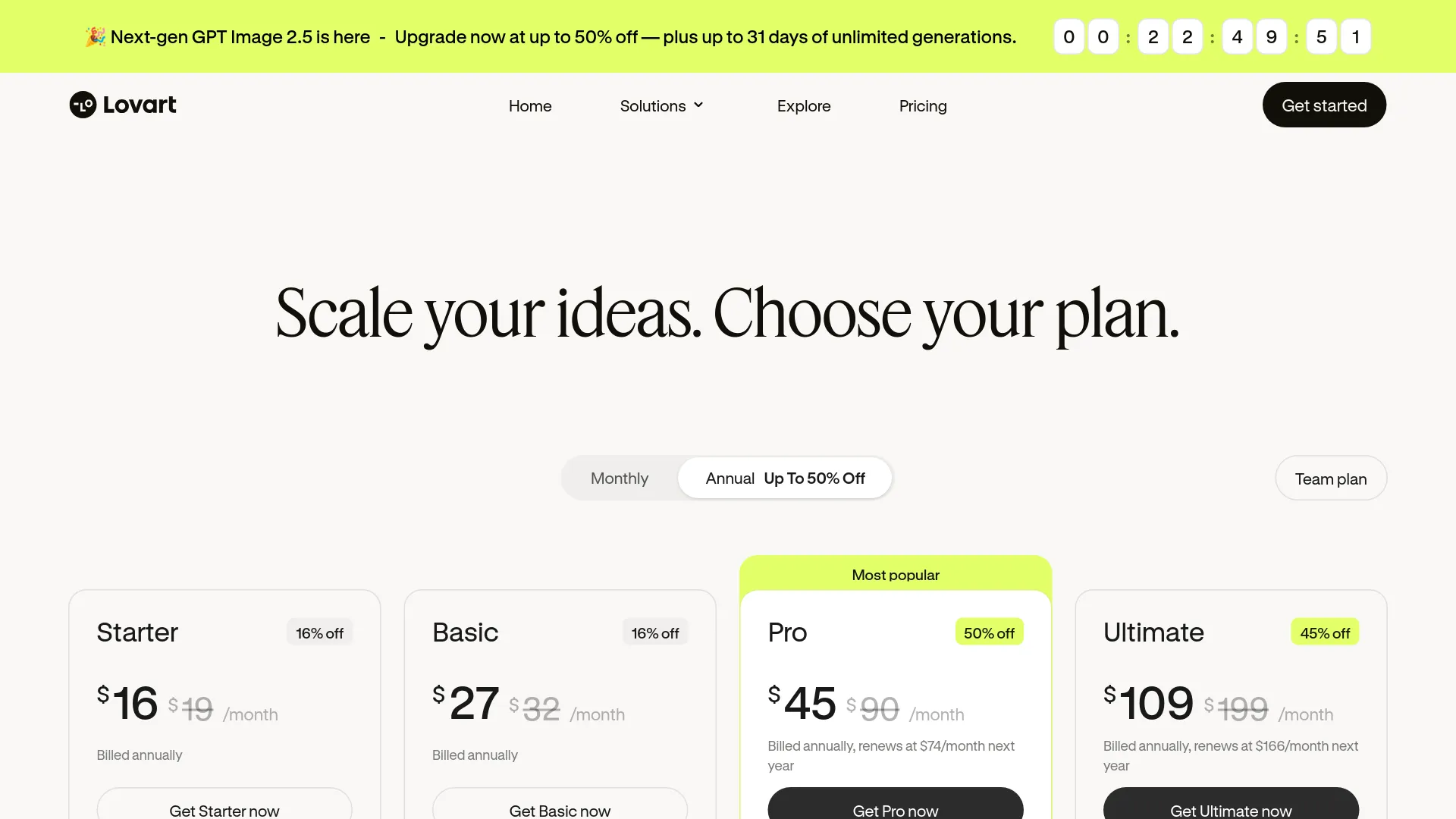
Lovart pricing plans and credits
The table below reflects the September 24, 2026 pricing summary attributed to Lovart’s official page; annual figures are monthly equivalents, and promotional prices may be limited to a first term.
| Plan | Monthly price shown in current summaries | Fast credits | Other reported limits or features |
|---|---|---|---|
| Free | $0 | 30 daily credits reported | Limited models, one task at a time, no confirmed commercial rights |
| Starter | $19/month; about $16 annual equivalent | 2,000/month | 100 daily credits, two concurrent tasks, five Brand Kits |
| Basic | $32/month; about $23 annual equivalent | 3,500/month | 100 daily credits, four concurrent tasks, 10 Brand Kits |
| Pro | $90/month; promotional annual price reported at $39/month initially | 11,000/month | 100 daily credits, eight concurrent tasks, 30 Brand Kits, top-up discount |
| Ultimate | $199/month; promotional annual price reported at $99/month initially | 27,000/month | 100 daily credits, 10 concurrent tasks, 100 Brand Kits |
| Team | Contact Lovart | Not publicly stated | Intended for multiple users |
Lovart’s earlier global-launch announcement listed a different structure: Free with 500 new-user credits, Starter at $19 monthly or $15 annually, and Plus at $32 monthly or $26 annually. That older table is historical, not evidence of the current checkout.
The practical implication is more important than the names: Lovart sells access to a workflow plus a variable credit allowance. Do not compare the $19 Starter price with Canva or Figma until you know how many usable revisions your project consumes.
What Lovart credits buy in practice
A Lovart credit is not a stable “one image” unit. The reported cost varies with the selected model, task complexity, image size, quality, style, advanced settings, edits, and video work. A brand-kit request can therefore consume credits across planning, generations, variations, and rework rather than producing one billable object.
Lovart’s public pricing explanation separates fast generation from Relax generation. Fast requests use credits. Relax requests can be available on selected plans without using fast credits, but they are queued and slower. “Unlimited” therefore does not mean unlimited priority output.
The official-style pricing information also distinguishes two balances:
| Credit type | What to assume |
|---|---|
| Subscription credits | Refresh with the billing cycle; unused monthly credits generally do not roll over |
| Top-up credits | Purchased separately; current summaries report a 366-day validity period or no immediate expiry, so check the purchase terms |
An Aniday pricing explainer estimates roughly 10–25 credits for a typical image or video, but that is not a universal rate card. It cannot safely be used to promise that a $19 plan buys 80 images. Resolution, model, retries, and edits can move the result sharply.
That is the missing calculation most pricing pages avoid: your real cost is the subscription divided by accepted deliverables, not generations. If a campaign needs 12 accepted assets after three directions and several edits, failed or rejected outputs are part of the cost.
Is Lovart free?
Yes, Lovart has a free entry path. No, it should not be treated as a permanently predictable free design studio.
Current summaries report a Free tier with daily credits, limited model access, one concurrent task, and restricted commercial use. Older launch material advertised 500 credits for new users. Real users have also reported changing daily allowances over time. Those posts show uncertainty in the user experience; they do not prove a universal current policy.
Use the free tier for three checks before paying:
- Generate one representative brand or product task, not a novelty prompt.
- Record the credit balance before and after the first generation, edit, and retry.
- Confirm whether the intended commercial use is allowed on the account you are using.
The free tier is useful for testing workflow fit. It is not enough evidence for forecasting a paid campaign unless the same model, resolution, and task type are available.
Billing, cancellation, and refund checks
Lovart’s pricing page describes automatic renewal, monthly credit resets, separate top-ups, and a limited refund window. The accessible pricing summary reports a seven-day refund period when no credits have been consumed. Annual-plan refunds may be more restrictive once usage begins, so read the terms attached to checkout.
Before buying an annual plan, check these four items:
- Renewal date: save the confirmation email and set a calendar reminder.
- Credit timing: verify whether annual billing grants credits monthly or upfront.
- Cancellation path: cancel from the account dashboard and keep the confirmation.
- Failed generations: ask support how credits are restored when a task errors or produces an unusable result.
This is not a theoretical concern. In a Reddit discussion, u/Decent_Education_198 described an Ultimate annual subscription whose credits were distributed monthly and said a prorated refund was refused after credits had been used. That is one user’s account, not a universal rule, but it is a good reason to test monthly before committing annually.
“I’ve been trying it too with high hopes but unfortunately it is constantly glitching…” — u/GracefullyLost, r/AIAssisted
When Lovart pricing makes sense—and when it does not
Lovart’s price is easiest to justify when the job is coordinated production: one brief that must become a logo direction, product visuals, social assets, and a short campaign concept. Its agent and shared canvas can reduce the cost of switching between separate tools, but the credit system charges for exploration and refinement.
Choose Lovart when:
- You need many related assets from one brand brief.
- You value speed and creative directions more than pixel-level control.
- You can cap the first month’s spend and measure accepted assets.
- A human can review typography, logos, product claims, and commercial rights.
Avoid making Lovart your default subscription when:
- You mainly need predictable templates and resizing.
- You need precise vector or layout control.
- Your work depends on repeatable brand-safe text and exact spacing.
- You cannot tolerate expiring monthly capacity or unclear failed-task billing.
Canva AI is the closer fit for template-led marketing production. Recraft is the more natural fit when the job is image, vector, or style exploration. Figma AI fits teams that already need collaborative interface and layout workflows. Lovart is not simply a cheaper replacement for all three; its distinctive bet is an agent that plans a multi-asset design job.
Lovart pricing FAQ
How much does Lovart cost?
Current summaries report a free tier and paid plans commonly labeled Starter at $19/month, Basic at $32, Pro at $90, and Ultimate at $199. Promotional annual equivalents and account-specific offers can differ, so confirm the final checkout price.
Can I use Lovart designs commercially?
Lovart’s pricing materials describe commercial-use rights on paid plans, while the free tier may be restricted. Check the plan terms and any underlying-model licenses before commercial delivery.
Should I buy Lovart monthly or annually?
Start monthly unless you already know your accepted-asset volume. Annual billing can lower the monthly equivalent, but expiring credits, automatic renewal, and limited refund eligibility make an untested annual commitment harder to unwind.
The practical call
Lovart pricing is reasonable for a small team that needs a fast, coordinated visual system and can measure output by accepted campaign assets. It is poor value for users who only need occasional images or exact production layouts.
The lowest-risk path is to test one real brand or e-commerce brief on the free tier, then buy one monthly plan. Track starting credits, failed tasks, revisions, accepted assets, and time saved. Upgrade only when the agent’s reduction in tool switching is worth the credits it burns.