 AIREITER
Grok 4.5 and Claude Opus 4.8 are both real, shipping frontier models, and the Grok 4.5 vs Opus 4.8 matchup splits along two lines rather than crowning one winner. SpaceXAI launched Grok 4.5 on July 8, 2026 at $2 per million input tokens and $6 per million output, while Anthropic shipped Opus 4.8 on May 28, 2026 at $5 input / $25 output — roughly 4× more expensive per output token.
Pick Opus 4.8 when you want the stronger benchmark profile, a 1M-token context window, and Anthropic's full agent toolkit (computer use, parallel agents, code execution). Pick Grok 4.5 when the bill matters: it is faster on the wire, much cheaper per token, and SpaceXAI claims it burns about a quarter of the tokens Opus 4.8 needs for the same coding task. For a lot of teams the practical answer is running both.
At a glance: Grok 4.5 vs Opus 4.8
Here is the spec sheet, with token prices and speeds verified July 9, 2026 against Anthropic's announcement, SpaceXAI's launch posts, and live routing data on OpenRouter. (All figures in this article were checked that day; both models are new enough that benchmarks will shift.)
Spec | Grok 4.5 | Claude Opus 4.8 |
|---|---|---|
Maker | SpaceXAI | Anthropic |
Released | July 8, 2026 | May 28, 2026 |
Input / output (per 1M tokens) | $2 / $6 | $5 / $25 |
Cached input (per 1M) | $0.50 | $1.00 |
Context window | 500K | 1M |
Latency, p50 (OpenRouter) | 0.80s | 1.92s |
Throughput | ~92 tok/s (SpaceXAI cites ~80) | ~101 tok/s |
BenchLM composite (provisional) | 75 | 86 |
Strongest at | Agentic tasks, cost | Coding depth, long context, agent toolkit |
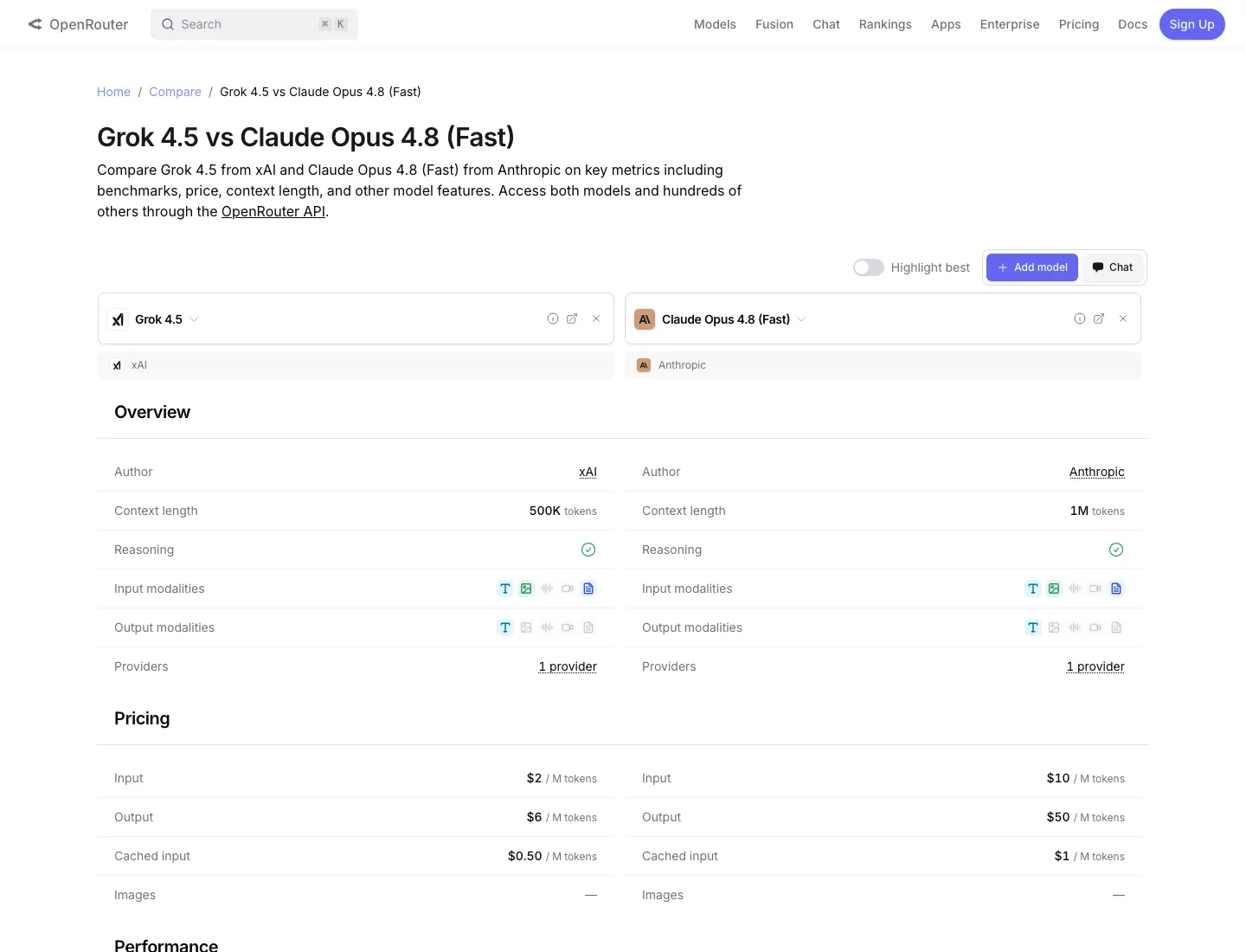
Two things to note before reading that table. First, OpenRouter's page compares Grok 4.5 against the Opus 4.8 Fast variant, a research-preview tier priced at $10 input / $50 output — double the standard Opus 4.8 price above. Standard Opus 4.8 is $5/$25. Second, Grok 4.5 was released a single day before this comparison, so every benchmark here is provisional.
Pricing and the real cost per task
Per-token price is the easy part. The harder, more useful question is what a real task costs.
Model | Input (per 1M) | Output (per 1M) |
|---|---|---|
Grok 4.5 | $2 | $6 |
Claude Opus 4.8 | $5 | $25 |
Claude Opus 4.8 Fast (research preview) | $10 | $50 |
GPT-5.5 / 5.6 (for reference) | $5 | $30 |
Claude Fable 5 (for reference) | $10 | $50 |
On raw output price, Grok 4.5 is about 4.2× cheaper than standard Opus 4.8. The sharper claim is about token efficiency: SpaceXAI says Grok 4.5 used roughly 4.2× fewer tokens than Opus 4.8 to complete the same SWE Bench Pro tasks (The Decoder reported the figure). That is SpaceXAI's measurement, not an independent one.
Run the math on a representative coding-agent task — 200,000 input tokens (a repo plus instructions) and 40,000 output tokens. Standard Opus 4.8 costs 200K × $5/1M + 40K × $25/1M = $1.00 + $1.00 = $2.00. Grok 4.5 at the same volume costs 200K × $2/1M + 40K × $6/1M = $0.40 + $0.24 = $0.64, about 3× cheaper. Apply SpaceXAI's 4.2× fewer-tokens claim and Grok 4.5's bill for the same finished work drops toward ~$0.15 — roughly an order of magnitude below Opus 4.8, if the efficiency holds in your workload.
For teams already paying Anthropic's full list price, the other cost lever is routing: API relays like AIReiter run the broader Claude family (currently up through Opus 4.6) at roughly 0.2× the official rate — useful when most of your traffic is Sonnet- or Opus-4.6-class and only the hardest jobs need Opus 4.8. See our Claude API pricing guide for the model-by-model breakdown.
Benchmarks: where each actually wins
Grok 4.5 is SpaceXAI's newest flagship — it supersedes earlier Grok 4.x releases like Grok 4.3, so if you arrived here from an older "Grok vs Opus 4.8" question, these are the current numbers. It is built first for coding and agents, with native Cursor integration. "Built for," though, does not mean "wins outright." The coding/agent field looks like this:
Model | DeepSWE 1.1 | Terminal Bench 2.1 | SWE Bench Pro |
|---|---|---|---|
Claude Fable 5 (max) | 70% | 84.3% | 80.4% |
GPT-5.5 (xhigh) | 67% | 83.4% | 58.6% |
Claude Opus 4.8 (max) | 59% | 78.9% | 69.2% |
Grok 4.5 | 53% | 83.3% | 64.7% |
GLM 5.2 | 44% | 81.0% | 62.1% |
These scores are from The Decoder's July 8 launch roundup; "max" and "xhigh" denote each model's highest-effort configuration, so the rows are close but not perfectly apples-to-apples. Read the columns. Opus 4.8 leads Grok 4.5 on the deeper software-engineering benches — SWE Bench Pro (69.2% vs 64.7%) and DeepSWE 1.1 (59% vs 53%). Grok 4.5 pulls back hard on agentic and terminal work, posting 83.3% on Terminal Bench 2.1 versus Opus 4.8's 78.9%. BenchLM's provisional composite reflects that split: Opus 4.8 ahead 86 to 75 overall, with the coding category at 76.4 vs 64.7 and the agentic category flipping to Grok 4.5 at 83.3 vs 80.3.
Opus 4.8 is the safer pick for hard, long-horizon coding where a few extra points of resolve-rate matters more than price. Grok 4.5 is competitive to ahead on agent loops and shell tasks, and close enough on coding that its cost advantage does most of the deciding. Anthropic also points to Opus 4.8's first-place Legal Agent Benchmark result (the first model over 10% on the all-pass standard) and 84% on Online-Mind2Web for computer-use work — capability edges Grok 4.5 has not claimed yet.
Speed, context and day-to-day feel
Live routing numbers favor Grok 4.5 on responsiveness. On OpenRouter, Grok 4.5 returns first tokens in about 0.80s at p50 versus Opus 4.8's 1.92s. Throughput is closer — ~92 tok/s for Grok 4.5 against ~101 tok/s for Opus 4.8 — so once Opus 4.8 is streaming it is marginally faster token-for-token, but it takes longer to start. SpaceXAI separately cites ~80 tok/s sustained.
Context is where Opus 4.8 has a structural edge: 1M tokens versus Grok 4.5's 500K. That matters for large codebases, long transcripts, and retrieval-heavy agents where earlier turns must stay visible. It matters less for short tool-call loops.
The capability surface differs too. Opus 4.8 exposes reasoning, function calling, tool use, structured outputs, code execution, computer use, and parallel agents. Grok 4.5 is leaner on paper, though it is explicitly tuned for agent and IDE workflows and ships with plugins for Word, PowerPoint, and Excel plus native Cursor integration. Availability also differs: Opus 4.8 is live across Anthropic, AWS Bedrock, Google Cloud Vertex AI, Microsoft Foundry, and OpenRouter. Grok 4.5 is available through Grok Build, Cursor, and the SpaceXAI console, and is not yet available in the EU, with SpaceXAI targeting mid-July there.
What real users did on day one
Both models are days old, so long-term field reports do not exist yet. But the first 24 hours of X discussion (July 8, 2026) already shows a pattern in where each model fits. These are early-adopter anecdotes, not a controlled trial — treat them as signal on role fit, not as final verdicts.
Cost is the dominant trigger. One developer posted that they were "tired of paying @AnthropicAI $1k a day in tokens" and forwarded the budget to Grok (@PermitZIPhvac). Another noted Grok 4.5 on a $20 plan matched Opus 4.8's usage while Opus carried a "WORSE API PRICE" (@accelerate27).
Accuracy still sometimes favors Opus. Benchmarking both as the brain of a quoting agent, one user got Opus 4.8 at 100% accuracy and 3.7s/turn versus Grok 4.5 at 90% and slower, and stayed on Opus (@Jebediah80).
Speed impressions favor Grok. "Three hours with Grok 4.5… FAST. Definitely smarter than Opus 4.8, but not as smart as GPT 5.5," wrote one early user (@xorxorg); another switched their Cursor instances to Grok after finding it "comparable to Opus 4.8 high" (@edt11x).
Multi-model stacks are the emerging pattern. Rather than pick one, users slot Grok 4.5 in as a cheaper "implementer" agent under an orchestrator, keeping Opus 4.8 for precision roles (@Oluwaphilemon1).
For the wider field, our adjacent matchups cover the neighboring tiers: Grok 4.5 vs Claude Sonnet 5, Grok 4.5 vs GPT-5.5, and Claude Sonnet 5 vs Opus 4.8. Everything we know about Grok 4.5 collects the launch details.
Which should you pick?
The answer depends on which constraint binds first.
Pick Grok 4.5 if token spend is a real line item, your work is agent- or IDE-heavy, and you can live with a 500K context window. It is the cheaper, faster option and competitive on agentic benchmarks. Its EU launch is still pending, which is a hard blocker for European deployments today.
Pick Opus 4.8 if you need top-tier coding resolve-rates, a 1M context window, computer use or parallel-agent capabilities, or broad cloud-provider availability. You pay roughly 4× more per output token for it.
And seriously consider both. The multi-model stack pattern from day-one users is a real cost optimization, not a hedge: Grok 4.5 for high-volume implementer work, Opus 4.8 for the precision jobs where a missed edge case costs more than tokens.
Two caveats before you commit. Grok 4.5 launched July 8, 2026, so its benchmark numbers are provisional and may shift as independent testers run it. And every comparison here is one snapshot in a market where both labs ship monthly — re-check pricing and benchmarks before locking in a procurement decision.
FAQ
Is Grok 4.5 better than Opus 4.8?
Not outright. Opus 4.8 leads the provisional composite (86 vs 75) and the deeper coding benchmarks; Grok 4.5 wins agentic tasks and is far cheaper. "Better" depends on whether you optimize for quality ceiling or cost per task.
Which is better for coding, Grok 4.5 or Opus 4.8?
Opus 4.8 for hard, long-horizon software engineering — it posts 69.2% on SWE Bench Pro and 59% on DeepSWE 1.1 versus Grok 4.5's 64.7% and 53%. Grok 4.5 is competitive on agentic and terminal coding (83.3% on Terminal Bench 2.1) at a fraction of the cost.
Which is cheaper, Grok 4.5 or Opus 4.8?
Grok 4.5, by a wide margin — $2/$6 per million tokens versus Opus 4.8's $5/$25. On output price alone that is about 4.2× cheaper, before SpaceXAI's claim that Grok 4.5 uses ~4.2× fewer tokens per coding task.
Is Grok 4.5 available in the EU?
Not as of its July 8, 2026 launch. SpaceXAI targeted a mid-July EU rollout. Opus 4.8 is already available globally through Anthropic and the major cloud providers.
Which has a larger context window, Grok 4.5 or Opus 4.8?
Opus 4.8, at 1M tokens versus Grok 4.5's 500K. That gap matters for large codebases, long documents, and retrieval-heavy agents where earlier context must remain visible.
Is this the same as the Grok 4.3 vs Opus 4.8 comparison?
Close. Grok 4.5 is the newer model — it replaced Grok 4.3 in SpaceXAI's flagship slot on July 8, 2026 with a sharper focus on coding and agents. If you were weighing an older Grok against Opus 4.8, use these Grok 4.5 numbers as the current version of that matchup.