 AIREITER
GPT-5.6 Sol and Claude Mythos 5 are a statistical tie on agentic coding: 88.8% versus 88.0% on TerminalBench 2.1, a gap smaller than the run-to-run noise that benchmark produces. Where they diverge is price and access. OpenAI's Sol runs $5/$30 per million tokens against Mythos's widely-reported ~$10/$50, and it reaches comparable cybersecurity results using roughly a third of the output tokens. The catch is that neither model is something most teams can call today. Both sit behind government-coordinated limited rollouts. If you have Sol access and your workload is high-volume agentic coding, it is the better deal. If you need peak reliability on long-horizon, architectural work and you are already inside Anthropic's partner program, Mythos (or its Fable 5 variant) is the safer pick. For everyone else waiting at the gate, the practical move is the generally-available tier just below them.
What GPT-5.6 Sol actually is
GPT-5.6 launched on June 26, 2026 as a three-model family, not a single flagship. Sol is the top tier, Terra is the balanced mid-tier (OpenAI says it matches GPT-5.5 at half the cost), and Luna is the fast, cheap option. The naming is meant to last: the number marks the generation, the name marks a durable capability tier that can advance on its own cadence.
Two new modes sit on top of Sol. A max reasoning effort gives the model more time to think through hard steps, and an ultra mode spins up subagents in parallel to chew through complex work. That ultra mode is what lifts Sol from 88.8% to 91.9% on TerminalBench 2.1, per OpenAI's own chart.
Pricing is per million tokens and unusually clean for a frontier launch:
GPT-5.6 tier | Input | Output |
|---|---|---|
Sol | $5 | $30 |
Terra | $2.50 | $15 |
Luna | $1 | $6 |
OpenAI also reworked prompt caching with explicit cache breakpoints, a 30-minute minimum cache life, cache writes billed at 1.25× the uncached input rate, and cache reads at a 90% discount. The company reports Sol uses roughly 10–15% fewer tokens than GPT-5.5 on comparable work, and a Cerebras deployment is set to serve Sol at up to 750 tokens per second in July.
The access story is what caught people off guard. At the U.S. government's request, Sol started as a limited preview for a small group of trusted partners via the API and Codex, with the White House reportedly reviewing customers one by one for the first two weeks. OpenAI called the arrangement unsustainable and said broader availability would follow in the coming weeks.
What Claude Mythos actually is
Mythos is Anthropic's frontier model class, "Claude Mythos," first previewed on April 7, 2026 as the centerpiece of a defensive cybersecurity initiative called Project Glasswing. A leaked draft had earlier described it under the codename "Capybara" as "a new tier of model: larger and more intelligent than our Opus models," and "by far the most powerful AI model we've ever developed." Twelve partner organizations signed on; eight are named publicly, including Amazon, Apple, Broadcom, Cisco, CrowdStrike, the Linux Foundation, Microsoft, and Palo Alto Networks. Anthropic claimed Mythos had already surfaced thousands of zero-day flaws, many of them one to two decades old.
Two names show up in benchmarks and they are easy to conflate. Mythos 5 is the model that posts 88.0% on TerminalBench 2.1. Fable 5 is the most powerful Mythos-class variant, and the one that ran into the most trouble. The U.S. government previously pulled Fable 5 from the market over cybersecurity concerns; Anthropic released a public "safe" version around June 9, 2026. On the coding benchmark Fable 5 trails Mythos 5 (84.3% versus 88.0%), yet developers who have used both still rate Fable 5 the stronger, more reliable model overall, particularly on the high-risk tasks that triggered the restriction.
For the deeper Fable 5 head-to-head, see our GPT-5.6 Sol vs Fable 5 breakdown. The short version for this comparison: treat Mythos as the family and Fable 5 as its sharpest blade.
Head-to-head: GPT-5.6 Sol vs Mythos
Coding and agentic benchmarks
TerminalBench 2.1 runs models through real terminal-driven engineering: shell commands, file edits, multi-step recovery. Here is the full field OpenAI published at the GPT-5.6 launch:
Model | TerminalBench 2.1 | Access |
|---|---|---|
GPT-5.6 Sol Ultra | 91.9% | Limited preview |
GPT-5.6 Sol | 88.8% | Limited preview |
Claude Mythos 5 | 88.0% | Restricted |
GPT-5.6 Terra | 84.3% | Limited preview |
Claude Fable 5 | 84.3% | Controlled |
GPT-5.5 | 83.4% | Generally available |
GPT-5.6 Luna | 82.5% | Limited preview |
Claude Opus 4.8 | 78.9% | Generally available |
Gemini 3.1 Pro Preview | 70.7% | Preview |
Scores as published in OpenAI's GPT-5.6 announcement and reported by Lushbinary and The Decoder; vendor-reported under OpenAI's own evaluation harness.
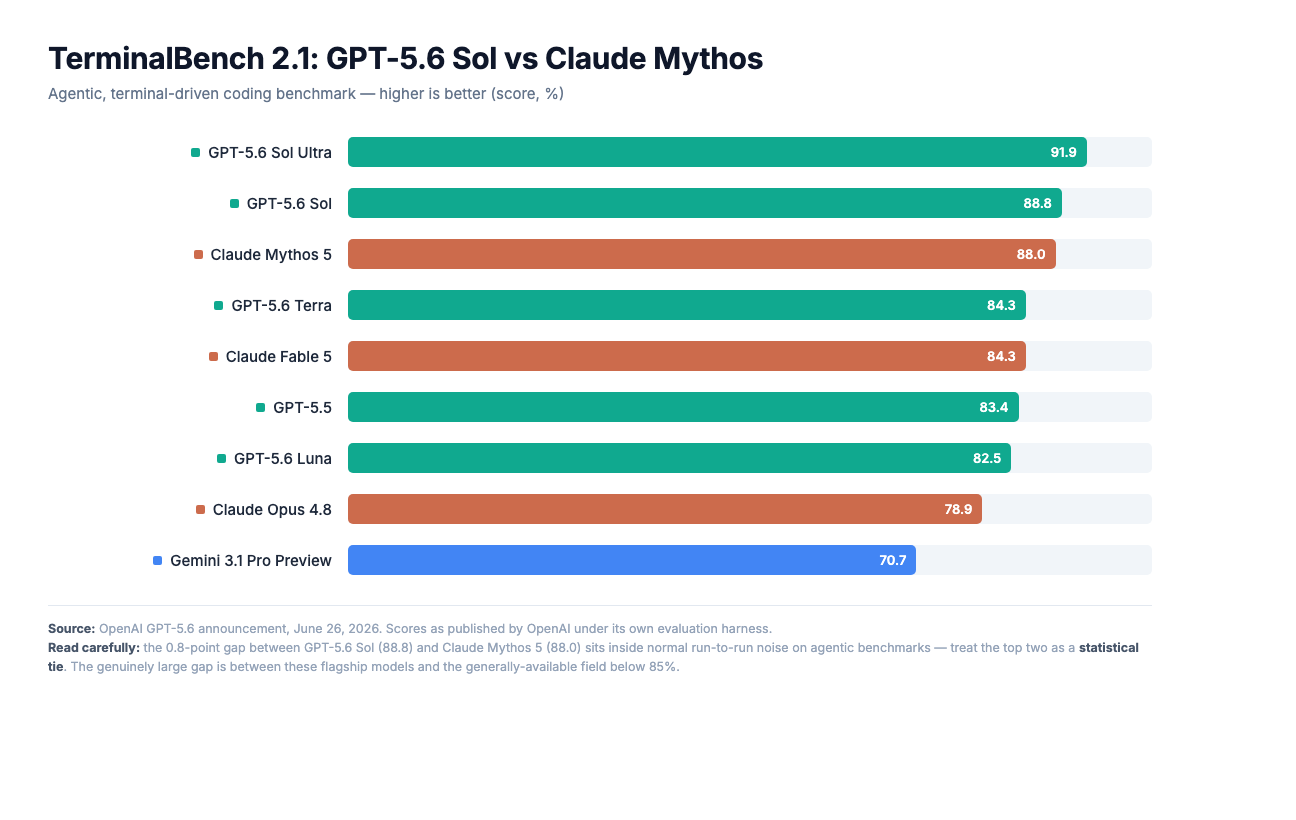
The headline rivalry, Sol at 88.8% versus Mythos 5 at 88.0%, is a tie for practical purposes. Agentic benchmarks are noisy: scores move with the random seed, harness configuration, tool timeouts, and which task subset a run samples. A sub-one-point gap sits inside the band where two runs of the same model disagree. The genuinely large gap is vertical: it separates the gated flagships from the field everyone can deploy. Claude Opus 4.8, generally available, lands about ten points behind Sol at 78.9%.
Cybersecurity and token efficiency
On ExploitBench, which tests whether an agent can find and exploit real flaws in Google's V8 JavaScript engine all the way to code execution, OpenAI reports Sol matches Mythos Preview using about a third of the output tokens. Independent token tracking lines up: the developer @banteg measured Sol as delivering roughly 2.75× "smarter tokens" than Mythos at about 40% lower cost, even where raw eval scores are slightly lower.
OpenAI frames Sol as a defender rather than an attacker, better at finding and fixing bugs than running end-to-end exploits. In Chromium and Firefox tests it identified bugs and exploitation primitives but did not produce an autonomous full-chain exploit, and OpenAI says it stays below the "Cyber Critical" threshold in its Preparedness Framework. Mythos, by contrast, is the model that pulled off a full-chain exploit in a different benchmark, the capability that spooked regulators in the first place.
Pricing
Sol's pricing is official and public. Mythos's is not on a standard rate card; it is consistently reported across developer discussion at roughly $10 input / $50 output per million tokens, about double Sol. Treat that as a widely-cited community figure rather than a confirmed Anthropic list price, since Mythos access itself is gated.
Model (per 1M tokens) | Input | Output | Access |
|---|---|---|---|
GPT-5.6 Sol | $5 | $30 | Limited preview |
GPT-5.6 Terra | $2.50 | $15 | Limited preview |
GPT-5.6 Luna | $1 | $6 | Limited preview |
Claude Mythos 5 | ~$10 | ~$50 | Restricted |
For the full cost breakdown across tiers and caching, see our GPT-5.6 pricing guide.
Access and availability
This is where the comparison stops being about benchmarks and starts being about whether you can ship. Both flagships are gated, but the mechanics differ.
Model | Status (July 2026) | Who gets it |
|---|---|---|
GPT-5.6 Sol | Limited preview, gov-coordinated | Trusted partners via API/Codex; broader access promised "coming weeks" |
Claude Mythos 5 | Restricted | Anthropic partner organizations (Project Glasswing) |
Claude Fable 5 | "Safe" public version from ~June 9 | Broader than Mythos, still controlled |
Claude Opus 4.8 | Generally available | Anyone with an API key |
If access can change on a government decision, the model at the top of a leaderboard matters less than the model wired into your production stack.
Safety and guardrails
Sol ships with what OpenAI calls its most robust safety stack: over 700,000 A100-equivalent GPU hours of automated red-teaming aimed at universal jailbreaks, real-time cyber and biology misuse classifiers that can pause generation for a larger model to review, and account-level pattern detection. Mythos's safety story runs through Project Glasswing's defensive-only deployment and the government review that led to Fable 5's temporary removal.
Which one should you actually use?
Benchmarks do not make this decision; your constraints do. Three honest paths:
Choose GPT-5.6 Sol if you run high-volume agentic coding and cost-per-task matters. Sol's combination of near-tied scores, roughly half the per-token price, and far better token efficiency wins wherever you pay for throughput. Developers who have used it say Sol max excels at implementation, code review, and debugging.
Choose Mythos or Fable 5 if you need peak reliability on long-horizon, architectural, or design-heavy work, or if you already have Anthropic partner access. Developers who have used both rate Fable 5 the stronger peak model, more capable on the hardest tasks, just more expensive and harder to reach.
The pragmatic answer: route both. This came up repeatedly in developer discussion, summarized cleanly by @saj_adib: "pick both and route intelligently." Send cost-sensitive, high-frequency coding to Sol; send the gnarly, high-stakes, architectural work to Fable 5. That only works if you can reach both, which for most teams right now is not possible.
What to use right now while both are locked
The model that runs your product this week is whichever generally-available tier sits one notch below the frontier, not the leaderboard-topper you cannot reach.
The benchmark gap between that tier and the flagships looks large on paper, Opus 4.8 is about ten points behind Sol on TerminalBench 2.1, but it shrinks fast in real workloads. A recurring sentiment from developers shipping production agents is that for most business tasks the difference between a current top-tier generally-available model and the locked flagships is nearly irrelevant; what matters is that the model is in your stack and stays there.
That is also where cost discipline pays off. The official Claude API is not cheap at the top tiers, and relay platforms that expose the same Anthropic-compatible API at a fraction of the list price are how many teams keep per-query cost manageable while the flagships sort themselves out. AIReiter, for example, serves the generally-available Claude lineup up to Opus 4.6 at roughly 20% of official Claude pricing, enough that you are not paying flagship prices for the tier you can deploy. It does not carry Mythos, Fable 5, or GPT-5.6; nothing does, broadly, yet. For the pricing mechanics, our Claude API pricing guide covers the full generally-available lineup.
The broader lesson from the access fight is the one Reddit keeps hammering: do not bet your roadmap on a single gated vendor. The teams that slept fine through the Sol launch were the ones with a fallback model wired in, a routing layer that could switch, and increasingly an open-weight option (Qwen, DeepSeek, Llama) fine-tuned on their own data as a Plan B.
FAQ
Is GPT-5.6 Sol better than Mythos?
On agentic coding they are a statistical tie, Sol 88.8% versus Mythos 5 88.0% on TerminalBench 2.1, inside benchmark noise. Sol wins clearly on price (about half) and token efficiency; Mythos and Fable 5 are rated the stronger, more reliable peak model on the hardest tasks. "Better" depends on your workload and, more often, on which one you can access.
GPT-5.6 Sol vs Fable 5: which wins?
Fable 5 is Mythos's most powerful variant and the model reviewers still call the stronger peak overall, especially on architectural and design work. Sol beats it on cost and token efficiency and leads on the TerminalBench 2.1 coding benchmark (88.8% vs Fable 5's 84.3%). For the full head-to-head, see our GPT-5.6 Sol vs Fable 5 breakdown.
What is the difference between Mythos and Fable 5?
Mythos is Anthropic's frontier model class; Fable 5 is its most powerful variant. Fable 5 is the model the U.S. government temporarily pulled over cybersecurity concerns before a public "safe" version was released around June 9, 2026. On TerminalBench 2.1, Mythos 5 outscores Fable 5 (88.0% vs 84.3%), but developers who have used both still rate Fable 5 the stronger model overall.
What is GPT-5.6 Sol Ultra, and is it worth it?
Sol Ultra is a compute-intensive mode that spins up subagents in parallel, lifting TerminalBench 2.1 from 88.8% to 91.9%. The roughly 3-point gain is real but costs more compute per task, so it pays off on high-value autonomous jobs and is overkill for routine work — reserve it for the hardest tasks and let standard Sol carry the rest.
How does GPT-5.6 Sol do on benchmarks?
Sol sets the state of the art on TerminalBench 2.1 (agentic, terminal-driven coding) at 88.8%, with Sol Ultra at 91.9%, ahead of Mythos 5 (88.0%) and well clear of the generally-available Claude Opus 4.8 (78.9%). It also leads on GeneBench v1 (biology) and matches Mythos Preview on ExploitBench (cybersecurity) using about a third of the tokens. All scores are vendor-reported under OpenAI's own harness.
How much does GPT-5.6 Sol cost?
Sol is $5/$30 per million tokens (input/output) per OpenAI's official pricing; Terra is $2.50/$15 and Luna is $1/$6, with prompt caching giving cache reads a 90% discount. Mythos has no public rate card; community reporting (see Sources) puts it near $10/$50, roughly double Sol, so treat that as an estimate.
Can I use GPT-5.6 Sol or Mythos today?
Probably not unless you are an approved partner. Sol is in a government-coordinated limited preview via the API and Codex; Mythos access runs through Anthropic's Project Glasswing partner program. For most teams, the generally-available tier (Opus 4.8 and below) is what you can call right now.
When will GPT-5.6 be generally available?
OpenAI plans to make Sol, Terra, and Luna generally available in the coming weeks, and developer discussion points to July for broader access, but the government review process makes the timeline uncertain. Keep a generally-available fallback wired into your stack in the meantime.
What do developers actually say about Sol vs Mythos?
The dominant view on X and Reddit is pragmatic: Sol wins on cost and efficiency for those who can access it, Fable 5 and Mythos win on peak reliability, and sophisticated teams should "pick both and route intelligently." The louder theme is frustration that both flagships are government-gated, pushing teams toward open-weight fallbacks like Qwen, DeepSeek, and Llama.
The bottom line
The 0.8-point coding gap is noise, so the decision breaks elsewhere. Sol wins on economics, roughly half the per-token price and a third of the tokens on security work, in a clean three-tier lineup. Mythos, and especially Fable 5, is the stronger peak model and the one regulators trust less. What changes the picture next is Sol's move to general availability: if broader access lands in July as OpenAI has signaled, Sol becomes the default high-volume coding model for anyone with an API key, and the question shifts from "which flagship is gated" to "which one you can actually bill against." Until then, the model that protects your roadmap is the one you can reach today, behind a routing layer, with a generally-available tier doing the work.
Sources and confidence
Official / vendor-reported (OpenAI's June 26, 2026 announcement and system card): GPT-5.6 launch date, Sol/Terra/Luna tiers,
max/ultramodes, all pricing and caching mechanics, Cerebras 750 tok/s, 700,000 A100-hours of red-teaming, TerminalBench 2.1 scores, ExploitBench results, Cyber Critical threshold. OpenAI.Reputable press: Mythos origin, Project Glasswing, partner list, zero-day claims (TechCrunch); Fable 5 pull and "safe" release (The Guardian); government rollout mechanics and benchmark reporting (The Decoder, Lushbinary).
Community-reported (developer discussion on X, July 2026): Mythos ~$10/$50 pricing, the "2.75× smarter tokens / 40% cheaper" efficiency figure, and the "route both" consensus. These are widely cited but not on an official rate card; treat as directional. @banteg, @saj_adib.
Unconfirmed: Sol's exact general-availability date (OpenAI says "coming weeks"; community points to July) and GPT-5.6's context window (not officially stated; expected to match GPT-5.5's up to 1M). Verify before depending on either.