 AIREITER
GPT-5.6 Luna is the cheapest tier in OpenAI's GPT-5.6 family, priced at $1 per 1M input tokens and $6 per 1M output tokens, five times below the Sol flagship. It is not a stripped-down toy: OpenAI's developer team says Luna "nearly matches GPT-5.5's peak performance at well under half the estimated API cost," and on the Terminal-Bench 2.1 coding-agent test compiled by DataCamp, Luna scored 84.3%, actually edging out the pricier Terra tier (82.5%) while trailing Sol (88.8%). The catch is scope. Independent early testing points to a model that shines on narrow, high-volume, parallelizable work and falls behind the flagship on complex planning, long-horizon agents, and chart-heavy documents. This guide pulls together the official specs, third-party benchmarks, and developer reactions so you can decide whether Luna belongs in your stack.
What GPT-5.6 Luna Actually Is
OpenAI previewed the GPT-5.6 series on July 9–10, 2026 as three distinct models: Sol (the flagship), Terra (mid-tier, coding-leaning), and Luna (the efficiency tier). According to OpenAI's model documentation, Luna is "designed for cost-sensitive, high-volume workloads" and "roughly corresponds to the nano model tier used in earlier GPT-5 families."
The official specs are more capable than the "cheapest tier" label suggests:
Model ID:
gpt-5.6-lunaContext window: 1,050,000 tokens (about 1M)
Max output: 128,000 tokens
Knowledge cutoff: February 16, 2026
Modalities: text and image input, text output
Features: function calling, structured outputs, streaming, and reasoning tokens
One trap to know before you write code: coursiv's Luna reference notes that the bare gpt-5.6 alias routes to Sol, not Luna, so you must pass the full gpt-5.6-luna ID or you will be billed at flagship rates. Luna is not individually selectable in standard ChatGPT chats; it is primarily an API and ChatGPT Work model.
GPT-5.6 Luna Pricing
Here is how the three tiers line up per 1M tokens, from OpenAI's model docs and preview announcement:
Model | Input | Cached input | Output | Role |
|---|---|---|---|---|
GPT-5.6 Sol | $5 | — | $30 | Flagship reasoning |
GPT-5.6 Terra | $2.50 | — | $15 | Coding, mid-tier |
GPT-5.6 Luna | $1 | $0.10 | $6 | Efficiency, high-volume |
Luna is 5x cheaper than Sol and 2.5x cheaper than Terra on standard tokens, and the cached-input rate of $0.10 per 1M is a 10x discount for repeated system prompts. Independent benchmarking site Artificial Analysis puts Luna's blended price at about $0.87 per 1M tokens on a typical 7:2:1 input/cache/output mix. For the full three-tier breakdown, including long-context rates, see the GPT-5.6 pricing guide.
How GPT-5.6 Luna Performs
Because Luna is brand new, the picture here is early and drawn from vendor claims plus a handful of independent benchmarks rather than a settled body of testing. Read it as a first read, not a verdict.
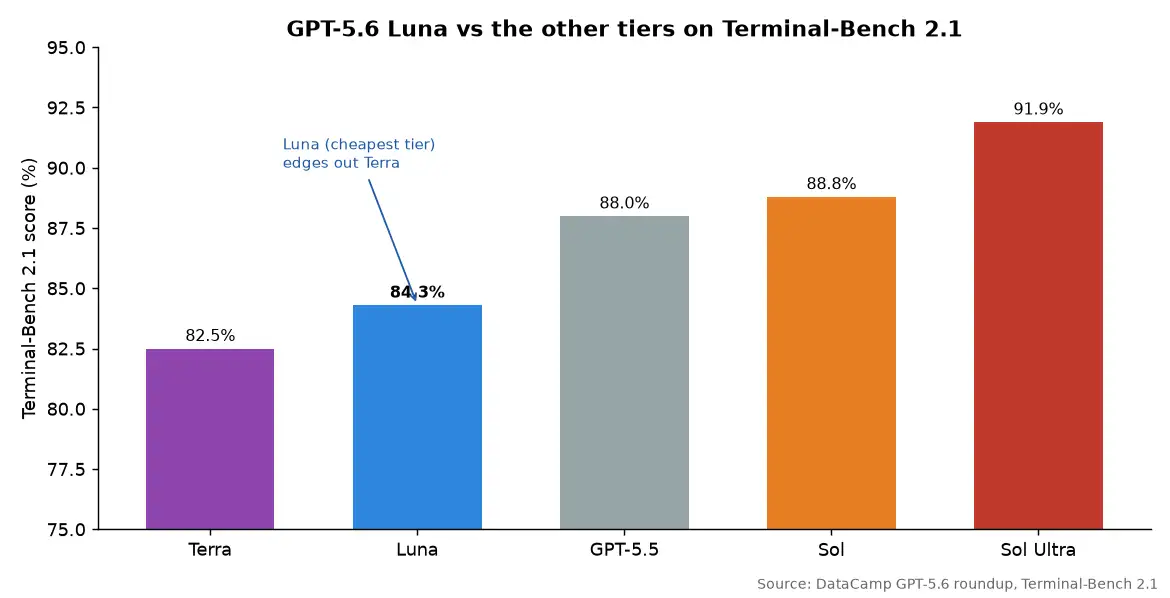
Coding agents. On Terminal-Bench 2.1, DataCamp's roundup lists Luna at 84.3%, above Terra (82.5%) and within striking distance of Sol (88.8%) and GPT-5.5 (88.0%); Sol Ultra tops the chart at 91.9%. The headline there is that the cheapest tier beat the mid tier on a command-line coding benchmark, which lines up with OpenAI's claim that Luna "nearly matches GPT-5.5's peak performance."
Document parsing. The LlamaIndex team ran the family through ParseBench and reported that Luna is "about 6x cheaper than Sol and only results in minor degradations across all ParseBench metrics" on text and tables, while noting the whole GPT-5.6 family "continues to struggle with charts and layout." So for extracting structured data from text-heavy documents, Luna gives up little for a large cost saving; for chart- or layout-heavy pages, no tier is a safe bet.
Speed. Artificial Analysis measured Luna's output speed at roughly 204 tokens per second, in line with its "fast, affordable" billing. Note that with maximum reasoning effort the model spends meaningful time thinking before the first token, so end-to-end latency depends heavily on how much reasoning you enable.
Token efficiency. Cost per task depends on tokens spent, not just the per-token rate, and the GPT-5.6 generation appears to be more frugal than its predecessor. One developer testing the family on r/codex reported that GPT-5.6 "uses 20-30% less tokens for the same performance," which compounds Luna's already-low pricing on high-volume jobs.
The consistent theme across sources is efficiency, not raw capability: OpenAI's developers describe Luna as bringing "speed to well-defined, high-volume work," and developer @debasishg summed it up as "the fast, inexpensive worker for narrow, parallelizable tasks." Where the flagship pulls ahead is planning, decomposition, and long-horizon agent work.
When to Pick Luna vs Terra vs Sol
The pattern across benchmarks and developer reports is to pick the tier by task shape, not just budget:
Use GPT-5.6 Luna for narrow, high-volume, parallelizable work: classification, extraction, tagging, batch drafting, and well-scoped coding. It carries a 1M-token context, so it also suits cheap long-document processing where you do not need flagship reasoning.
Use Terra for balanced everyday coding and research where you want more headroom than Luna but not flagship pricing.
Use Sol for planning, decomposition, judgment, final synthesis, and long-horizon agent work that demands sustained tool use and follow-through.
A common production pattern developers describe is to default to Luna and escalate only when a task needs it:
def answer(prompt):
    out = call("gpt-5.6-luna", prompt)
    if not passes_validation(out):          # schema check, unit test, confidence gate
        out = call("gpt-5.6-luna", prompt, reasoning_effort="high")
    if not passes_validation(out):
        out = call("gpt-5.6-terra", prompt)  # or gpt-5.6-sol for planning-heavy work
    return out
Because Luna supports reasoning tokens, raising its reasoning effort is often a cheaper first move than jumping a tier.
Limitations to Keep in Mind
Luna is a strong value, but it is not a drop-in flagship replacement, and a few caveats are worth holding onto:
The benchmarks are early. Most public numbers come from the first days after launch and from vendor or single-run sources. Treat them as directional and test on your own workload before committing a pipeline.
Charts and layout are a weak spot. LlamaIndex found the whole GPT-5.6 family struggles with charts and visual layout, so document pipelines that depend on parsing figures should validate output carefully regardless of tier.
Complex reasoning still favors Sol. For multi-step planning, decomposition, and long-horizon agents, developer consensus points to the flagship; Luna's edge is on well-scoped, verifiable tasks.
Verify third-party access. Some API gateways remap model names, so a request for
gpt-5.6-lunacan quietly be served by a different or older model. If you route through a reseller, confirm the backend is genuinely Luna before trusting cost or quality comparisons.
How to Access GPT-5.6 Luna
Luna is available through the API. Any OpenAI-compatible client works; set the model to gpt-5.6-luna:
from openai import OpenAI

client = OpenAI()
resp = client.chat.completions.create(
    model="gpt-5.6-luna",
    messages=[{"role": "user", "content": "Classify this ticket: ..."}],
)
print(resp.choices[0].message.content)
At launch, GPT-5.6 access rolled out gradually, with VentureBeat reporting the models were initially limited to preview partners before wider availability. In ChatGPT, Luna surfaces through ChatGPT Work plans rather than the free tier. Several third-party API gateways also list gpt-5.6-luna; if a call returns "model not found," check whether the provider expects dots or hyphens in the ID, and confirm the gateway actually serves the genuine model rather than remapping the name to an older one.
FAQ
When was GPT-5.6 Luna released?
OpenAI previewed the GPT-5.6 series (Sol, Terra, and Luna) on July 9–10, 2026, with access rolling out gradually from preview partners outward.
What happens if I call gpt-5.6 instead of gpt-5.6-luna?
The bare gpt-5.6 alias routes to Sol, so you would pay $5/$30 instead of Luna's $1/$6. Pass the full gpt-5.6-luna ID whenever you want Luna.
Is GPT-5.6 Luna good enough for coding?
For well-scoped coding, yes. It scored 84.3% on Terminal-Bench 2.1 in DataCamp's roundup, ahead of the pricier Terra and close to GPT-5.5. For long-horizon, planning-heavy agent work, developers still point to Sol.
How big is the GPT-5.6 Luna context window?
1,050,000 tokens, with up to 128,000 output tokens, per OpenAI's model docs. That makes cheap long-document processing one of Luna's stronger use cases.
Luna vs Terra: which should I use?
Default to Luna for high-volume, well-defined tasks; it even edged Terra on Terminal-Bench 2.1. Choose Terra for broader everyday coding and research where you want a bit more general headroom.