 AIREITER
Genie 3 is Google DeepMind's general-purpose world model: type a text prompt and it generates a 3D world you can navigate in real time at 24 frames per second and 720p. It is also a limited research preview, with no public sign-up, no API, and no price tag, and the one consumer-facing app built on it (Project Genie) is gated behind a Google AI Ultra subscription. If you are searching for a genie 3 alternative, you want something you can run today. No public tool fully matches Genie 3's real-time interactive worlds yet, but five come close, split across three camps: open-source world models for developers who can self-host, a production real-time platform for teams building a product, and embodied-AI simulators for agent training. There is also an accessible image-generation layer you can use right now while Genie 3 stays closed, covered at the end.
What Genie 3 actually does (and why you can't use it)
Announced August 5, 2025 on the DeepMind blog, Genie 3 is DeepMind's first world model to support real-time interaction, a step past Genie 2 and GameNGen. It models physical properties like water and lighting, simulates ecosystems, renders fictional animation, and lets you explore locations and historical settings, with "promptable world events" that can change weather or introduce characters mid-session. DeepMind's published limitations are candid: a constrained action space, weak multi-agent interaction, imperfect real-world geography, poor text rendering, and sessions that last only a few minutes.
The blocker is access, not quality. Genie 3 is open only to "a small cohort of academics and creators." Project Genie, the web app built on top of it, is covered by MediaPost as a prototype combining three models: Genie 3 for world simulation, Nano Banana Pro (Google's image model built on Gemini 3 Pro Image) for image generation, and Gemini for reasoning. It is restricted to Google AI Ultra subscribers. That gap between "the demo looks incredible" and "I cannot touch it" is the entire reason the genie 3 alternative query exists.
The 5 Genie 3 alternatives, by what you need
1. Matrix-Game 2.0 / 3.0 — the open-source flagship
Skywork AI released Matrix-Game 2.0 on August 12, 2025, a week after Genie 3, under the MIT license, with code on GitHub and weights on HuggingFace. It generates interactive video at a stable 25 fps with minute-long sessions, trained on roughly 1,200 hours of Unreal Engine and GTA5 footage with frame-level keyboard-and-mouse inputs, so it learns how worlds respond to actions rather than just what they look like. It supports forward and backward movement, lateral motion, and camera rotation across urban and wilderness scenes in realistic or oil-painting styles. A Matrix-Game 3.0 update (released March 27, 2026, per the project repo) added real-time streaming and longer-horizon memory, narrowing the gap with Genie 3.
This is the most mature open-source option. The catch: you self-host it, it needs a real GPU, and setup is a developer task, not a sign-up flow. Skywork has not published an official VRAM figure; the model is on the order of 17 billion parameters per third-party ComfyUI integrations, which points to a high-end consumer GPU (24GB+ VRAM class) or a cloud GPU such as an A100 or L40S on RunPod or Lambda at minimum.
2. LingBot-World — open-source on Alibaba's Wan2.2
LingBot-World runs real-time interaction at 16 fps and is fully open source, built on Alibaba's Wan2.2 model, with code on GitHub. It appeared in February 2026 as part of a Chinese open-source wave that also includes Tencent's HunyuanWorld, an open-source world model that generates immersive, explorable 3D worlds from text or images (released mid-2025). Both are open source, though their documentation is thinner than Matrix-Game's. The strength of this camp is accessibility and speed; the weakness is that you are reading code and community threads rather than vendor docs, and maturity varies.
3. PixVerse R1 — production-ready real-time platform
PixVerse R1 is the one alternative positioned explicitly as production-ready rather than a research demo, in its own research blog. It generates real-time streaming video with native synchronized audio (footsteps, ambient weather, context-aware sound), built on an "Omni" multimodal foundation model that folds video, audio, and interaction into one model. Output is 720p HD, with 1080p in research models. Access is either an instant web trial or an API Partner Program with RESTful endpoints on rolling entry for qualified partners.
This is the option for teams that want to build a product on real-time worlds. Two honest caveats: the API is gated behind application review rather than open self-serve, and PixVerse has not published pricing. Because the comparison-to-Genie-3 claims come from PixVerse's own blog, treat the framing as marketing until you test it.
4. Decart Oasis — playable Minecraft-style worlds
Decart Oasis, by Decart and Etched, is a diffusion-transformer world model that produces playable, Minecraft-style interactive worlds in real time from keyboard input (aixploria's comparison rates it at roughly 20 fps). Decart has run live playable demos of Oasis, though access has shifted over time, so check the project page for current status. Oasis is the closest peer to Genie 3 in aixploria's comparison set, the one entry that is a generative interactive world model rather than a simulator or game engine. The trade-off is aesthetic: it is built around a blocky Minecraft look, so it will not produce photorealistic environments. If your goal is something playable now, it will; if your goal is realism, it will not.
5. Genie Sim 3.0 (Agibot) — embodied AI simulation
Genie Sim 3.0 from Agibot uses LLMs to generate synthetic scenes for embodied AI evaluation: endless, reproducible worlds for training and benchmarking robots and autonomous agents. This is a different goal than the others, not generative media for creators but synthetic environments for agent research, which happens to be the exact use case DeepMind names for Genie 3. If you are training and evaluating agents, this is the relevant lane.
Comparison at a glance
Alternative | Type | Open source | Access | FPS / output | Hardware | Best for |
|---|---|---|---|---|---|---|
Matrix-Game 2.0/3.0 | Interactive world model | MIT | Self-host | 25 fps, minute-long | GPU ~17B params, 24GB+ VRAM class (unofficial) | Devs wanting a true open clone |
LingBot-World | Interactive world model | Yes | Self-host (Wan2.2) | 16 fps | GPU | Open-source tinkerers |
PixVerse R1 | Real-time platform | No | Web trial + API Partner Program | 720p (1080p research) | Cloud | Teams building a product |
Decart Oasis | Playable world model | Partial | Demo | ~20 fps | Cloud / GPU | Playable worlds now |
Genie Sim 3.0 | Embodied-AI simulator | Yes | Self-host | Synthetic scenes | GPU | Agent training and eval |
What doesn't count as a Genie 3 alternative
Not every tool tagged a "Genie 3 alternative" actually generates interactive worlds. Diagramming tools like Miro and Creately, and 3D-asset generators like Meshy, produce diagrams or static objects, not playable worlds. Game engines like Unity or Unreal Engine 5, and simulators like Nvidia Isaac Lab, are powerful, but you build or script their scenes yourself — they do not generate a navigable world from a text prompt. The line: a real Genie 3 alternative generates the world for you. These tools help you build one.
The accessible generation layer: what you can use today
Genie 3's full pipeline, real-time interactive world simulation, is not publicly available. But the image-generation layer of world creation is, and it is the same model Google uses inside Project Genie. Project Genie pairs Genie 3 with Nano Banana Pro — Google's image model built on Gemini 3 Pro Image — for image generation, and you can call that same model through an API.
To show what that layer produces, I ran the same world-creation prompt through two image models on the AIReiter API:
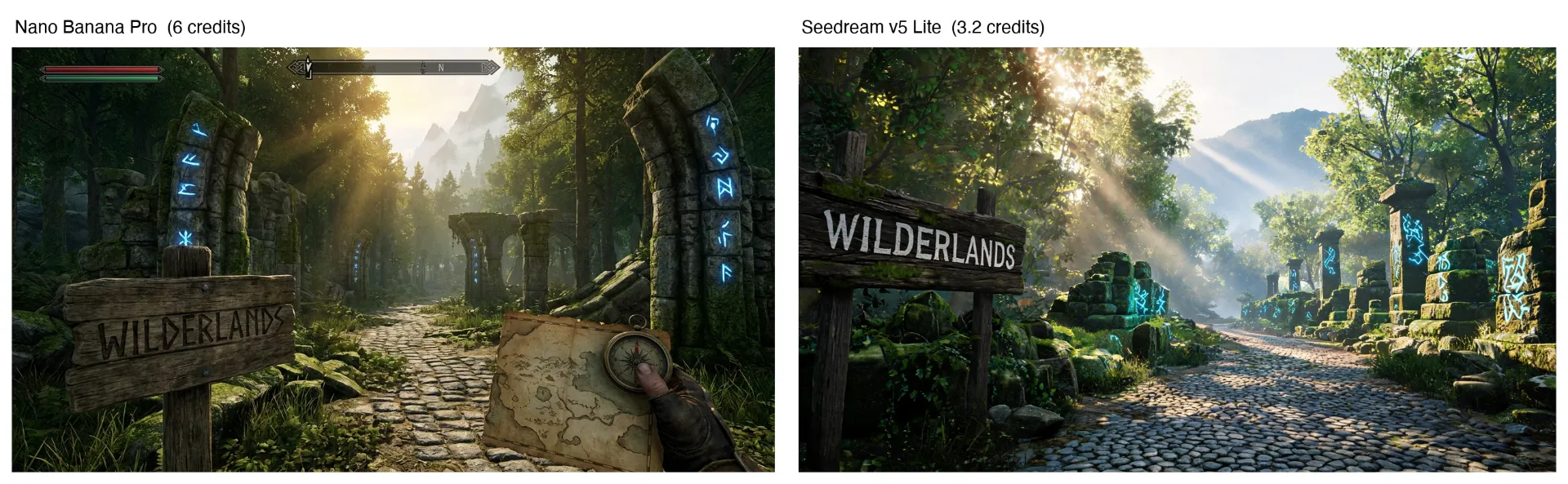
The prompt asked for a first-person view of an explorable open-world environment: cobblestone path, mossy ruins, emerald forest, golden morning light, a wooden sign reading "WILDERLANDS," and glowing blue runes. Both models rendered the full scene and the sign text correctly. Nano Banana Pro, at 6 credits (about $0.06 at AIReiter's 500-credits-for-$5 rate, verified July 2026), produced the more immersive first-person key art at 1376x768. Seedream v5 Lite, at 3.2 credits, produced a higher-resolution 2848x1600 image at roughly half the cost. To be clear: this is the image-generation layer, not Genie 3. There is no real-time navigation and no promptable world events. It is useful when what you need is world imagery or key art today, pay-per-use, with no GPU on your desk, rather than a self-hosted world model.
How to choose
Self-host a true interactive world model → Matrix-Game 2.0/3.0
Build a product on real-time worlds → PixVerse R1
Get something playable now → Decart Oasis
Train and evaluate agents → Genie Sim 3.0
Generate world imagery or key art via API today → Nano Banana Pro or Seedream v5 Lite through AIReiter
Genie 3 is impressive because real-time interactive world simulation is genuinely hard, and no public tool has fully caught up. The open-source camp has closed most of the research gap, PixVerse has a production path, and the image-generation model Google uses inside Project Genie is available by API right now.
FAQ
Can you use Genie 3 right now?
No, not directly. Genie 3 is a limited research preview open only to a small cohort of academics and creators, per the DeepMind announcement. The closest public access is Project Genie, Google's web app built on Genie 3, but it requires a Google AI Ultra subscription.
Is there a free, open-source Genie 3 alternative?
Yes. Matrix-Game 2.0 (MIT license, GitHub, HuggingFace) and LingBot-World (GitHub, built on Alibaba's Wan2.2) are both open source and free to run, though you supply the GPU.
What's the best Genie 3 alternative for developers?
Matrix-Game 2.0/3.0 from Skywork AI. It is MIT-licensed, hits 25 fps, handles minute-long sessions, and the 3.0 update added real-time streaming and longer memory. You self-host it, so expect GPU and setup work.
Will Genie 3 be released to the public?
DeepMind says it is "exploring how we can make Genie 3 available to additional testers in the future," but has given no public release date. Treat any specific date you see online as speculation.
Is Nano Banana Pro the same as Genie 3?
No. Nano Banana Pro is Google's image generation model, built on Gemini 3 Pro Image. Genie 3 is the world model that simulates interactive 3D environments. Project Genie combines the two: Genie 3 for the world, Nano Banana Pro for image generation, Gemini for reasoning.
What hardware do open-source Genie 3 alternatives need?
A capable GPU. Matrix-Game is on the order of 17 billion parameters per third-party ComfyUI integrations (Skywork has not published an official VRAM figure), so expect a 24GB+ VRAM consumer card or a cloud GPU like an A100 or L40S at minimum. LingBot-World and Tencent's Hunyuan world model have similar requirements. If you do not want to own a GPU, the API route avoids it entirely.