 AIREITER
A 10-second image-to-video render can cost less than a coffee—or almost four times as much three weeks later. FLUX 3 Max video pricing on fal is $0.0425 per output second during the launch promotion, so a 10-second 720p clip costs $0.425; the listed regular rate is $0.17 per second, or $1.70 for the same clip. The catch is that fal currently documents 720p output, not a direct 1080p option.
The short answer: FLUX 3 Max costs $0.425 per 10-second clip during the launch promotion
FLUX 3 Max is live on fal for text-to-video and image-to-video. Both routes use output-duration billing at the same rate, with no subscription or minimum charge stated on the product page.
| Item | Launch promotion | Listed regular rate |
|---|---|---|
| Price per output second | $0.0425 | $0.17 |
| 5-second clip | $0.2125 | $0.85 |
| 10-second clip | $0.425 | $1.70 |
| 20-second clip | $0.85 | $3.40 |
| Resolution documented by fal | 720p | 720p |
| Billing model | Pay as you go | Pay as you go |
fal advertises the promotional rate as 75% off until November 7. The page did not print a year beside that date when checked on October 20, 2026, although the launch timing and page update context point to November 7, 2026. Recheck the live rate before starting a large batch.
Price clock: what changes after November 7
The headline discount cuts the rendering charge by exactly 75%, but the practical change is easier to see in project terms: every 10-second attempt rises from $0.425 to $1.70. A four-attempt revision cycle therefore moves from $1.70 to $6.80 after the offer ends.
Cost per 10-second image-to-video attempt
The arithmetic is direct because fal charges by returned output duration:
Promotional cost: 10 seconds × $0.0425 = $0.425
Regular cost:     10 seconds × $0.17   = $1.70
Image-to-video does not carry a documented surcharge over text-to-video. The fal product page says both endpoints use the same post-trained model and the same per-second price.
Practical cost per usable clip
A generated clip is not automatically a usable clip. Prompt misses, motion errors, malformed hands, subject drift, or a poor camera move can require another paid attempt, so budget by attempts rather than by final exports.
| Attempts needed for one usable 10-second clip | Promotional cost | Regular cost |
|---|---|---|
| 1 | $0.425 | $1.70 |
| 2 | $0.85 | $3.40 |
| 3 | $1.275 | $5.10 |
| 5 | $2.125 | $8.50 |
These are scenario costs, not a claimed success rate. fal does not publish a typical retry count, rejection rate, or cost-per-accepted-clip metric. That missing variable matters more than a fraction-of-a-cent difference in the advertised unit price.
A separate naming trap can inflate comparison work. Several search results sell a “Max” subscription plan for an independent FLUX-branded website; that plan name is not the FLUX 3 Max model. For example, flux-ai.video labels its highest credit subscription “Max,” while www-flux3.com uses the same word for a service tier covering multiple models. fal's page is the authoritative source for the model-specific rate discussed here.
What is actually available on fal
fal exposes FLUX 3 Max through two launch endpoints: text-to-video and image-to-video. The product page provides JavaScript and Python integration examples and identifies the text route as blackforestlabs/flux-3-max/text-to-video.
| Capability | fal status checked October 20, 2026 |
|---|---|
| Text-to-video | Available |
| Image-to-video | Available |
| Output resolution | 720p documented |
| Clip duration | 5–20 seconds reported by Artificial Analysis |
| Subscription required | No |
| Minimum charge | None stated |
| Commercial use | Check fal's current terms before production use |
| Native audio | Not claimed for FLUX 3 Max |
| Reference-video input | Not documented as a launch endpoint |
| Open weights | Not announced on the product page |
The duration range comes from Artificial Analysis' launch note, which reports 5-to-20-second 720p generation. The fal page itself demonstrates 6- and 10-second examples but does not present a compact limits table.
What FLUX 3 Max does not document
FLUX 3 Max should not be purchased on the assumption that every FLUX 3 mode is present. fal's launch page does not document a native 1080p route, native audio, reference-to-video, video editing, or downloadable weights for the Max model.
That distinction is important because third-party front ends may advertise 1080p, audio, or a broad model catalog under a FLUX 3 brand. Those capabilities and prices belong to the third-party service unless the fal endpoint documentation confirms them. If 1080p delivery is mandatory, include a separately priced upscale step or select a model with a documented native 1080p route.
Generation speed: near real time in the benchmark, slower in early user runs
fal reports 12.45 seconds to generate a 10-second, 16:9 video in the preliminary AA-Video-I2V v1.1 comparison. That is roughly 10 times faster than the original FLUX 3 result of 126.44 seconds and about 22 times faster than Seedance 2.5's 277.80 seconds in the same table.
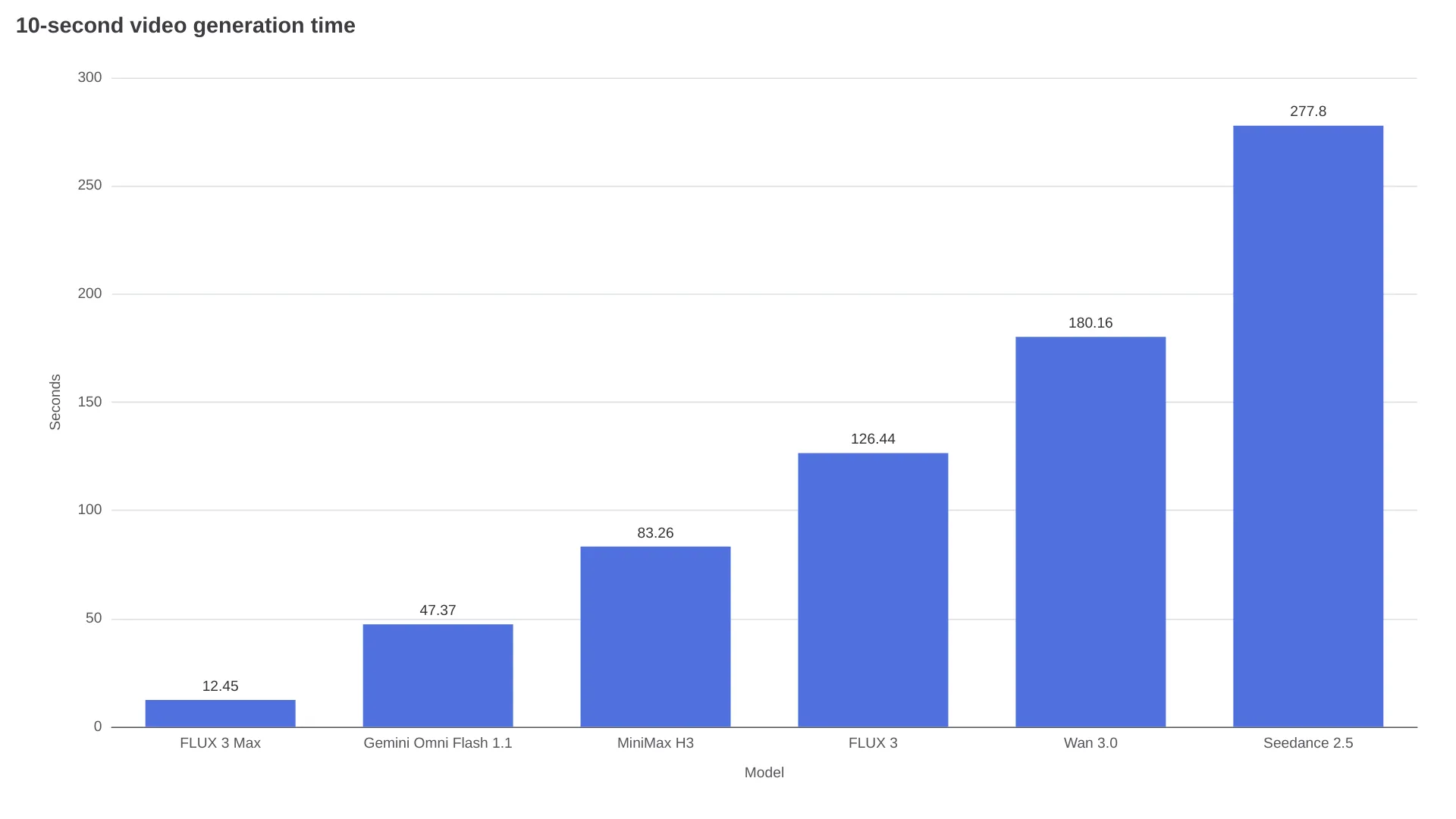
| Model | 10-second benchmark time | Image-to-video Elo |
|---|---|---|
| FLUX 3 Max | 12.45 s | 1,139 |
| Gemini Omni Flash 1.1 | 47.37 s | 1,134 |
| MiniMax H3, 768p | 83.26 s | 1,141 |
| FLUX 3 | 126.44 s | 1,089 |
| Wan 3.0 | 180.16 s | 1,127 |
| Seedance 2.5 | 277.80 s | 1,139 |
The preliminary benchmark covers a specific 720p/768p, 16:9 configuration, not guaranteed wall-clock latency; uploads, safety checks, routing, queues, and result delivery can add time.
Early public runs already show that spread. X user @OzanSihay reported a 20-second 720p generation that cost $0.85 and took 51 seconds. Another user, @aden_gomes23, reported a $0.85 text-to-video run completing in 35 seconds, though the post does not provide enough settings to normalize the result against the benchmark.
“20 saniye 720p, Üretim süresi 51 saniye, maliyet 0.85 $” — @OzanSihay, reporting a 20-second 720p run, 51-second generation time, and $0.85 promotional cost.
The useful planning range is therefore not “every 10-second job finishes in 12.45 seconds.” Treat 12.45 seconds as a controlled average cited by fal and measure end-to-end latency in your own region before promising near-real-time delivery.
Is the promotion worth using?
Use the promotion for evaluation and 720p iteration if image-to-video fits the workflow. Do not build a production budget around the promotional rate unless the project finishes before the offer ends. The fourfold price increase is large enough to change which prompts, retry policies, and shot volumes remain economical.
The model is a strong fit when:
- 720p is an acceptable master or an upscale step already exists.
- Fast prompt iteration matters more than native audio.
- Clips fit within the reported 5-to-20-second range.
- A hosted fal API is acceptable.
- The team can test failure and retry behavior during the discount window.
Choose another route when native 1080p, native audio, reference-video input, local weights, or a fixed post-November budget is non-negotiable.
A $10 test budget
At the promotional rate, $10 funds 23 complete 10-second attempts, with $0.225 left. At the regular rate, the same budget funds five complete attempts, with $1.50 left.
| $10 budget | Complete 10-second attempts |
|---|---|
| Promotional rate | 23 |
| Regular rate | 5 |
Twenty-three attempts are enough to test several motion types, portrait and landscape inputs, prompt lengths, and camera instructions. Five attempts are closer to a smoke test than a reliable quality evaluation.
A 100-clip production budget
The one-attempt floor for 100 usable 10-second clips is $42.50 during the promotion and $170 at the regular rate. A more cautious budget should reserve two or three attempts per accepted clip.
| Planned attempts per accepted clip | Total attempts | Promotional cost | Regular cost |
|---|---|---|---|
| 1 | 100 | $42.50 | $170 |
| 2 | 200 | $85 | $340 |
| 3 | 300 | $127.50 | $510 |
This table excludes taxes, storage, transfer, post-processing, upscaling, and labor. fal's public product page also does not state a general billing rule for every rejected, failed, or cancelled request, so verify failure handling before automating a large queue.
FLUX 3 Max pricing FAQ
Is FLUX 3 Max on fal now?
Yes. fal lists live text-to-video and image-to-video endpoints on the FLUX 3 Max product page.
How much is a 10-second image-to-video clip?
A 10-second 720p image-to-video attempt costs $0.425 at the promotional rate or $1.70 at the listed regular rate. The practical cost is higher when multiple attempts are needed.
Does image-to-video cost more than text-to-video?
No separate surcharge is documented. fal states that text-to-video and image-to-video use the same $0.0425 promotional or $0.17 regular per-output-second rate.
Is 1080p available on fal?
The reviewed fal page documents FLUX 3 Max at 720p and does not list a native 1080p endpoint. Do not infer fal capability from a third-party FLUX-branded service advertising 1080p.
How long can FLUX 3 Max videos be?
Artificial Analysis reports a 5-to-20-second output range for the launch model. Confirm the accepted duration values in the live endpoint schema before coding a fixed interface.
How fast is a 10-second generation?
fal cites an average of 12.45 seconds for a 10-second benchmark clip. Early users have reported longer end-to-end times, so production latency should be measured under the intended region, queue load, and input workflow.
Is a third-party “Max plan” the same as FLUX 3 Max?
No. “Max” may be the name of a website's subscription tier, while FLUX 3 Max is fal's post-trained video model. Check the endpoint name and per-second rate rather than the plan label.
When does the 75% discount end?
fal says the offer ends November 7. The product page did not display the year beside the date when checked on October 20, 2026, so verify the live page and dashboard quote before submitting a batch near the deadline.
The best next step is a controlled 10-clip image-to-video batch during the promotion: record total wall-clock time, accepted outputs, retries, and actual debits. That small test will reveal whether the real number to budget is $0.425, $0.85, or more per usable 10-second clip.