
Fable 5 and Mythos 5 are not two different models. They are the same Claude model, released together by Anthropic on June 9, 2026, configured two ways. Fable 5 is the version anyone can call through the API; when a request touches cybersecurity, biology, or distillation, it silently falls back to Opus 4.8. Mythos 5 is the same weights with those safeguards lifted, but Anthropic only hands it to government cyber defenders and, soon, vetted biomedical researchers. Both cost $10 per million input tokens and $50 per million output.
In over 95% of sessions the two produce identical output, because the fallback never triggers. So "Fable 5 vs Mythos 5" is the wrong frame if you are shopping for a more capable model. The real questions are narrower: can you even get Mythos 5, does your work hit the classifiers, and are you OK with the 30-day data-retention policy that ships with both?
Same model, two configurations
Anthropic launched Fable 5 and Mythos 5 on the same day as a single "Mythos-class" model, a tier that sits above Opus in its lineup. Anthropic's own description is blunt: Fable 5 is "a Mythos-class model that we've made safe for general use." Mythos 5 is the same underlying model with safeguards lifted in some areas.
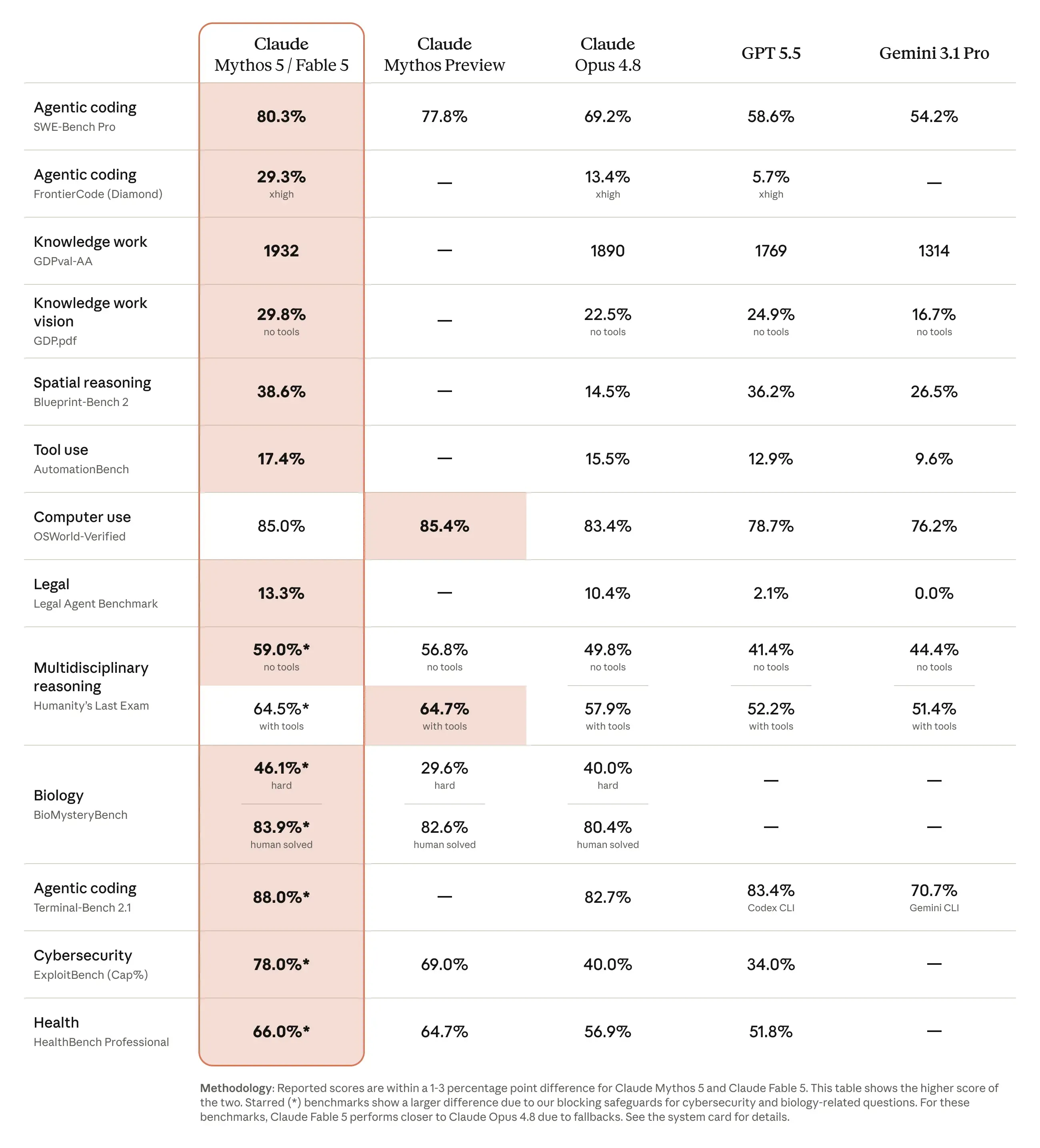
The two share everything that matters on a spec sheet: the same 1M-token context window, the same 128K max output, the same reasoning benchmarks. On SWE-Bench Pro (real GitHub issue resolution) both score 80.3%, versus Opus 4.8's 69.2% and GPT-5.5's 58.6%. On Humanity's Last Exam with tools, they reach 64.5% versus GPT-5.5's 52.2%. They diverge only sometimes, and only when a query trips one of Fable 5's safety classifiers.
The one real difference: safety classifiers and the Opus 4.8 fallback
How the fallback works
Fable 5 runs a two-stage classifier system on top of the base model. A probe monitors the model's internal activations on every request; when activations look risky, the request escalates to a separate LLM classifier that makes the final call. Three domains are covered: cybersecurity, biology and chemistry, and distillation (attempts to extract Claude's capabilities to train a rival model).
When the classifier fires, the request is not refused. It is handed to Claude Opus 4.8 instead, the user is notified, and the response is charged at Opus 4.8 rates ($5/$25 per million tokens) instead of Fable 5 rates ($10/$50). That billing detail matters. Anthropic's early data puts the trigger rate below 5% of sessions. For the other 95%-plus, Fable 5's output is effectively the same as Mythos 5's.
What the safeguards cost you
The cost shows up most clearly on cyber. With classifiers active, Fable 5 scores 0.0% across four cybersecurity benchmarks. The underlying Mythos model scores 88.4% on Firefox exploit development. That gap is the entire point of the split, and the reason most readers cannot get Mythos 5.
The biology and chemistry classifier is deliberately broad and admits false positives. Medicinal chemistry, genomics, and ordinary biology questions can trip it, which is why Anthropic explicitly committed to narrowing it (with no timeline). Even the Terminal-Bench 2.1 score of 88.0% for Fable 5 carries an asterisk: when Fable and Mythos diverge on a task, Fable is the one that performs worse.
Real users have run into this directly. On July 2, @LarryPixel posted on X: "Claude Fable 5 feels like a bad joke… Every single time, it switches back to Claude Opus 4.8." That is the fallback working as designed, and being as frustrating as Anthropic warned it might be.
Pricing: identical on paper, sneaky in practice
Both Fable 5 and Mythos 5 are priced at $10 per million input tokens and $50 per million output, less than a third of the $30/$150 Mythos Preview cost they replace. Against the models you are more likely to compare them with, that is a premium:
Model | Input ($/M) | Output ($/M) |
|---|---|---|
Fable 5 / Mythos 5 | $10 | $50 |
Claude Opus 4.8 | $5 | $25 |
Claude Sonnet 5 (standard) | $3 | $15 |
Claude Mythos Preview | $30 | $150 |
GPT-5.5 | $5 | $30 |
Two mechanics make the real bill drift higher than the sticker. First, the fallback: when Fable 5 reroutes to Opus 4.8, you pay Opus 4.8 prices, which are cheaper per token, but you also stop getting Mythos-class reasoning mid-task, which can mean more retries. Second, Fable 5 cannot disable extended thinking. Every request, including a one-line summary, generates thinking tokens billed at the $50/M output rate. Users have noticed. @_nilni reported on June 10 "torched 90% of my tokens in two 5-hour sessions (it spent 2x the token than Opus)." @CYBERDEMON6669 wrote on July 3 that Fable 5 is "eating all the tokens within an hour or two and then leaving me with bugs and unfinished tasks."
Access: you can use Fable 5, you probably can't use Mythos 5
Fable 5 availability
Fable 5 is generally available through the Claude API as claude-fable-5 and on consumption-based Enterprise plans. Subscription access (Pro, Max, Team, seat-based Enterprise) was free through June 22, then moved to usage credits, with Anthropic saying it will restore standard-plan inclusion when capacity allows.
On June 12, three days after launch, a U.S. Commerce Department export-control directive forced Anthropic to suspend worldwide access to both Fable 5 and Mythos 5. Reuters, CNBC, and Forbes reported the order was tied to a reported jailbreak; controls were lifted on June 30 and access restored on July 1, with Fable 5's general availability reopened globally while Mythos 5, never broadly available, stayed limited to its vetted partners. The practical takeaway, which Anthropic's own customers have landed on: Fable 5 should not be a sole dependency. Anything built on it needs a fallback path, Sonnet 5 or Opus 4.8, both because of the classifier reroutes and because the model has already gone dark once.
Mythos 5 availability
Mythos 5 is not a pricing tier you can buy. At launch it went only to existing Project Glasswing partners, U.S. government cyber defenders, as an upgrade from Mythos Preview, with cyber safeguards lifted. Anthropic plans to widen access through a trusted-access program: cybersecurity organizations will be able to apply, and a separate biology program will give researchers Mythos 5 with biology safeguards removed (cyber safeguards stay on). None of this is self-serve. Anthropic frames Mythos 5 as comparable to or somewhat stronger than Mythos Preview at a substantially lower cost, but only for vetted operators with legitimate use cases and their own deployment safeguards.
The 30-day data retention catch
Both Fable 5 and Mythos 5 carry "Covered Model" status, which forces a data-handling change that does not apply to Opus 4.8 or Sonnet 5. Anthropic requires 30-day retention on all Mythos-class traffic, on both first- and third-party surfaces. The company says this data is not used to train new models, that all human access is logged, and that data is deleted after 30 days in almost all cases.
The stated purpose is defense: catching novel jailbreaks and reducing classifier false positives over time. For regulated industries, the effect is a hard block. If your organization has data-residency or zero-retention requirements, Fable 5 and Mythos 5 are not available to you, regardless of how capable they are. For those teams, this single retention policy can outweigh every capability the models offer.
What Mythos 5 can do that Fable 5 can't
The capabilities below come from Anthropic's own launch announcement; independent third-party confirmation is still limited this soon after release. They are the capabilities that make Mythos 5 different: not a smarter model, but one allowed to do specific kinds of work.
In drug design, Anthropic's internal protein team used Mythos 5 to accelerate parts of the process by roughly 10x. On 14 protein targets spanning immune checkpoints, neurodegeneration, and muscle disease, nine yielded strong drug-design candidates, and Mythos 5 ran the work autonomously, choosing binding sites, selecting tools, and recovering from failures the way a scientist would.
In molecular biology, Mythos 5 is Anthropic's first model to consistently produce novel, compelling hypotheses. In blinded head-to-head comparisons against Opus-class models, scientists preferred Mythos's hypotheses about 80% of the time, and one, a novel mechanism for an E. coli protein, was independently corroborated by a lab working on the same problem. In genomics, Mythos 5 spent over a week on largely autonomous research, training a custom model on single-cell data across 138 animal species that outperformed a recent Science-published model despite being 100x smaller.
These are exactly the biology and cyber tasks Fable 5 will reroute to Opus 4.8. If your work touches them, the Fable-versus-Mythos gap is real. If it does not, it is theoretical.
Do you need Mythos 5?
For the majority of workloads, no. Software engineering, knowledge work, vision, finance, long-context analysis: none of these trip the classifiers often, so Fable 5 delivers Mythos-class output at the same $10/$50 price. Andrej Karpathy noted on June 9 that the model is a genuine capability bump "peaking especially for long problem-solving sessions on very difficult problems," and that holds for Fable 5 in exactly the sessions where the fallback stays quiet.
The decision turns on your domain. If you do security research, bio/pharma work, or anything dual-use, expect the fallback to fire often, and accept that you are sometimes paying Opus 4.8 prices for Opus 4.8 reasoning. If you need the unblocked capability, apply for Mythos 5 trusted access, but plan for a wait and a vetting process, not a checkout page. If you cannot get Mythos 5 and the fallback hurts, the pragmatic move is to step down rather than up: Opus 4.8 at $5/$25 or Sonnet 5 at $3/$15 give you Claude coding and reasoning with no classifier friction and no 30-day retention.
Routing between tiers by task difficulty tends to beat committing to one model, and API aggregators can handle that routing on a single integration. If you are comparing the full Claude rate card, our Claude API pricing guide breaks down where each tier fits; for how Fable 5 stacks up against Sonnet 5 specifically, see Claude Sonnet 5 vs Fable 5, and for the cross-vendor tradeoff, Fable 5 vs GPT 5.5.
Fable 5 vs Mythos 5 at a glance
Fable 5 | Mythos 5 | |
|---|---|---|
Underlying model | Claude Mythos-class | Same |
Access | General: Claude API, Enterprise, subscription | Glasswing partners + trusted-access program only |
Safeguards | Cyber/bio/distillation classifiers active | Lifted in the covered domain (cyber or bio) |
Fallback | Reroutes to Opus 4.8 on flagged queries | None in the covered domain |
Price (input/output per M tokens) | $10 / $50 | $10 / $50 |
Data retention | 30 days mandatory | 30 days mandatory |
Cyber capability (exploit dev) | 0.0% (classifiers on) | 88.4% |
Context / output | 1M / 128K | 1M / 128K |
Best for | General API use, coding, knowledge work | Vetted cyber defense, biomedical research |
FAQ
Is Mythos 5 more powerful than Fable 5?
No. They are the same underlying model with identical reasoning, context, and benchmarks. The only difference is that Fable 5 reroutes cyber, bio, and distillation queries to Opus 4.8, which happens in under 5% of sessions.
Can I buy Mythos 5 access?
No. Mythos 5 is not a pricing tier. It is restricted to Project Glasswing cyber-defender partners, with a trusted-access program opening for cybersecurity organizations and biology researchers. Access is vetted, not purchased.
Why does Fable 5 sometimes feel like Opus 4.8?
Because it effectively becomes Opus 4.8. When a query trips a safety classifier, Fable 5 hands the request to Opus 4.8 and tells you. If your work is security- or biology-adjacent, this can happen often.
Are Fable 5 and Mythos 5 the same price?
Yes. Both are $10 per million input tokens and $50 per million output. The one pricing wrinkle: when Fable 5 falls back to Opus 4.8, that portion is billed at Opus 4.8 rates ($5/$25).
Is Fable 5 available right now?
Yes. Fable 5 was suspended on June 12 under a U.S. export-control directive and redeployed on July 1, 2026, after controls were lifted. It is available through the Claude API (claude-fable-5) and consumption-based Enterprise plans; subscription access has had usage caps.
Which should I use for coding?
Fable 5. Non-security coding rarely trips the cyber or biology classifiers, so you get full Mythos-class reasoning at the standard price. Sonnet 5 is the cheaper pick for routine work where the 17-point SWE-Bench Pro gap does not matter.
Do Fable 5 and Mythos 5 have the same context window?
Yes. Both support a 1M-token context window and 128K max output. There is no context difference between them.
What is the data retention policy?
Both models require 30-day mandatory retention on all traffic, on first- and third-party surfaces. The data is not used for training, human access is logged, and it is deleted after 30 days. This blocks use for many regulated industries.